Join a community of readers who are committed to Jewish stories
Sign up for JBC’s Nu Reads, a curated selection of Jewish books delivered straight to your door!
Earlier this week, Emily Stone wrote about Jews and Hollywood (have you taken her quiz “It’s True-ish, They’re Jewish!”?) and Jews and sports (have you taken her quiz “Athlete or Mathlete?”). Her book, Did Jew Know: A Handy Primer on the Customs, Culture, and Practice of the Chosen People (Chronicle Books), is now available. She has been blogging here all week for Jewish Book Council and MyJewishLearning.
 Jews and politics make familiar if shaky and rivalrous bedfellows. While it would seem that the leftward lean is the quintessentially Jewish way, the relationship between Jews and sovereign states is at once ancient, complex, and old as God. Or at least the Hebrew Bible. As soon as Abraham decided the time was nigh to be in a monogamous relationship with God and the Jews became the Jews, two political challenges arose: how to govern the people from within and how to handle hostile forces from without and do so without ending up with your noggin on a platter. While the former seemed easy enough, the latter was easier argued than done and various divisive factions began forming about which everybody and their uncle had something to say. Or, as my grandmother would say, “If you have two Jews, you have three opinions.”
Some biblical historians assert that Jewish internal party politics began as early as Jacob and Esau, twin brothers in-fighting since ye olde womb. As the story goes, through an act of cunning and utzed by his mother Rebecca, Jacob beats out his hairy older brother who sells him his birthright for a bowl of red stew and Isaac is none the wiser: “Let peoples serve you and nations bow to you.” (Genesis 27:29) Others scholars, such as Stuart Cohen, see three distinct biblical powers arise from this point forward: the priesthood, the throne, and the prophets. In other words, three Jews, three thousand opinions!
If Jew ask me, here’s the dilly: the phrase “Jewish political movement” basically means an organized effort to represent the best interest of the Jews outside the Jewish community. The only glitch of this movement was that from the time of the destruction of the Second Temple, the Jews had community, but no territory. Add to this dilemma the cold, hard fact that Jews were either hounded or excluded from the wider political sphere from all the nations in which they dwelled until the Enlightenment and the Haskalah (the Jewish Enlightenment) in the eighteenth-nineteenth centuries. And even then, it still wasn’t what anyone would call a bed of roses, even after a bottle of schnapps, let’s face it.
As long as Jews lived in segregated communities surrounded by hostile gentile forces that at best excluded them and at worst imprisoned and murdered them, the rabbi was their most important religious and civil leader. When the segregated communities moved toward integration or Haskalah, and Jews were no longer in isolation from other Jews, suddenly the problem arose as to which Jew with what opinion was right about what was best for the Jews.
Fast forward to the Revolutions of 1848, in which Jewish statesmen, like their non-Jewish revolutionary counterparts, were actively pursuing political freedom and equality in the secular sphere. Eventually, the gurgles and rumbles of proto-socialism and communism began to signify a deeper need than could be fulfilled by a simple bowl of ordinary Jew-stew. Moses Hess, a founder of Labor Zionism, introduced the Marx brother to Historical Materialism and it seemed the West, if not one, was won — that is, temporarily, until factions formed factions that formed factions and everyone and their brother took turns crying in the bathroom.
Meantime, over in Eastern Europe and Russia, the Bund — the Esau to Zionism’s Jacob — became an important force in uniting and organizing Jews. On the one hand, Hess set forth the notion that Jews needed both a secular and restored homeland in the Holy Land as a means of becoming a true nation rather than a bunch of schleppy tsotchke-peddling merchants. On the other hand, the Jewish merchant class thought they had a pretty decent thing going and were none too keen at the thought of trading in their buttons and bows for a pickaxe and a suntan — i.e., more divisive arguing.
Next thing you know, it’s the first wave of European migration to America (late-nineteenth century) and the same two factions find themselves floundering and forming on the shores of the New World. While the Jews of Germany tended toward the conservative, the Jews of Eastern Europe, who became the majority, were more liberal. Or rather, the Jacob/Esau rivalry evolved into that of Joseph and Moses. Joseph, an exile in a foreign land, becomes a court Jew who played down his Hebrew ancestry. Moses then arrives on the scene, a big, ripped Jew who didn’t care who the hell knew. Same old story, new singspiel. Only now, in America — the only land to grant full rights of citizenship to Jews — Jewish politicians with diverse goals (and a thousand opinions) began to appear in cities from sea to shining sea as early as Tammany Hall and well into and through the next century. Oy or yay: Jew decide! Gezai Gezunt!
Cut to the 1950s as the Soviet Union emerged as a repressive anti-Semitic regime rather than a cotton candy socialist utopia: More opinions. Then, in 1975, a UN resolution condemns Zionism as racism and out pops the neo-conservative movement — conservative Jews who knew from racism and saw the nation of Israel as essential, Arabs as terrorists and America as a new and improved Zion where a Jew could be a Jew. While earlier Jewish radicals like Abby Hoffman opposed the American mainstream, the neocons, led by the intrepid Norman Podhoretz, opposed the opposition and the Polis was further, well, polarized. Next thing you know, the middle caves in and it’s the fall of the Roman Empire only without Charlton Heston playing the lead.
On some level, this is what is both great and challenging about democracy: It’s all fun and games until everybody has a triple bi-pass trying to define exactly what’s good for it, especially, you guessed it, Jews. While the Chosen Tribe might be a helluva long way from a menorah in the window at 1600 Pennsylvania Avenue, one thing’s for sure: they’ve made their mark on every political movement from soup to nuts.
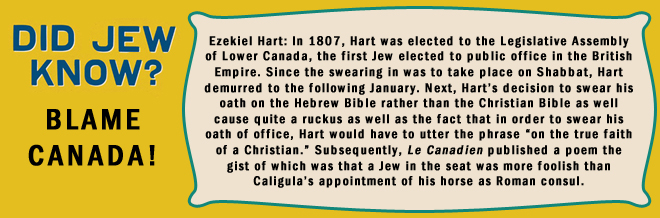
Behold some key players who dwelleth outside the Land of Israel and who becameth and have becometh forces to be reckoned with in the secular political sphere:
Born in New Orleans and raised in Brooklyn, Emily Stone is a writer and a yoga teacher living in New York City.
Born in New Orleans and raised in Brooklyn, Emily Stone is the author of Did Jew Know? (Chronicle Books).