Join a community of readers who are committed to Jewish stories
Sign up for JBC’s Nu Reads, a curated selection of Jewish books delivered straight to your door!
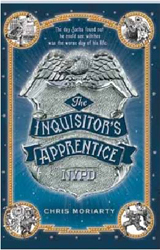 When I try to explain why I wrote The Inquisitor’s Apprentice – and why it’s emphatically not a Jewish Narnia a la Michael Weingrad — I always end up telling people that this is the book I wrote for my children.
Basically, I wrote it because I was a frustrated mother who wanted my son to be able to read a boy wizard book where the Jewish kid got to be the hero. That was the first kernel of the idea that has become the NYPD Inquisitor books: me rereading the books I remembered from my childhood, and then reading the new books that had been written since then, and realizing that the book I wanted my son to be able to read still wasn’t out there.
I wanted a children’s fantasy about a Jewish kid. And I wanted a book with all the magic, adventure, and humor of my childhood favorites, but whose mythology, worldview and characters would celebrate our family’s roots, beliefs and values.
I might as well be honest about it and admit that those values were hot pink. I grew up in left-wing New York political circles, in a predominantly Jewish but significantly multiethnic community that had its own distinctive hagiography (the Lincoln Brigade and Freedom Riders), family stories (the Rosenbergs, the McCarthy blacklist, the Peekskill riots), music (can you say Hootenanny?) and even summer camps (my Mom went to Camp Redwing. Get it, wink, wink, Redwing?)
My husband grew up only a few miles away from me. Until the most recent Manhattan construction boom you could actually see my parents’ apartment building from his parents’ apartment building if you knew where to look. But he grew up in a New York that embodied a completely different version of the Jewish-American experience. His grandfather emigrated from Russia, went to work in the garment district, saved up his money, went into wholesale, and had two sons who both grew up to be cardiologists. My grandparents were atheists, his were Orthodox. My grandparents marched on Washington, his retired to Florida. And — this last sentence says it all, really — I grew up on the Upper West Side, he grew up on the Upper East Side.
I wanted to share both sides of that New York heritage with my children. I wanted to tell them about the Vaudeville musicians and sweatshop workers, the rabbis and the wobblies, the grandfather who grew up on Avenue J, and the grandmother who grew up in Greenwich Village. I wanted to take my kids back to the Lower East Side a hundred years ago, and let them see first-hand the lives, the struggles, and the values of their great-grandparents. I wanted to celebrate the special magic of New York — and the equally special magic of the loud, zany, eccentric and argumentative New Yorkers I grew up around. I wanted to get my son excited about being Jewish, excited about the Lower East Side, and curious about the vibrant intersection of Judaism and left-wing politics that contributed shaped not only our own family’s history but much of American history throughout the 20th century.
And … well … if he developed a taste for klezmer, too, I wasn’t exactly going to cry about it.The Inquisitor’s Apprentice is my attempt to do that. And if it’s wrapped up in a New York fairy tale, with a little romance, and a big dose of slapstick humor? Well … love, laughter, and fantasy are some of the best ways humans have of making sense of our world.
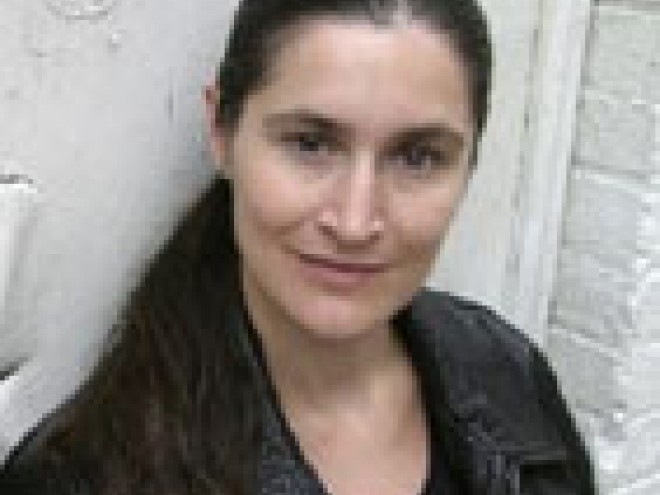
Chris Moriarty’s children’s fantasy debut, The Inquisitor’s Apprentice, received starred reviews from Publishers Weekly and Kirkus. The New York Times praised its successful blend of magic, Judaism, and New York history, and Bookpage called it “a book for anyone who has ever thought that maybe there is more to this world than what we can see.” Chris science fiction novels have won the Philip K. Dick Award and been nominated for numerous other awards.
Why I Wrote “The Inquisitor’s Apprentice”
Food, Music and Meshugas: Bringing the Lower East Side to Life