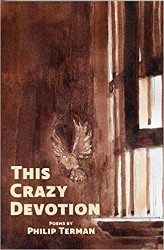
Philip Terman’s collection, The Whole Mishpocha: New and Selected Jewish Poems, 1998 – 2023, highlights Jewish life beyond even the big cities that dot the Midwest. Terman is with a Jew in a trailer park in Clintonville, PA; with tankers in Oil City, “carrying their crude”; in synagogues whose ancient pipes burst in the cold. In lesser hands this book might be an ambered reclamation of a mid-century, Midwest scene, but as Terman joyfully catalogues unheralded pockets of Jewish life, he wrings new wonder from them.
Like much contemporary Jewish poetry, Terman’s teases out the mundane from the holy, such as when a narrator watches his boyhood rabbi reading the sports section, taking a rest from “the Great Factory of the Eternal.” Terman makes a bridge not only between the ordinary and the holy, but also between the past and the present. He approaches this intersection with what Tony Hoagland called a poem’s “sensuousness.” Take the rebuilding of an Orthodox synagogue from “The Jewish Quarter in Budapest”: “The chandeliers are sheeted and drooping/lopsided from the ceiling over the sanctuary,/shaped like wrapped bells. In front//two workers crouch on a scaffold, delicately/etching Jewish stars with blue paint on thin brushes./Something is putting back this house.//of worship piece by piece, star by star./ They don’t look like angels.”
Terman can activate a poem’s layers subtly, as evidenced by “crude” carried along by tankers near the mighty Allegheny. But the best string of poems powerfully concentrate and develop his poetry’s sensuousness throughout: “Among the Scribes,” “Moses Had His Burning Bush,” “Our Scriptures,” and “In the School of J,” where Terman claims a desire to labor even as one of those scribes’ “lesser servants.” “Didn’t they tell you, all those sages,/that the promised land is this moment?” Terman asks, among those scribes. Terman’s willingness to open and draw out a poem’s core patiently, longingly, allows him to figure Moses’s burning bush against “daughters stepping off the school bus/and charging full-tilt across//the sweetness of the just-mown hayfield/toward the blossoming dogwood,” which, as with the Sea of Reeds, “breaks the heart precisely in two.”
Such earnestness could become saccharine. Terman avoids this trap in two ways. The first is his cleverness, delivered in sly understatement, often capping off a poem. A mother argues with Ecclesiastes, “from beginning to end.” Or when a carp speaks Hebrew, the “local rabbi decreed: to honor this wonder/everyone should not eat carp for a week.” The second is his willingness to carry a premise past its initial discovery, as in the lovers who become Torah scrolls in “Our Scriptures,” hoisted above the rabbi’s head and carried around the synagogue. When Terman imagines dead forebears meeting together for tea, the revelation is not just that “The bill, which is grief, arrives,” but that “They agree to split it.”
There are a few brief moments when Terman tips past that intersection — of mundane and holy, past and present — perhaps a bit lingering in the bygone. But it’s easy to go along with the people he brings back — such as the mother in one poem, who asks if the author of Ecclesiastes is a “schlemiel,” a “putz,” and “meshuggah” because he’s never had “the blintzes at Corky and Lenny’s.”
Poets often caution that the people in their poems are characters, and a poem’s speaker is not necessarily the poet. But the best poets confuse such discretion. That mother could be yours, or Gerald Stern’s — a forerunner of Terman, and a north star for him — or any number of famous Jewish moms, but she seems very much Terman’s mother, and her unique, idiosyncratic character is developed throughout the book. Terman’s voice is a powerful one, and this is a necessary selection of American Jewish poetry.
Joshua Gottlieb-Miller is the author of The Art of Bagging (2023) and serves on the faculty at San Jacinto College. His work has also been published in Brooklyn Rail, Image, Poet Lore, Pleiades, and Breaking the Glass: A Contemporary Jewish Poetry Anthology, among others.