Join a community of readers who are committed to Jewish stories
Sign up for JBC’s Nu Reads, a curated selection of Jewish books delivered straight to your door!
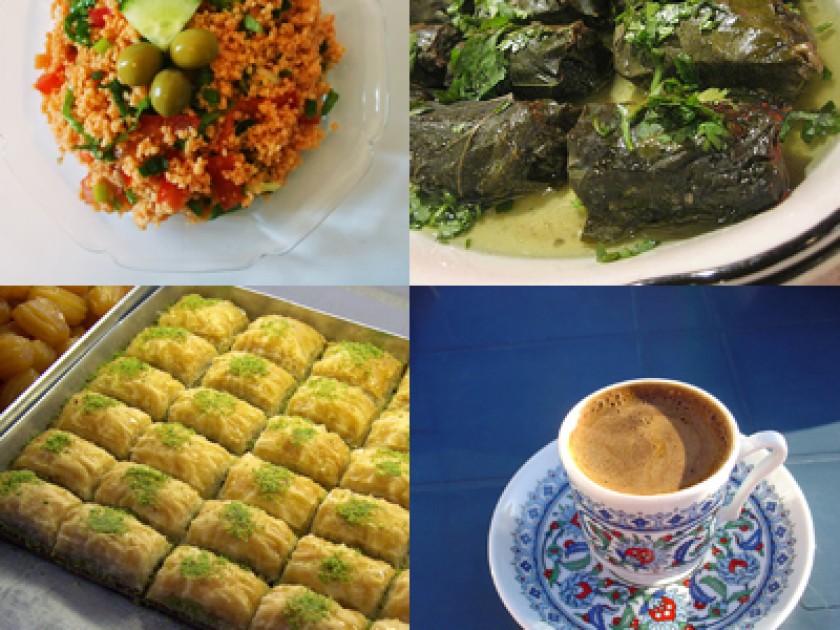
This week, Michael David Lukas, the author of The Oracle of Stamboul blogs for The Postscript on understanding the Middle East through food, and what to eat while discussing his book. The Postscript series is a special peek “behind the scenes” of a book. It’s a juicy little extra something to add to a book club’s discussion and a reader’s understanding of how the book came together.
A few years ago, I wrote an essay for Slate arguing that food — particularly Claudia Roden’s cookbook, Arabesque—might be the best way to understandthe Middle East. I may have overstated my case (I was working, at the time,as an assistant to the Jewish cookbook authorJoan Nathan and was very much enamored by the power of food). But I stillstand by the basic crux of the essay: food is an excellent means ofunderstanding Middle Eastern history, society, and religion. Food brings peopletogether and allows us to communicate beyond language. As the Turks say, “foodfeeds the essence of life.” Thus, I have devised the following menu for bookclubs reading The Oracle of Stamboul.
To read more from Michael, see his blog posts for The Visiting Scribe.
Author of The Last Watchman of Old Cairo and The Oracle of Stamboul, Michael David Lukas has been a Fulbright Scholar in Turkey, a student at the American University of Cairo, and a night-shift proofreader in Tel Aviv. A recipient of the National Jewish Book Award, the Sami Rohr Prize for Jewish Literature, the Sophie Brody Medal, and a National Endowment for the Arts Fellowship, his writing has appeared in The New York Times and The Wall Street Journal. He teaches at San Francisco State University and lives in Oakland, California. He’s very close to finishing his third novel, a post-apocalyptic retelling of the biblical Book of Esther called Scroll of Stars.