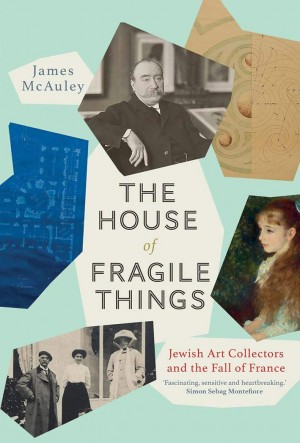
Edmond de Rothschild (1845 – 1934) was “a renegade from the elite into which he was born,” James McAuley writes. The subject of this enthralling biography started his adulthood as an aesthete whose formidable wealth should have protected him from the vicissitudes of history. Born into the most famous family in modern Jewish history, Rothschild enjoyed exceptional privilege. He felt blessed to live in post-Emancipation France, though he hardly accepted its premise of political equality.
Roughly the first half of McAuley’s book establishes a baseline of French prosperity and progress, with Rothschild and his family among the most conspicuous beneficiaries. Then, in the last third of the century, racial antisemitism erupted — in part because the Rothschilds’ wealth aroused accusations that these Jewish capitalists ranked as the true “kings of the epoch.” The second half of the book covers the period from the shock of the Dreyfus Affair to the Final Solution half a century later. The Zionist movement could not retard — much less prevent — the horrors soon after the death of Edmond de Rothschild. But this biography identifies the crucial and unappreciated role that he played in meeting the danger of antisemitism through settlement in Palestine and in injecting agency rather than victimhood in the evolution of Jewish experience. The grandeur of his life stemmed from his realization that, although the historical process of assimilation in the Diaspora and the dream of full civic equality were intertwined, they were insufficient. The precariousness of Jewish Lives — the name of the distinguished series to which this volume contributes — mandated the importance of what Foreign Secretary Arthur James Balfour called “a national home.”
McAuley has drawn heavily on archival research in France, Great Britain, Israel, and New York City, and has even found in an English estate the draft of a presumably lost memoir of the octogenarian dynast. Nevertheless, the paper trail that McAuley has followed seems not quite extensive enough for a narrowly biographical focus. In many pages of this book, Rothschild disappears. But even the byways that McAuley explores are intriguing — from the peculiarities of other Rothschilds to the emergence of Arab nationalism in Palestine. Always, the author artfully contrives to return to Edmond de Rothschild himself, whose allegiance to Orthodox Judaism and whose vision of the agricultural settlements in Zion are lucidly placed in context.
Although two eminent scholars — Simon Schama and Niall Ferguson — have published books on this family, McAuley has managed to carve out something distinctive. He has unraveled the mysterious career of the renegade who foresaw the existential need for an ancestral Jewish homeland. The narrative ends on May 14, 1948, when David Ben-Gurion proclaimed the birth of the state of Israel in Tel Aviv. He did so at Number 16, Rothschild Boulevard.
Stephen Whitfield is Professor of American Studies (Emeritus) at Brandeis University. He is the author of Learning on the Left: Political Profiles of Brandeis University (2020).