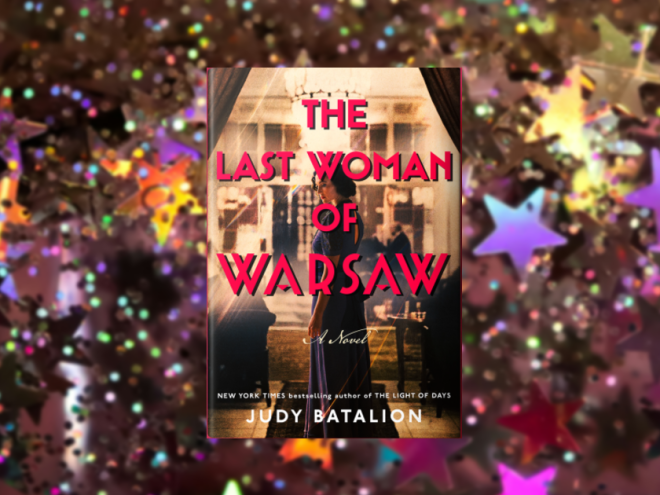
Toward the end of Judy Batalion’s The Last Woman of Warsaw, one of the two female protagonists — Zosia — tells a gathering of Jewish youth movement members, “I am trying to hold ambivalence, to respect complication and nuance.”
In a novel in which the interwar years in Warsaw are presented as a kaleidoscope of cultural flowering and burgeoning political conflict, with a Jewish community trying to navigate all of that and more, Zosia’s declaration is perhaps the best summary of all that she and others like her are trying to do. They are living in a world in which choices seem to be black or white: to stay in Poland and bet on a Jewish future; to leave for Palestine to build a new Jewish future; to step into expected roles as dutiful daughters; or to rebel and launch themselves into a future without the stranglehold of the old rules and expectations. And yet they are also reaching, in fits and starts, for something more fully drawn, more inclusive of their complicated and ever-shifting views of what is possible and what is necessary.
Zosia finds her way to Warsaw from her family’s shtetl, a place where Jews struggle to put enough food on the table and keep a roof over their heads — one that might protect them from both the natural elements and the far more dangerous political ones. Zosia has decided that Jews have no future in Poland and that her future lies in Palestine. She joins a youth movement in the hopes of securing a visa to that promised land.
In Warsaw, she crosses paths with Fanny, a daughter of privilege who is pushed and prodded by her mother to marry into a family with great wealth, in order to secure her future and her position as a society wife and mother. But the harder her mother pushes, the more Fanny resists, doubling down on her determination to achieve independence and success as a photographer.
In Zosia, Fanny meets her polar opposite — a poor Jewish woman disinterested in fashion, in high society, and in what she sees as Fanny’s trivial concerns. But the two women wind up sharing a common interest in the fate of a female professor whom Fanny sees as a mentor, and whom Zosia is hoping will help her secure a visa to Palestine.
As the story unfolds, so does the chaos swirling in and around Warsaw and Europe more broadly. Hitler annexes Austria. Polish Jews are exiled from Germany and shunted to a no-man’s land, as they are no longer considered Polish citizens. Right-wing fascists are increasingly flexing their muscles. Ghetto benches in university classrooms are imposed on Jewish students, visibly segregating them from their peers. While Fanny is shocked and horrified by this betrayal of her status as a loyal Polish citizen, Zosia sees it as validation of the imperative to leave.
The Last Woman of Warsaw is a novel that zigs and zags its way through the changing desires, dreams, and destinies of these two young Jewish women. At times it can be hard to understand their shifting attitudes and behaviors. But if one pauses to recall what it’s like to be young — the heady sense of possibilities, the fear of getting caught doing something illicit, the desire to pull away from what’s familiar and safe — along with the guilt of doing so — it makes perfect sense.
Looking back at a time when few could have imagined what lay ahead for the Jews of Poland, the choices of two young women might seem small in the scheme of things. But Batalion makes them emblematic of what was at stake for each and every Jew in interwar Poland. Knowing how few of the three million Jews who lived in Poland survived the horrors of World War II makes each choice to move toward or away, to recommit or move on, that much more fraught and heartbreaking.
Nina Mogilnik left a long career in philanthropy, non-profit, and government work to focus on family, on causes dear to her, and on her own writing, which she publishes on Medium, at the Blogs of the Times of Israel, and elsewhere.