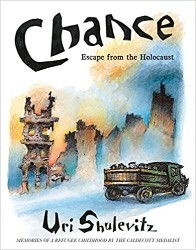
The last book by author and artist Uri Shulevitz (1935−2025) is an homage to his uncle Yehiel Szulewicz, a father figure and artistic role model to the young refugee. Written towards the end of Shulevitz’s long life, this illustrated account narrated in the author’s uncle’s voice is also a meditation on the meaning of his own life. With an understated elegiac tone, documentary photographs, and powerful black, white, and gray illustrations, , Shulevitz has summarized his vision of how a life is constructed through both random events and imperfect choices.
Yehiel and his family are living in Poland, first in Warsaw and later in the small town of Żyrardów. His parents’ deep religious commitment is a source of awe when he is young, but eventually becomes a barrier to self-expression. “When I was little,” Yehiel states, “God lived in our home.” His piety turns to alienation when his father slaps him for preferring play to a nap on the day of rest. Shulevitz’s illustration shows a child innocently pointing upwards towards his father, a towering figure with oversized hands. Yehiel leaves at the age of fifteen, never to see his family again. Even in voicing his alienation, he resorts to biblical narrative, drawing parallels between his own exile and the story of Joseph and his brothers.
Shulevitz’s memoir Chance functions as a shadow text to The Sky Is My Blanket. In the earlier book, Shulevitz enumerates all the contingencies that governed his life during the war and his ultimate survival. In Yehiel’s story, seemingly random events also intervene as he wanders through Europe, sleeping under the stars and staying with Jewish communities that offer him protection. Finding his way to Vienna, a friendly professor advises him to learn Hebrew and Bible, but also to acquire a trade. As Yehiel states, “In each town, I cut my sidelocks a little shorter and I looked for work.” A stay in France is abruptly ended because of the Depression economy. Yehiel moves on to Spain, only to be confronted by Francisco Franco’s attack on the Republic and the ensuing Civil War.
Yehiel recounts his engagement with the International Brigades fighting in Spain; while chance affects his life’s trajectory, deliberate decisions also play a role. He willingly risks his life in joining the French Resistance against the Nazis, although the unpredictable consequences of every action limit his success. Still, his survival itself is a victory. Pointing out that logic and reason had become “casualties of war,” he can never forget its most intense application to his own people. “All of Europe was a locked cage, with no escape. Especially if you were Jewish.”
Uri Shulevitz meets his uncle, now known as Henri, at the age of eleven, when he and his parents arrive in France after the war. In his afterward, the author returns to Chance, repeating events from that memoir in a final dialogue with his readers.
The Sky Was My Blanket is highly recommended for readers aged ten and older.
Emily Schneider writes about literature, feminism, and culture for Tablet, The Forward, The Horn Book, and other publications, and writes about children’s books on her blog. She has a Ph.D. in Romance Languages and Literatures.