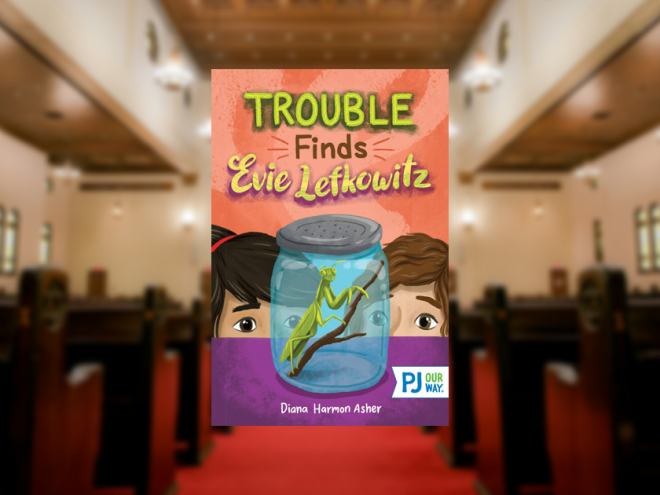
Evie Lefkowitz is facing more than the typical problems of adolescence. As her bat mitzvah ceremony approaches, Evie’s acute grief at the loss of her father overshadows excitement or anticipation. He was the cantor at her synagogue, Shir Shalom. Although Cantor Mindi, his replacement, is sensitive to Evie’s complex response to this rite of passage, no easy solution can alleviate the tragedy. To make matters worse, Evie’s mother has tentatively begun to date Mr. Mitchell, the assistant principal of Evie’s middle school.
Diana Harmon Asher’s novel avoids simple life lessons and embraces ambiguity. The cast of characters in Trouble Finds Evie Lefkowitz includes several of the types populating middle-grade novels. Evie is intelligent and sensitive. Her best friend, Rachel Mizusawa, is an ideal companion and source of support. Evie’s mother struggles with her own issues, but even her awkward attempts at moving forward are sincere. Two socially less well-adjusted boys, Tommy Halliday and Joey Ceraco, are the proverbial bad influences held up as negative examples by parents and teachers. Yet Asher’s narrative sophistication thwarts stereotype. No one has definitive moments of self-knowledge. Everyone is confused. Even Mr. Mitchell admits to his students that his love of Chaucer’s Canterbury Tales drew him to his position at Canterbury Middle School.
There are no lavish celebrations in the book. Asher has Evie explain the difference between the misconception that one has, as opposed to becoming, a bar or bat mitzvah, “like some weird shape-shifting creature.” Evie’s accurate expression is a hybrid of fear and awe, an appropriate response to a turning point in a young person’s Jewish life. Hebrew school is both a haven and a provocation for her, especially since sadness has actually driven Evie and her mother from weekly services: “We still go to temple on holidays, but most Friday nights we stay in, just my mom and me. It feels too sad to be at temple without him there.” Asher allows the irony of Evie’s statement to have its own impact, without suggesting any contradiction.
Life at Canterbury Middle School takes a provocative turn. Evie and Rachel’s friend, Spencer, involves them in his plan to rescue praying mantises from an enthusiastic science teacher’s experiment. Their plot ultimately involves Joey and Tommy, whose reputations follow them everywhere, from the school reading specialist to local law enforcement. They are victims of misunderstanding but also bullies, if only to a rather uncommitted degree. When Rachel and Evie confront them with their ignorance about each girl’s respective ethnic heritage, the scene is empowering and believable. “A sayonara is not something you wear,” Rachel admonishes them, and a hora is not Evie’s default dance for every occasion.
The surprises that arise in Evie’s story are not unexpected plot points. They are moments of confusion and affirmation, steps towards life changes that never relegate the past to irrelevance. Young as well as adult readers will relate to the characters’ unmistakable authenticity in a novel which is both accessible andsophisticated, perfect for sharing across generations. Trouble Finds Evie Lefkowitz is highly recommended.
Emily Schneider writes about literature, feminism, and culture for Tablet, The Forward, The Horn Book, and other publications, and writes about children’s books on her blog. She has a Ph.D. in Romance Languages and Literatures.