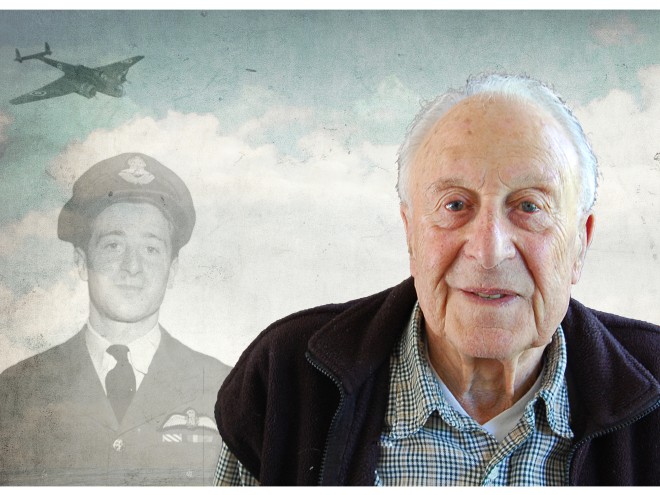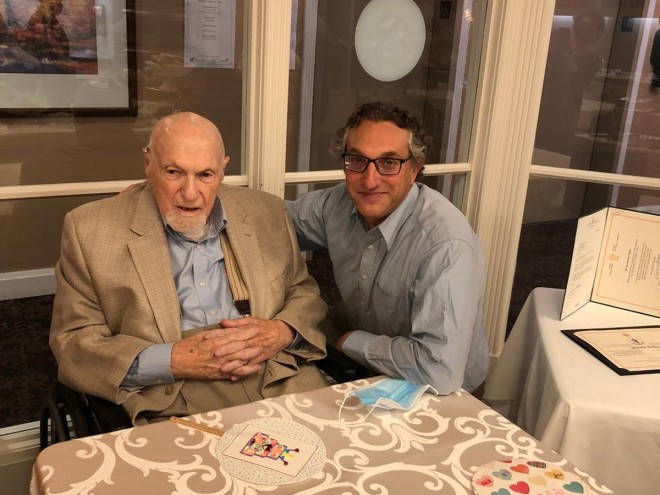
In Zaidy’s Band, Aron Heller vividly recounts his dogged effort to learn the details of his grandfather’s World War II service in the Royal Canadian Air Force. (“Zaidy” is Yiddish for grandfather.)
Heller’s grandfather, Mickey Heller, became tightlipped whenever his grandson asked about his role in the war. Since Heller is an investigative reporter, Mickey’s reticence only increased his determination to get an answer, provided he could do so in a way that would not damage their tight-knit relationship. Heller’s quest forms the frame for the book, which quickly branches out to the stories of Mickey’s Jewish friends and colleagues who also served in the wartime RCAF. Indeed, it is the stories of these men, “Zaidy’s band,” that predominate.
The first of the band we encounter is airman Wilf Canter, called the “great escapist” because he was shot down twice over Germany. The first time he evaded capture, returning to England with the help of the French resistance. The second time he was captured and interned in a POW camp for nearly a year before returning home to Canada.
At Mickey’s request, Heller investigates Canter’s story. After World War II ended, Canter went to Israel and served in Israel’s fledging air force. Though he died tragically in an aviation accident, he was one of a contingent of foreign fighters who were crucial to Israel’s victory in its 1948 War of Independence. In a touching coda to Canter’s story, Heller, who is a citizen of Israel, pays a visit to the airman’s grave there and places a pebble on the escapist’s grave marker.
In researching Canter and other members of the band, Heller realizes that the contribution of the foreign fighters, who were mostly, but not exclusively, Jewish, to Israel’s victory in 1948 deserves more recognition. This insight leads him to track down other stories of these men, known to Israelis as Machal.
The other historical lacuna Heller focuses on is the story of the 1,500,000 Jewish soldiers who served in Allied armies during the War. As with the Machal, Heller realizes that these soldiers had not yet been properly remembered and celebrated. He recounts the slow process that ultimately led to the creation in Israel of the Chaim Herzog Museum of the Jewish Soldier in World War II.
Both the story of the Machal and the Jewish WWII veteran are a means to an end for the author, who hopes that by engaging with his grandfather about these historical themes, his zaidy will finally open up. At a certain point, though, the reader realizes that Mickey’s story cannot possibly be the capstone to the many heroic feats his band performed in the skies of Europe and Israel. As the book winds down, it becomes apparent that the power of Mickey’s story will be not in its details but rather in the way it brings grandfather and grandson closer.
When we finally learn them, the details of Mickey’s wartime experience prove prosaic but still praiseworthy. For the Second World War is nothing like the Agincourt battlefield where Shakespeare’s Henry V exults that his small “band of brothers” will divvy up an abundance of glory. By contrast, victory in the Second World War required the contributions of tens of millions, each doing their small part so that collectively overwhelming force could be brought to bear against Hitler and his allies.
Mickey’s story is one of those millions, for which Heller can be proud, and we can be grateful.
Alex Troy worked at two Jewish schools, teaching history at one and serving as Head of the other. Before becoming an educator, he worked as a lawyer and investor for thirty years. He recently published his first novel, The Academy Of Smoke And Mirrors: A Boarding School On The Brink. Alex is a graduate of Yale, Harvard Law, and St. John’s College.