Join a community of readers who are committed to Jewish stories
Sign up for JBC’s Nu Reads, a curated selection of Jewish books delivered straight to your door!
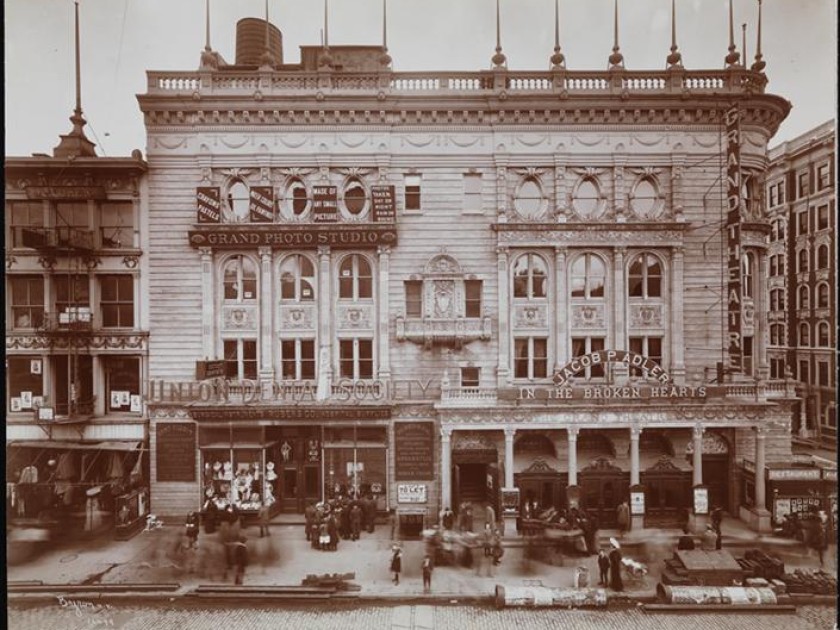
Grand Theatre with a sign announcing Jacob P. Adler in The Broken Hearts, 1903. WikiMedia Commons
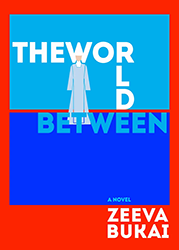
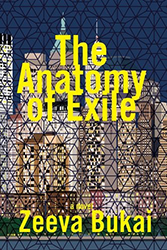
While I was in Israel this winter, I taught a masterclass to alumni from the Bar-Ilan MA Creative Writing Program. The class was titled: Transforming Family Stories Into Fiction and the students were talented, sensitive, and engaged. I chose the topic because while writing my debut novel, The Anatomy of Exile, I discovered that my natural tendency was to dip into my family history and memories. It’s what I did then, and what I continued to do in my second novel, The World Between.
In The Anatomy of Exile, I used aspects of my father’s Mizrahi past to create characters (Salim and Hadas). In The World Between, I used elements of my mother’s story. She was born in Siberia to Polish parents after their forced deportation by the Soviets at the start of World War II. My grandfather was drafted into the Soviet army, leaving my grandmother alone with two children, my mother, an infant, and her six-year-old brother; however, only my mother was placed in a children’s home, which I was told allowed my grandmother to work. My grandmother, who labored as a laundress washing Soviet uniforms and bedsheets, visited her once a week. There are days when I cannot fathom how my mother survived the loneliness and deprivation in the children’s home. There were too many children to feed and too little food. She, like the others, was rarely held and mostly ignored, until my grandmother’s weekly visit. I wondered how my grandmother survived the war on her own, how she endured the grueling work, the lack of food and medicine, and the brutal cold. I wrote The World Between to better understand them and the circumstances that shaped them. My aim isn’t factual truth, but the emotional truth I try to get at in fiction.
However, growing up this was the story I was told: My mother was born in a gulag.
After my father died, I went through a box of family papers and came across a school document that listed my mother’s place of birth as Orsk, a city on the Siberian border. Was the family in Siberia or on the outskirts of Siberia? Did my grandmother visit once a week or more often? What is the truth? And does it matter when, over time, memory becomes distorted? As is so often the case, there is no one left to ask. I wish I had made sure I had the whole story and not just remnants of it when I had the chance. The sorry truth is that this history is now buried with those who knew it best. It belongs in that liminal space between memory and imagination, the nicht ahin, nicht aher, the neither here nor there. This is the world my narrator inhabits in The World Between.
I was twenty-five years old when my mother died of scleroderma, an autoimmune disease that overproduces collagen, causing the connective tissue to harden, tighten, and scar, mummifying the skin. She was forty-three. I can barely catch my breath when I think about how young she was, how she could otherwise have begun a new life with her children almost grown. She could have fulfilled her desire to complete her education. She had never finished high school. She never had the chance. My grandmother needed help paying the bills.
I write to capture missed chances and reclaim lost causes.
I wish I could hear her voice. She had a beautiful, operatic voice but was poor and without the resources it would take to train it, especially in 1950s Israel. She married at seventeen in the hopes of gaining independence, only to find that marriage, too, curtailed her freedom. Children rarely see their parents as entities outside of themselves, so it was only after she died that I realized her adolescence was taken from her.
I wrote The World Between to better understand them and the circumstances that shaped them. My aim isn’t factual truth, but the emotional truth I try to get at in fiction.
In The World Between the narrator is a former Yiddish stage actress. I created her out of my experiences as an actor. The narrator is me, but she is also my mother, and like my mother, the narrator spent time in a children’s home in a Siberian gulag. But the layers of imagination and memory don’t stop there. My mother is embedded in the toddlers the narrator cannot bear to comfort for fear of becoming too attached to children who might not survive the war.
In her book, Survivor Cafe: The Legacy of Trauma and the Labyrinth of Memory, Elizabeth Rosner creates, “The Alphabet of Inadequate Language.” It begins, “A is for Auschwitz, B is for Buchenwald, Bergen-Belsen, beating.” It’s brilliant and searing because it names places of loss and reasons of loss, while acknowledging that there is no adequate language to describe the atrocities of war on the mind and body. Nor the trauma we inherit from those who experienced it firsthand. When I studied acting, I learned that memory resides in the body. In a scene study class that I took with the late Nola Chilton at Tel-Aviv University, we were asked to imagine ourselves as children in a Displaced Persons camp. An Italian woman in the class kept shouting, facista, facista, in a shrill voice, while some of the Israeli students lay on the ground in fetal position, trying to make themselves as small as possible. This was in 1977. Four years earlier these students had lived through the Yom Kippur War.
When the narrator in The World Between finds herself in the Sisters of the St. Joseph of the Apparition Hospice, she’s reminded of the gulag. Her aide in the sanatorium is a Georgian woman who wears her hair in a crown of braids like the Queen of Razorblades, the matron in the orphanage who once a week shaved the children’s lice-ridden heads. This was one of the few details my mother gave me about her life in Siberia. It was a gift that remained with me all of these years to use when I needed it. It’s these small details that seep into a story that lend it authenticity and anchor it in the world between memory and imagination.
Zeeva Bukai is the author of the novels, The Anatomy of Exile, winner of the National Jewish Book Award for Debut Fiction, and The World Between. Her work has appeared in numerous journals and anthologies. Her honors include fellowships at the Center for Fiction and Hedgebrook. She holds an MFA from Brooklyn College and lives with her family in Brooklyn, NY.