Following the triumphant critical reception of her National Jewish Book Award – winning debut novel, The Anatomy of Exile, Zeeva Bukai’s new novel proves an equally captivating and no less transformative work, despite its relative brevity.
The World Between journeys retrospectively through the strata of the tumultuous life of its narrator, whose life has recently unraveled and whose hold on reality may be tenuous. The unnamed woman is a sixty-six-year-old former Yiddish actress living in a sanitorium administered by the nuns of Sisters of Saint Joseph of the Apparition Hospice in Jaffa. At times she is trapped in a fugue state and at other times under the stern care of a psychiatrist. The narrative brings to colorful life her rich memories of an extraordinary past of loves and losses and it becomes evident that she still has a fierce appetite for living. As she convalesces, she muses: “I straddle two worlds — the world of nothing and the world of everything.” To Bukai’s credit, she conjures all the sensations of the latter, its joys as well as terrors, to haunting effect.
The story that unfolds is both tender yet unsparing, raising haunting questions about the protagonist’s memories — how they shape her identity, and how she consciously and unconsciously acts on them. Ranging from the childhood origins of a deep and sustaining friendship, to the savagery of the Holocaust, the brutality of a labor camp in the Siberian Gulag, the protagonist’s early married life amidst the warm cacophony of Tel Aviv, her years on stage in both Israel and New York City, to her dire present, Bukai’s short, fragmented chapters are gripping. In the narrator’s memories of her later years, we witness her generous spirit as she reaches out to others. She befriends another traumatized survivor whose wife perished in the Holocaust; when he confuses her for his lost wife, she does not correct him, providing him with the comforting illusion that sustains him at his lowest ebb. And just prior to the psychotic breakdown that has led to her own confinement, she takes an impoverished Russian immigrant and her neglected baby under her care, a seemingly selfless act yet one dangerously complicated by suppressed grief for the baby she lost years ago.
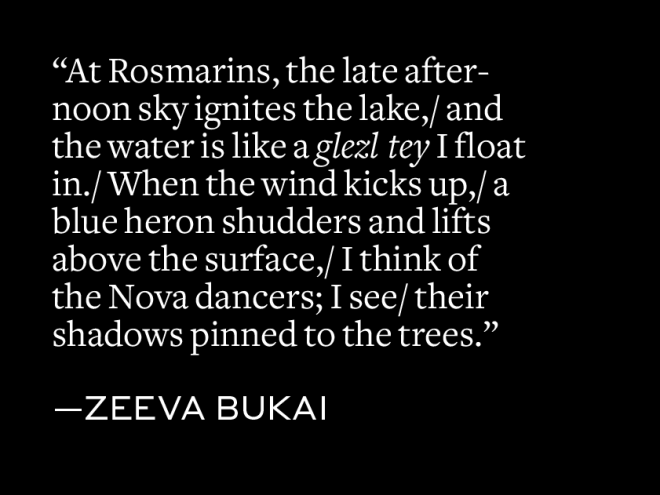
Throughout, Bukai’s poetically concise language is a gift to the reader, her often surprising prose distinguished by deft, painterly imagery. A group of young soldiers gathering at a pool in the early years of the state appear to the narrator as “gods cast in sunshine,” a baby’s laughter is “a crystal prism flooding the room with color,” while the narrator’s “mind wades into the past like a fish that has slipped its net.” There are also moments when her imaginative perception takes a whimsical turn, such as when she gazes out at the garden from the window of her hospice room in Jaffa: “Have you ever noticed how palm trees resemble conductors…short and squat, tall and thin, all with floppy hair, conducting a symphony no one can hear.”
Throughout, Bukai delivers as splendid an orchestration of life as one might usually anticipate from a much longer novel, so filled is it with notes of longing, melancholy, bitterness, resounding love, and fleeting joys. The author has said that the devastating sense of loss after her mother’s death inspired her to write a kind of homage, and it is hard to imagine mothers and daughters — or indeed any reader, not celebrating the result. And this is a consistently evocative work; the various eras the narrator revisits are vividly, lovingly curated, illuminated with a genuine sense of authenticity. The World Between is a shattering, heartfelt, and exuberant achievement.
Ranen Omer-Sherman is the JHFE Endowed Chair in Judaic Studies at the University of Louisville, author of several books and editor of Amos Oz: The Legacy of a Writer in Israel and Beyond.