Join a community of readers who are committed to Jewish stories
Sign up for JBC’s Nu Reads, a curated selection of Jewish books delivered straight to your door!
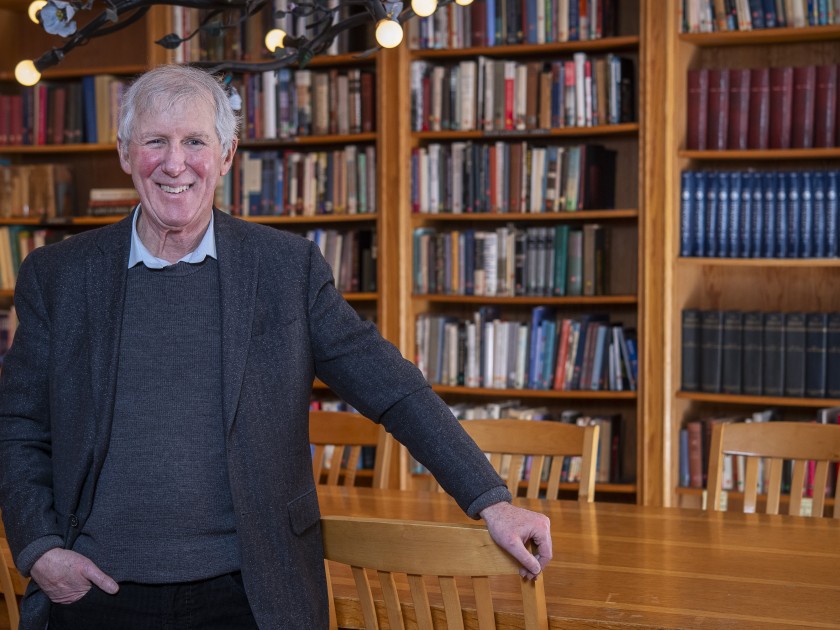
Aaron Lansky by BBImages, courtesy of the Yiddish Book Center, Amherst, MA
One hundred years ago, the head librarian of the Boston Public Library’s West End Branch — a young Russian immigrant named Fanny Goldstein — founded Jewish Book Week. In time, Jewish Book Week became Jewish Book Month, organized by Jewish Book Council. The 2026 issue of Paper Brigade pays tribute to the woman behind JBC with this conversation with a present-day figure known for his active role in conserving and promoting Jewish books.
Aaron Lansky has worked to preserve the rich heritage of Yiddish literature since he was a graduate student in his mid-twenties. After realizing that the Yiddish books published and read by Jews before the Holocaust were in danger of disappearing, he traveled around the world, rescuing entire libraries from basements and even dumpsters — and meeting thousands of people with their own stories to share. In 1980, Lansky founded the Yiddish Book Center in Amherst, Massachusetts, to house this collection. Over the years, the center expanded to offer fellowships, Yiddish language courses, summer programs, and field work opportunities, all intended to preserve — and reinvigorate — Yiddish culture and memory.
Lansky retired from his position as the Yiddish Book Center’s president in 2025, having created a legacy of innovation and meaningful contributions to the field of Yiddish Studies. He received the 74th National Jewish Book Award for Mentorship for providing a new generation with the tools to continue his work.
In this conversation, Lansky looks back on his career — his initial inspiration, the stories he’ll always remember, and the lessons he will carry with him as he begins a new chapter.
Isadora Kianovsky: You founded the Yiddish Book Center over forty years ago, at the age of twenty-four. Can you speak about what it was like to be so young with this big idea? Was there a specific instance or experience that convinced you to make this idea into a reality? Did you turn to any mentors for advice?
Aaron Lansky: Well, the best part about being young is, you don’t know you’re young, and all things seem possible. You don’t hesitate — you just jump in. And it was only because I knew the work had to be done that I didn’t stop to think about it. I knew how to drive a truck and I knew Yiddish, so I figured that was a pretty good combination.
In terms of mentors: I was in graduate school when I came up with the idea, and I discussed it with one of my professors at the time, Ruth Wisse — she’s a remarkable person, and a brilliant scholar of Yiddish literature. She thought it was a great idea: “This is the most important thing that has to be done right now.” So she was totally supportive, and we arranged that I would take what I thought would be a two-year leave of absence from grad school to go save the world’s Yiddish books. And here I am, forty-five years later … technically still on leave. Ruth and I have stayed very close ever since. She has always been a mentor and a friend.
There was Leonard Glick, who was my professor as an undergraduate at Hampshire College. I remember going off to the library at UMass Amherst, and finding Simon Dubnov’s History of the Jews. I brought it back and said, “Len, what do you think about this book? Is this important?” And he said, “I don’t know. You’ll have to read it and figure it out for yourself.” Learning alongside a teacher was the best kind of education. And then my Yiddish professor, Jules Piccus, was extraordinary. Obviously, nobody starts anything completely from scratch. You have to have people behind you. And I had a very good team behind me before I even started.
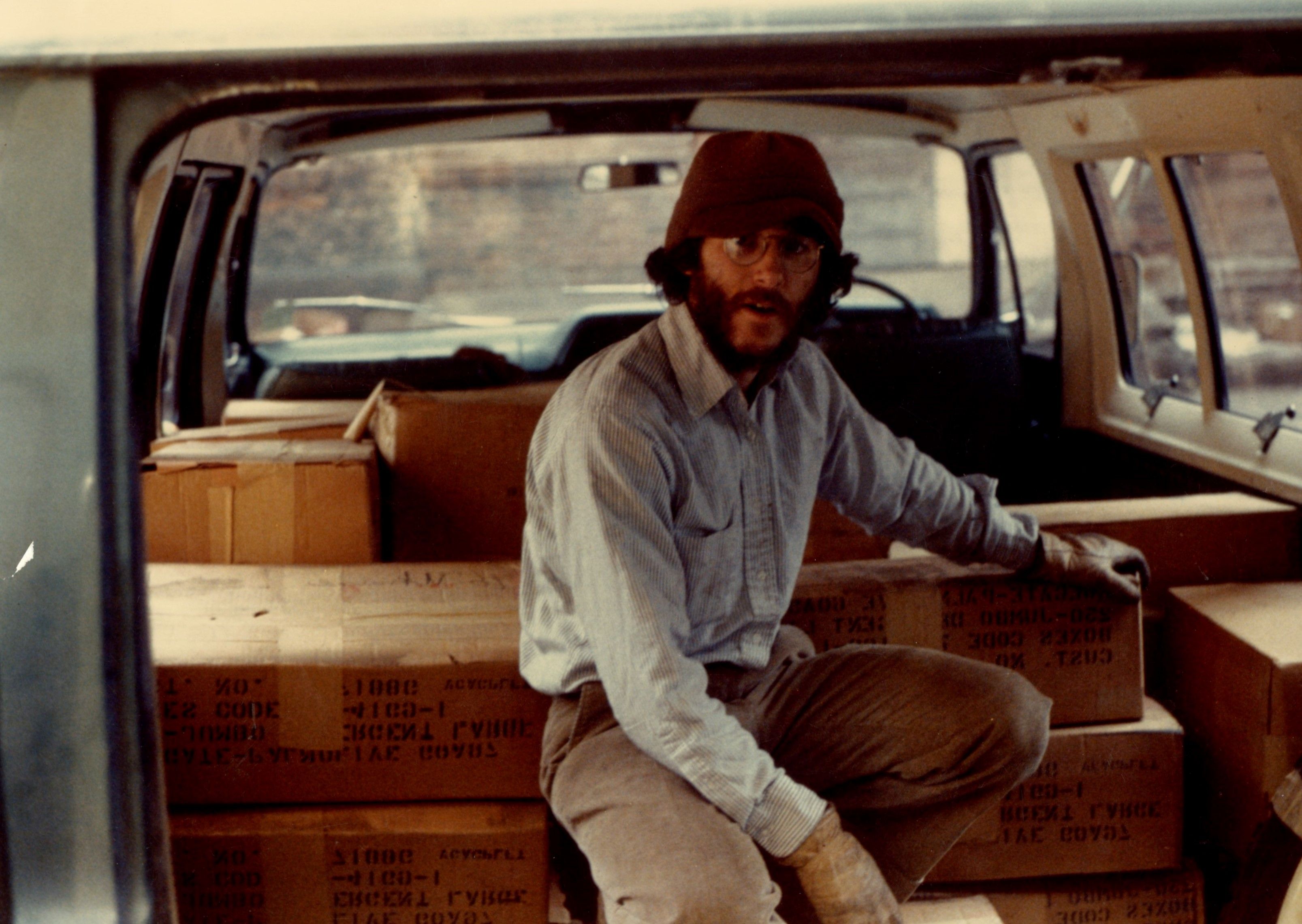
Aaron Lansky in the truck with boxes of rescued books. Image courtesy of the Yiddish Book Center, Amherst, MA
IK: Absolutely. At our seventy-fourth National Jewish Book Awards ceremony, where you were given the Mentorship Award, you quoted the Talmudic rabbi Chananya: “I have learned much from my teachers, more from my colleagues, and most of all, from my students.” Can you share an interaction you had over the course of your career that has stuck with you as particularly meaningful and resonant?
AL: There’s an embarrassment of riches. I once figured out that I had visited the homes of about 3,000 people in the course of collecting books. That’s an extraordinarily large number, considering how intense the visits were. Nobody just gave me their books. I don’t think Jews are constitutionally capable of that act. Everybody had to talk. Everybody had to sit me down at the table, give me hot tea in a water glass, and ask me a million questions about myself to make sure I was worthy of accepting these books, and that we could take care of them.
But they all gave me something besides the books. There was tremendous wisdom there. A lot of them had lived pretty remarkable lives. Almost all of them were born in the old country, and many had survived the Holocaust. None of them had what one would call an “easy life.” When people live eventful lives, they have a lot of stories to tell.
I heard more stories than I could ever take in. In fact, sometimes we used to sit in the truck afterwards with a tape recorder and try to remember what people had told us. I still have hundreds of hours of these tapes. When I wrote my book, I never even listened to them because it was just too much material. In retirement, I would love to go back and actually listen to those recordings. I think there’d be a lot of surprises in them.
IK: That sounds amazing. I’m thinking of the story in your book about your friends Sam and Leah Ostroff. That was such a beautiful connection that you made over the years.
AL: They were the most wonderful people. They helped us collect others’ books for years. It could be seven o’clock in the morning, and they’d have a great big meal ready for us. Their stories were endless, and we became very close to them. I’ll never forget the time Sam called me up and said, “I’ve got some more business for you. Now you’ve got to come and get my books.”
Suddenly I find myself in the same situation. At that time, it seemed like it would be a million years before I would ever get rid of my own books. Like Sam, I’m not exactly eager to give up any of them.
IK: It’s like giving away a part of your own history and your own inheritance. And in your book, you mention a man who told you, “They’re old friends, these books.” Books give us a sense of connection, both on the page and with those who we share these stories with. You yourself have made many close friends and allies around the world in your quest to save Yiddish books. What do you think it is about literature — about stories — that connects us so deeply? And why do you think this bond is so prevalent in the Jewish community in particular?
AL: Books are a wonderful human artifact — one of the great things that human beings do is that we create literature and tell stories. Robert Frost referred to poetry as that which is lost in translation. Of course, you could use a computer to translate a technical text into a reasonable facsimile of English. But literature? No, literature is something very subtle and sublime. And telling stories is how we understand and define ourselves.
So why do Jews value books so much? Why do we call ourselves Am haSefer, People of the Book? Jews used to say that books were their portable homeland — for much of Jewish history, we had no country of our own, and as a result, books were the defining factor in our lives. Books are what gave us our identity in so many different ways. When I was a kid, if we dropped a book on the floor, we were taught to pick it up and kiss it. To this day, I have to hold myself back from doing it. That would get very exhausting after a while in my line of work — there’s not enough chapstick in the world.
I find it very stirring that we value books in that way even when they are no longer of use. You know, books with shamot—God’s name in them — are given a proper burial. Jews used to build genizahs — rooms where they would lock up books and papers that were no longer usable, and they just would lie there for centuries. When I started the Yiddish Book Center, people said, “Are you going to be building a genizah for Yiddish literature?” And I said, “Oh, no, God forbid!” It was exactly the opposite: I wanted to collect books not to store them away, but to put them in the hands of new readers. Every box of books was important, and I was like a treasure hunter. I consider myself one of the luckiest people in the world to have work like that.
Every box of books was important, and I was like a treasure hunter.
IK: I want to return to something you said about translation. Translation is such a human art, and there’s really no way to automate it. Over the last few decades, we’ve seen a renewed interest in Yiddish Studies that the Yiddish Book Center has been such a huge part of supporting. The Yiddish Book Center is not only a repository of Yiddish language books, but also offers dynamic initiatives in Yiddish language, history, arts, and translation. A prime example of this is the new translation of Chaim Grade’s Sons and Daughters, which was translated by Rose Waldman, a former Yiddish Book Center fellow.
In your own book, you write that post-Holocaust Yiddish literature was primarily used to “eulogize a world that had been destroyed. As a result, translated titles were often those that cast the old country in a rosy glow, while those that portrayed Jews as real-life human beings with frailties and foibles, conflicts and contradictions … were … largely overlooked.” I feel like Sons and Daughters has less of a rosy glow. It shows a complicated family that is moving away from the traditional world of their parents. Do you see this shift in which books are being translated — a shift toward more realistic Jewish stories? What can Yiddish books in translation tell us about the state of Jewish life today?
AL: Nobody knows how many discrete Yiddish titles there are. It was such a complete historical rupture that we lost track of our own literature to such a degree during the Holocaust. But of all those books, something like two percent have been translated into English so far. That’s a vast cultural treasure that’s largely inaccessible to everybody except the relatively few people who still are able to read Yiddish. Not only has the Yiddish Book Center collected all of these books in Yiddish, but also we digitized them. Within a matter of seconds, you can search about ten million pages of Yiddish literature. In Yiddish, they call this a hayntike velt—a modern world, today’s world.
All that being said, most people still need to read Yiddish books in translation. Yes, I’ve said for years that the books that had been translated were the schmaltzy ones, those that portray that world in a softer focus. Before the Second World War, there was very little in the way of translation of Yiddish literature. But after the war, everything changed, of course. I think it was a normal instinct; the rubble was still piled high in the cities of Europe at that point, and people wanted to eulogize the world that had been destroyed. As translation began to pick up, a lot of the great books of the prewar era were translated. Books by writers like Y. L. Peretez, Mendele Mocher Sforim, Itzik Manger. The biggest lacuna in all of this was literature by women; there were thousands of women who wrote in Yiddish. So once we put all the books online, suddenly all that literature became available. We started our translation program, and it ended up being a far more ambitious project than I ever imagined. It begged the question: are there Yiddish masterpieces that haven’t been discovered yet?
Are there Yiddish masterpieces that haven’t been discovered yet?
I have a tangential connection to the Grade book that just came out. After Grade’s wife, Inna — who was very protective of his works after his death — passed away, no one knew who all this material in her apartment belonged to. The Public Administrator’s office of the Bronx sent somebody down there to check it out before they could throw everything away. And it just so happened that the person they sent there was a young lawyer who had taken a course in Yiddish at Columbia many years before. Thank God for that, because otherwise, we would have lost everything.
He got in there and said, “I think these are Chaim Grade’s papers.” So he wrote a letter to me, Ruth Wisse, the YIVO Institute in New York, and the New York Public Library asking us to help assess what was there. YIVO realized there was a manuscript, originally published in Der Forverts, and ended up hiring Rose Waldman to do the translation. I spoke with Rose about what she was doing with this book. It sounded so interesting to me. I can’t imagine that the book will be a beach read, but I’m looking forward to reading it.
There are a lot of treasures still out there. I am one hundred percent sure of that. There’s going to be a lot more coming, and I can’t wait to see it.
IK: I know this is an impossible question, but is there a particular book (in Yiddish or otherwise) that has deeply impacted you, the work you do, and the way you view the Jewish world?
AL: In some ways, I could tell you that every single book that you see here in my office has shaped me in some way. The reason I love to hold onto books is because the books we read make us the people we are. And so yes, therefore I value every book that I’ve read.
But are there books that made a particular impact on me? Yeah, there are a lot. My favorite Yiddish book of all time is probably the only Yiddish book that most people have heard of, and that’s Tevye der milkhiker—Tevye the Dairyman—by Sholem Aleichem. The stories in that book were the basis for Fiddler on the Roof. But Fiddler on the Roof was such a bowdlerization of the original stories. In the movie, Tevye has the support of the Jewish community in his shtetl. But in the original story, Tevye lives in the middle of nowhere, where there are no other Jews around. When each of his daughters in turn brings in the challenges of modernity, Tevye has to figure it out for himself. That’s what makes the story so resonant. Tevye becomes a precursor of us — of the readers — in his own time. Now that we’re distanced from the original religious texts, we also have to make up our own minds all the time. There’s not a day that goes by when you’re not making choices as a Jew in the modern world. We’re always changing. We’re always walking a tightrope. The Tevye stories anticipate that modern dilemma so brilliantly. Tevye doesn’t exactly give us answers, but he tells us how to ask the questions, and to keep asking the questions. And for that reason, I love the book.
IK: That’s such a nice place to end. A sheynem dank.
Isadora Kianovsky (she/her) is the Membership & Engagement Associate at Jewish Book Council. She graduated from Smith College in 2023 with a B.A. in Jewish Studies and a minor in History. Prior to working at JBC, she focused on Gender and Sexuality Studies through a Jewish lens with internships at the Hadassah-Brandeis Institute and the Jewish Women’s Archive. Isadora has also studied abroad a few times, traveling to Spain, Israel, Poland, and Lithuania to study Jewish history, literature, and a bit of Yiddish language.