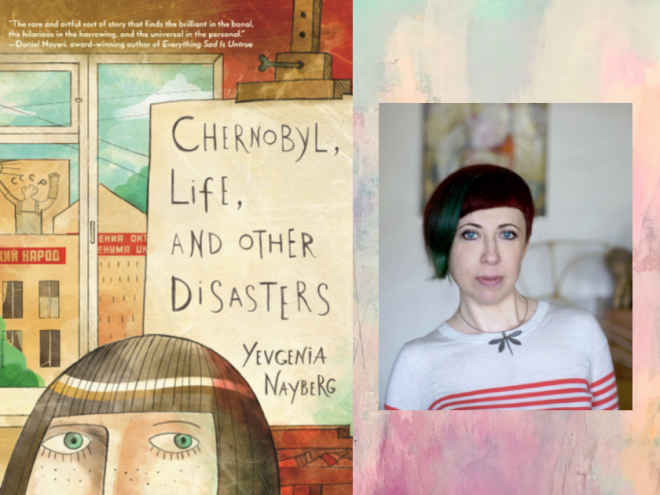
In Chernobyl, Life, and Other Disasters, Yevgenia Nayberg uses reflection, humor, and artistic innovation in creating a portrait of herself as a young woman. Living in 1980s Ukraine, young Genya (Yevgenia) aspires to be an artist, but confronts the restrictive reality of life in the Cold War era Soviet Union. When the disastrous nuclear accident at Chernobyl occurs in 1986, the aftermath rocks her already less-than-perfect family life. In this stunning work of graphic art and literature, Genya’s honesty and optimism coexist with her fears.
Focused on applying to Kyiv’s elite National Secondary School of Art, Genya is the constant recipient of frustrating information from adults. The school’s enrollment of Jews cannot be more than 1% of its student body, adding an additional burden to the normal pressure of competition. Nayberg captures an epiphany of this truth with her characteristic precision. “Mom, am I a Yid?” she asks. A culture of cruel but reflexive antisemitism is contained in that phrase. Genya’s stereotypically boyish appearance and left-handedness further contribute to her marginalization.
The book opens with a sense of anticipation, as Genya looks forward to the expected appearance of Halley’s Comet, a phenomenon she calculates that she will see twice during her life. Even as her story focuses on the personal, Nayberg describes the connections of her younger self to the outside world. When devising metaphors for the human condition, Nayberg makes them believable on an individual level. Genya describes her hair as “the color of a smoked herring.” When exposure to radiation forces her to cut off the long gender-affirming braid it has taken years to grow, she views its sad transformation into a “dead herring.” Later, she will find the braid in a drawer, but she no longer needs it, having rejected beauty standards that have come to seem ridiculous.
The hypocrisy of adults defines Genya’s application to art school. As her mother, a professional artist, explains, she will need to produce a perfect work of socialist realism in order to gain entry, and earn the freedom of artistic experimentation. Fortunately, she has a supportive group of bookish and quirky friends who share her disdain for this process. Any glimpse of escape is welcome, including reading One Hundred Years of Solitude: “I read it in one sitting. I have no
idea what it is about, but I love it!” One picture contains images of art implements on a background of graph paper, each one labeled with precision as she prepares to prove herself on the exam. Other more expansive scenes contrast the beauty of Kyiv with the stifling environment of Volgograd, where her family finds refuge with relatives after the nuclear accident. Both scenes feature an emerald green foreground, but in the second, the architectural splendors of Kyiv have been replaced by Volgograd’s brutalist monuments.
Narrative tension builds as Genya awaits the results of her application, culminating in a striking wordless picture of the adult Yevgenia Nayberg at work in her studio. Copies of her books occupy one end of a long table, with paint, paper, brushes, and a cup of coffee placed around her. Viewing her from the back, readers see her drawing with her left hand.
Emily Schneider writes about literature, feminism, and culture for Tablet, The Forward, The Horn Book, and other publications, and writes about children’s books on her blog. She has a Ph.D. in Romance Languages and Literatures.