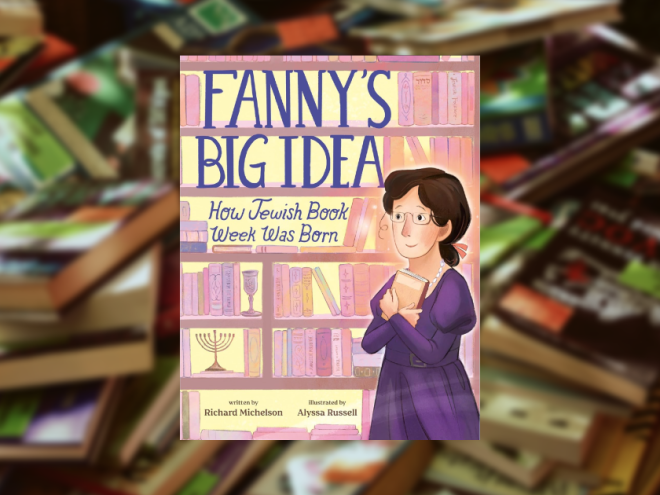
Richard Michelson and Alyssa Russell make the world of Fanny Goldstein come alive in this beautiful telling of the genesis and development of Jewish Book Week. Young Fanny grew up in the United States as a poor immigrant, having arrived from Russia with her family in the early 1900s. Living in Boston, she attended classes at the North End Settlement School, where she and other immigrants were taught about American customs and holidays, and were able to practice their English-speaking skills. Fanny’s favorite activity was reading English books, which the Settlement House Library loaned at no cost. Reading and studying were her greatest joys.
Fanny loved her Jewish heritage and savored her new exciting public school studies, but when her father died of tuberculosis, she had to get a job to help support her family. She spent as much time as possible at the public library, where she could expand her horizons by learning about democracy, women’s rights, and prison reform as well as culture and the arts, classic literature, and world history. She decided that she would spend her life contributing to the fund of knowledge that a well-stocked public library could provide; librarianship would be her career. She became the first Jewish person to direct a branch library in the United States, treating every patron as someone special and important.
Fanny knew it was vital to provide resources for everyone, and she was disturbed that there was very little literature at the library about her own peoples’ history and culture.She curated a week-long display of books by Jewish authors, which was the first time a collection of Jewish books was exhibited in a public library. She encouraged other librarians to display similar collections. That is how the first Jewish Book Week was born.
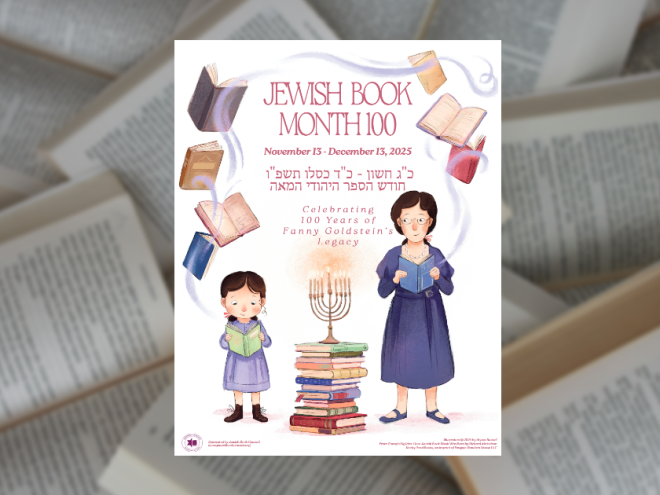
Today, Fanny is remembered as the initiator of the annual Jewish Book Week, now Jewish Book Month, which led to the founding of Jewish Book Council. She later founded other book weeks focusing on other cultures, and she encouraged people of all backgrounds to continue to learn about their heritage and history, always believing that understanding one another strengthens democracy, good will, and tolerance.
This colorfully and sensitively illustrated book teaches not only about Fanny’s experiences, but also about her impact on American society as a whole. It is both touching and eloquent. The author includes a detailed afterword about Fanny and the influence she had on libraries, education, and acceptance. Much in the spirit of Fanny Goldstein herself, Fanny’s Big Idea stresses the beauty and joys of broad knowledge, caring about others, and the depth and breadth of Jewish culture.
Michal Hoschander Malen is the editor of Jewish Book Council’s young adult and children’s book reviews. A former librarian, she has lectured on topics relating to literacy, run book clubs, and loves to read aloud to her grandchildren.