In Modern Architecture and Gender in Pre-State Israel, Sigal Davidi, herself an architect and architectural historian, presents the formative role played by female Jewish architects in Mandatory Palestine. She demonstrates how they used their craft to construct not only buildings, but also a model of the new Jewish woman.
Davidi focuses on the careers of female Jewish architects who flourished in Palestine under the British Mandate between 1920 and 1948. Primarily trained in Germany and influenced by modernism, these architects planned neighborhoods, public buildings, and institutional complexes, permanently influencing the look and feel of the Zionist enterprise.
The book is divided into two parts. The first lays out the background — primarily German modernism — that led to the rise of female architects and, with the growth of Jewish nationalism, the transfer of these ideas to Mandatory Palestine.
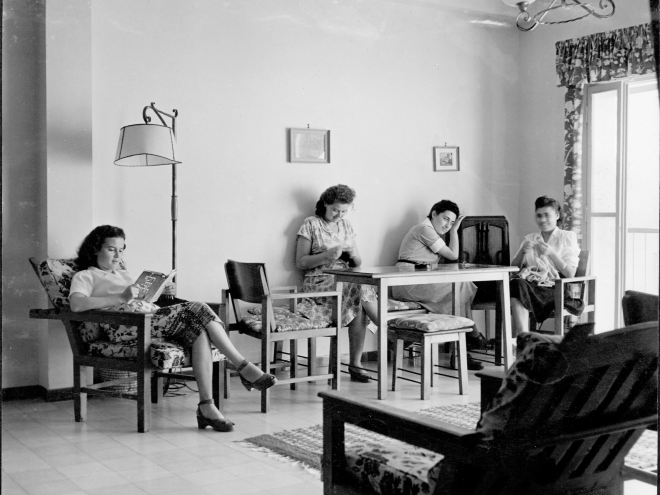
The second part explores buildings designed by female architects and commissioned by women’s organizations. It focuses on the partnership between these architects and organizations such as the Women’s International Zionist Organization (WIZO). Davidi explores how these organizations commissioned domestic science schools, youth villages, and training institutions for women that were meant to promote the development of the Zionist woman as productive, modern, and central to the success of the Zionist enterprise. She shows how the tenets of modernist design supported social innovation and elevated the status of women.
The architects Lotte Cohn and Elsa Gidoni feature prominently in this second section. Gidoni designed the WIZO House, a training center for the new Zionist woman. Her design featured “functional and minimalist design principles” to “chart a way of life for the contemporary Jewish woman.” Cohn designed WIZO’s Mothercraft Training Center, a place to support women in adopting modern motherhood practices, particularly within the disadvantaged Yemenite community of Tel Aviv’s Kerem Hateimanim neighborhood. Despite the positive impact the Mothercraft Training Center afforded this community, Davidi does not shy away from criticizing the bias represented in the establishment of a center to uplift Mizrahi Jewry by the European Jewish establishment.
Davidi also engages with historiography, asking why the achievements of women architects have been excluded from broader accounts of Israeli architecture. She argues that biases in both professional and Zionist narratives have rendered women’s contributions invisible, despite their clear influence on the Zionist enterprise.
Modern Architecture and Gender in Pre-State Israel offers readers access to an area of Israel Studies that will also interest historians of architecture and gender studies. It demonstrates that the Jewish community of pre-state Israel was built, quite literally, on the visions and designs of women whose work has too often been overlooked.