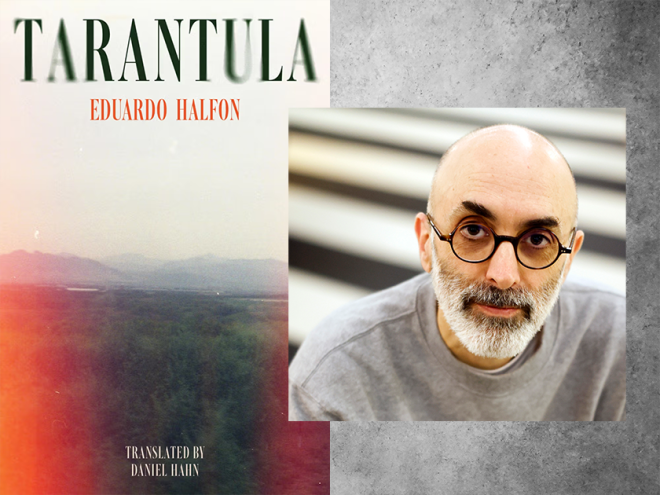
A Jewish outdoor summer program in Guatemala turns into a nightmare when, in an attempt to educate the children under their charge, the counselors stage a reenactment of the Nazi concentration camps, with themselves as Nazis and the unwitting campers as their victims, set in the 1980s. Many years later, one of the campers, a fictional Eduardo Halfon, meets the lead instigator in Berlin, and confronts both his past and his memory. Fast-paced and dark, with an undertone of violent menace that simmers quietly beneath the page without ever quite bubbling over, Tarantula is a masterful novel by author Eduardo Halfon on inheritance and memory.
For those new to Eduardo Halfon’s work, it is worth noting that the writer and the protagonist are not the same person, though their lives overlap significantly. Eduardo Halfon the character is an inheritor of two of the twentieth century’s great tragedies: the Guatemalan genocide of its indigenous Mayan population, and the Holocaust. Yet, unlike those who experienced these catastrophes first-hand, Eduardo is also drawn back to these events and the places where they played out. We meet him as a child in Guatemala, though he has already emigrated to the United States, and as an adult in Berlin, just miles from where his grandfather was interned at Sachsenhausen. Eduardo’s reason for gravitating back towards these places of tragedy is to seek an answer to the questions at the heart of Tarantula: What can be inherited, and what must be experienced? Is the simulation of horror ever justified?
These questions run through the novel hand-in-hand, because — as is articulated by Tarantula’s chief villain, the ex-counselor Samuel Blum — if there are evils in the world that must be experienced to be known, and the intimate knowledge of such evils are necessary for survival in a world in which these evils exist, then is it not our duty to prepare future generations by educating them in any way possible? Even if that means subjecting them to some taste of the horror itself?
Like the best novels, Tarantula asks these questions without insisting on the answers. In some ways, Blum’s cold logic is just as compelling as Eduardo’s repulsion, and we are left with the sense that it is Eduardo’s uncertainty, and his search for alternate answers, that give him the moral upper-hand against Blum’s unwavering conviction.
One question that Eduardo does answer is posed to him by a reporter: What were the books he’d never read that had had the greatest influence on him as a writer?
“The Torah and the Popol Vuh,” Eduardo answers:
Though I’ve never read them…And the thing is, I don’t need to read them, as they’re always with me, both of them inscribed some place very deep inside me. The book of the Jews and the book of the Guatemalans…those two monumental works that represent and define the two great columns upon which my house is built. But it’s a house that since childhood, for some reason, I have needed to destroy or at least abandon.
The house that Halfon feels the need to destroy in adulthood is the one we watch being built, remodeled, demolished and rebuilt in Tarantula. Between Guatemala and Berlin, between the grandfather’s concentration camp and its gross reincarnation, Halfon — writer and character both — searches for resolution, but finds only tension. And that tension is the propulsive force behind Tarantula.
Daniel H. Turtel is the author of the novels The Family Morfawitz and Greetings from Asbury Park, winner of the Faulkner Society Award for Best Novel. He graduated from Duke University with a degree in mathematics and received an MFA from the New School. He now lives in New York City. Follow him on X at @DanielTurtel.