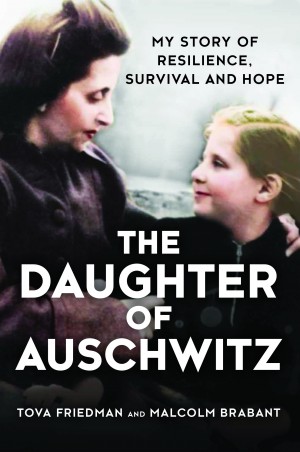
In 2022, Holocaust survivor Tova Friedman published her original memoir of imprisonment, torment, and survival in Auschwitz. Now she has adapted her book for older middle-grade and young adult readers. Her clear delivery of details and unstinting honesty convey the horrors of what she, and many others, endured, and for confirms how chance circumstances so often determined who would live and who would die.
The book begins when Tova (then named Tola) has arrived in New York City as a refugee, filled with a sense of alienation. An allegedly helpful school principal tries to convince her to change her clothing style in order to fit in with the other students. Worse, he suggests she should cover the tattoo that will mark her forever as a former inmate of Auschwitz. She is also pressured to change her name to Susan, eradicating her past life in Poland.
Then, Friedman recounts her traumatic experiences in the Holocaust in a series of chapters that seem analogous to Dante’s Inferno. Beginning with the unanticipated violent persecution of Poland’s Jews, and continuing through the respective components of hell, she describes such
atrocities as “The Shaving,” “The Tattoo,” and even “The Gas Chamber.” Forced to wait outside this place of mass execution, she and other Jewish children are finally sent back to their barracks. Since Soviet troops are approaching, the Nazis have begun to shut down their apparatus of death.
Tola’s close relationship with her mother is her story’s anchor. With unbelievable strength, this woman lays out a series of strict rules for her daughter, convincing the six-year-old that following them will ensure her survival. Adhering to this plan does not alleviate Tola’s anguish. She registers no emotions, and, with the understatement that characterizes her tone, reports, “I’d feel nothing, just numbness and emptiness.” Yet she accepts that, amidst the chaotic environment of the death camp, following her mother’s strategies for eluding death was her only possible course of action. When her mother disappears, Tola incorporates her instructions in spite of daily evidence that she is doomed. With painful frankness, the author admits that, like other inmates, she sometimes frightens younger children to gain an illusion of control and power.
After the camp is liberated, Tola is reunited with both her parents. Their attempt to return home forces them to confront the cruel reality that antisemitism in Poland has outlived the Jews themselves, most of whom had perished. After spending time in a sanatorium for treatment of tuberculosis, and in the comparative comfort and security of a camp for displaced persons in the American zone of occupation, Tola and her family leave for New York. She later moves to Israel, and finally returns to live in the United States.
Given the scale of her own suffering and the vast numbers of Jews murdered, Tola wonders if she might be “the last Jewish child in the world.” The question she shared with other survivors, about what had allowed her to live and tell her story, can never be answered. Tova Friedman’s purpose in speaking and writing about the Holocaust is not to provide comforting answers, but simply to tell the truth. That truth, she hopes, will warn the world about the dangers of antisemitism and other hatreds, as well as the complacency that allowed these poisons to take root and grow.
This highly recommended book includes a Q&A with the author.
Emily Schneider writes about literature, feminism, and culture for Tablet, The Forward, The Horn Book, and other publications, and writes about children’s books on her blog. She has a Ph.D. in Romance Languages and Literatures.