Join a community of readers who are committed to Jewish stories
Sign up for JBC’s Nu Reads, a curated selection of Jewish books delivered straight to your door!
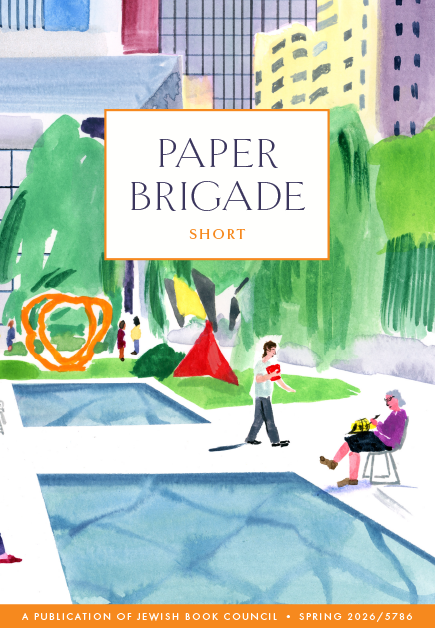
Paper Brigade Shorts are named in honor of the “paper brigade,” a group of writers and intellectuals in the Vilna Ghetto who risked their lives to rescue thousands of books and documents from Nazi hands.
Like our annual print journal, Paper Brigade Shorts celebrate the breadth of voices, genres, and ideas in the Jewish literary world — but in a delightfully small, portable form. Each Short contains one story, one poem, and one work of nonfiction, and is illustrated with a wrap-around cover.
The Spring 2026/5786 Short includes a story by Toby Lloyd, a poem by Jehanne Dubrow, and a recommended reading list by Samantha Ellis. Beautifully illustrated by Laura Junger, the Short covers topics as timely and diverse as books about Iraqi Jews and an accusation of antisemitism at a university in New York City.
Paper Brigade Shorts are exclusive gifts for Nu Reads subscribers and JBC members. To receive a one-year subscription to Paper Brigade Shorts, subscribe to Nu Reads or become a JBC member.
Contributors
Jehanne Dubrow is the author of ten poetry collections, three books of nonfiction, and a craft book, The Wounded Line: A Guide to Writing Poems of Trauma. Her next book of nonfiction, Frivolity: A Defense, is forthcoming from Columbia University Press in autumn 2026. Her writing has appeared in New England Review, Southern Review, and Ploughshares. She is a professor of creative writing at the University of North Texas. Read more of Jehanne Gubrow’s work published by Jewish Book Council here.
The daughter of Iraqi-Jewish refugees, Samantha Ellis is the author of How to be a Heroine and Take Courage. Her plays include How to Date a Feminist, Cling to me Like Ivy and Operation Magic Carpet. Her journalism has appeared in the Guardian, theTLS, the Spectator, Literary Review and more. She worked on the first two Paddington films. She lives in London, where Always Carry Salt was published under the title Chopping Onions on My Heart. Read more of Samantha Ellis’s work for Jewish Book Council here.
Laura Junger is a French illustrator and artist living in Berlin and Paris. Her work spans editorial commissions, physical objects, and visual campaigns. Selected clients include the New York Times, the New Yorker, Die Zeit, Warby Parker, Elle, the Wall Street Journal, and Rimowa.
Toby Lloyd is the author of Fervor, which was a finalist for two National Jewish Book Awards and the Sami Rohr Prize for Jewish Literature. The novel has been translated into five languages. His essays and short fiction have appeared in the Fence Magazine, SomeSuch Stories, the Los Angeles Review of Books and elsewhere. He lives in London and teaches creative writing at City Lit. Read more of Toby Lloyd’s work for Jewish Book Council here.
Discussion Questions for “Goliath” by Toby Lloyd
1. How should we treat canonized books that, even if they don’t contain stereotypes themselves, were nonetheless written by prejudiced authors? Mitzi Hoffman and Cory Feigenbaum have opposing opinions on this. With whom do you agree more?
2. Compare the ways in which the Holocaust has informed both characters’ points of view. How has the discourse around antisemitism changed from when Hoffman was young to 2016, when “Goliath” takes place? How has it changed from 2016 to today?
3. Unlike Hoffman and Cory, the narrator of “Goliath” doesn’t voice strong opinions — in fact, the narrator doesn’t speak at all until the very end of the story. Why do you think the author chose to characterize the narrator this way? What does the narrator’s perspective add to “Goliath”?
4. Consider the role of social media in “Goliath.” What are different ways in which social media can be helpful and harmful in calling out antisemitism and other hate speech? Does Cory’s use of social media remind you of other cases you have seen or heard about recently?
5. Hoffman says that for some twentieth-century writers, “travel was important. They went out into the world, hunting for stories like rare beasts. Borges was the opposite. As he saw it, the whole universe was contained in a library. And I’m with him. Let the stories come to me.” The narrator, on the other hand, has traveled from abroad specifically to study creative writing. How is place connected to story? Could “Goliath” be set outside New York City? Outside the United States?
6. For Hoffman’s class, The Craft of Fiction, students are asked to present about what they glean about composition from reading the work of renowned authors. What is a lesson in craft you’re learned from reading “Goliath”?
7. Examine Laura Junger’s wrap-around cover illustration of “Goliath.” How does it complement the story?
8. Who is Goliath in this story, and who is David? Could there be more than one David or Goliath?