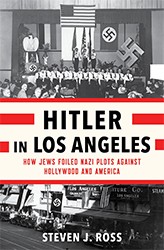
Steve J. Ross’s The Secret War Against Hate recounts the little-known history of a shadow conflict between three organizations (two of them Jewish) and four would-be dictators who dreamed of turning America into a Nazi state. The organizations were the American Jewish Committee (AJC), the Anti-Defamation League (ADL), and the Nonsectarian Anti-Nazi League (ANL), the last of which did not outlive its founder, James Sheldon. The conflict played out from the end of World War II until the mid 1970s, when the AJC and the ADL concluded that the threat posed by right-wing extremists was dying off. Regrettably, this judgment proved incorrect.
The AJC, ADL, and ANL had four principal adversaries: Emory Burke, J. B. Stoner, James Madole, and George Lincoln Rockwell. The four were fanatical antisemites, admirers of Hitler, and viciously anti-Black. They expressed their views openly and crudely, calling for the forced migration or extermination of American Jews. Stoner, who was belatedly convicted of an infamous bombing of a Black church that killed four young women, said that “Hitler was too moderate.”
The four never succeeded in uniting their small followings into a larger, national movement. In considering why they were unsuccessful, the activities of the three organizations deserve credit. The AJC, ADL, and ANL ran spying campaigns, placing agents in the hate groups. Those agents put their lives at risk — the hate groups knew that their operations were compromised. Despite their efforts to eliminate the spies, the hate groups failed.
Fortunately, their unsuccessful search for the spies diverted time and resources away from their twisted missions. The spying campaigns made already paranoid personalities more mistrustful, complicating any hope of coordinating their activities. The spies furnished reports back to their ultimate bosses, organizational heads George Mintzer (AJC), Arnold Forster (ADL), and James Sheldon (ANL). These men in turn could share the information with the media and law enforcement or use it to disrupt hate group activities.
The author notes that J. Edgar Hoover, head of the FBI over most of the period of this conflict, was uninterested in pursuing cases involving right-wing extremists. In Ross’s telling, Hoover was excessively focused on threats from the left. The author implies that Hoover’s lack of interest stemmed from his sympathy for the four. Perhaps, but it is also possible Hoover’s indifference had more to do with his focus on the Soviet Union, America’s Cold War adversary. The Soviet Union was conducting a successful spying campaign against the USA, a campaign more threatening than anything the four wannabe dictators were capable of.
This is why people are more familiar with the names of Alger Hiss, Julius and Ethel Rosenberg, and Harry Dexter White than of the four. Compared with the Soviets, Burke and his ilk were small potatoes. That is not to say that the four were not dangerous — Stoner was a murderer. But America was fortunate to have enemies as feckless as the four. The great fear of the AJC was that the four would combine into an important national party. But they did not trust one another or work well together. Tall and handsome, Rockwell looked the part of an autocrat, but his political skills were poor. Stoner, on the other hand, was a loner with a limp. He possessed a clever legal mind but was not a gifted communicator. Madole lived with his mother for much of his life and had a bizarre ideology that blended his enthusiasm for Nazism, the occult, and science fiction.
Of course, the hero of these misfits, Hitler, was a failed artist and vagrant before he became Führer. It would be imprudent to dismiss them as harmless because of their flaws. But while Hitler benefited from an inflation-ravaged economy and the humiliating Versailles Treaty, both of which fed German grievances, the four had no such tail winds propelling them towards power. To the contrary, the American economy performed powerfully over the period covered in the book. And the Nazis symbols and uniforms, so beloved by the four, were an anathema to the overwhelming number of Americans.
The first and last chapters of the book portray President Trump as the heir to the four would-be dictators. This claim ignores the President’s strong support for Israel, the pressure he has placed on universities which have tolerated antisemitic harassment of Jewish students, and his pride in having a Jewish daughter and grandchildren. Had they been living, Burke, Stoner, Madole, and Rockwell would never have ignored these facts — indeed they would have elicited wild charges of “Jewish control” and blood curdling threats. For different reasons, the conscientious historian cannot ignore them either, because they undermine the argument with which the book opens and closes.
Alex Troy worked at two Jewish schools, teaching history at one and serving as Head of the other. Before becoming an educator, he worked as a lawyer and investor for thirty years. He recently published his first novel, The Academy Of Smoke And Mirrors: A Boarding School On The Brink. Alex is a graduate of Yale, Harvard Law, and St. John’s College.