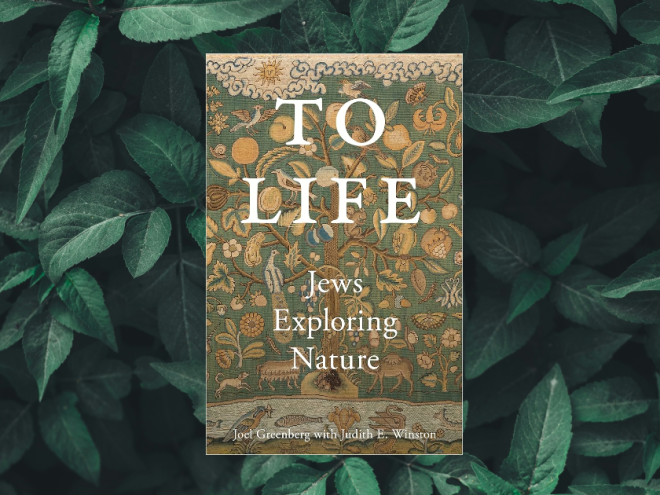
Shaped by exile, years of urban life, and a focus on Torah study, the Jewish story is not typically associated with interest in the environment. In To Life: Jews Exploring Nature, authors Joel Greenberg and Judith Winston present eight portraits of Jewish scientists who took a different path, exploring the natural world. These figures share Jewish heritage, but their fields of study include botany, ornithology, herpetology, mammalogy, invertebrate zoology, and ecology. Several of their stories include surprising twists, including espionage and murder.
The introductory essay, titled “The People of the Book Venture Outside,” surveys Jewish views regarding nature across religious and cultural history. Despite the biblical prohibition against wanton destruction (ba’al tashchit), the holiday of Tu B’Shevat, and God’s charge to Adam and Eve to care for the earth, Jews distanced their religion from nature to separate it from paganism. It was only with the rise of Modern Zionism, as Jews sought to return to Palestine, that interest in studying and rebuilding the land, with the support of science, became central to the Zionist vision.
The authors’ first chapter introduces us to Aaron Aaronsohn, an early Zionist, agronomist, and spy during World War I. In building the Jewish state, Aaronsohn discovered emmer, an ancient grain and the ancestor of modern cultivated wheat. His work took him throughout Ottoman Palestine, and he leveraged his discovery to establish NILI, a spy ring that supported the British conquest against the Ottomans. The third chapter shares the bizarre story of Nathan Leopold, a student at the University of Chicago, who partnered with Richard Loeb to commit a so-called perfect crime. The two were defended by Clarence Darrow, found guilty, and received life sentences. Loeb was murdered in prison, but Leopold was eventually released. He became a respected ornithologist in Puerto Rico and published a well-regarded study of the birds of the island.
The six other naturalists of To Life include herpetologist Hymen Marx, epidemiologist Andrew Spielman, zoologist Libbie Hyman, mammologist Philip Hershkovitz, arachnologist Herbert Levi, and ecologist Joan Ehrenfeld.
To Life fills a gap in the history of Jewish scientists and environmental history. It will appeal to readers interested in Jewish history, the history of science, and natural history. Greenberg and Winston make their subjects part of a larger story, one that has been too long overlooked.