Join a community of readers who are committed to Jewish stories
Sign up for JBC’s Nu Reads, a curated selection of Jewish books delivered straight to your door!
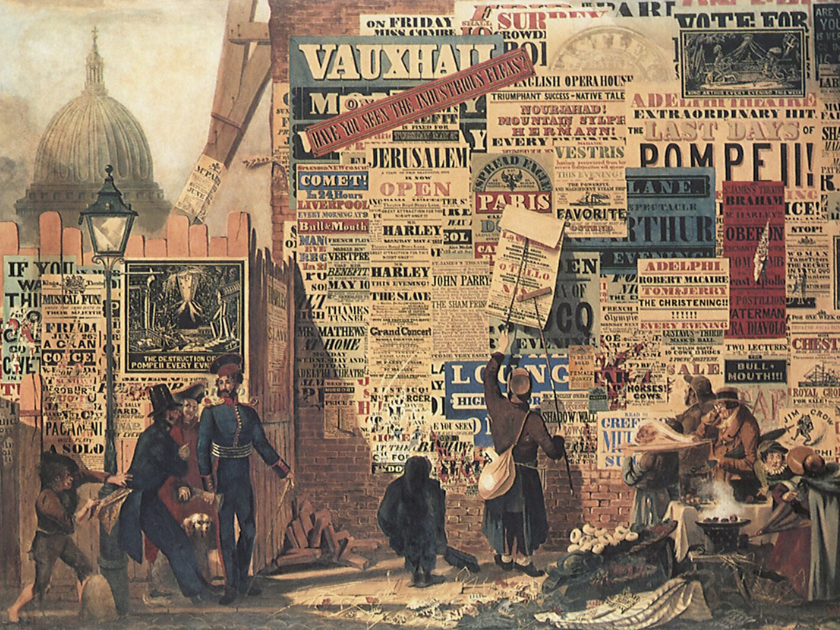
Watercolor by John Orlando Parry, “A London Street Scene” 1835 (detail),
in the Alfred Dunhill Collection. Via Wikimedia Commons.
How can we counteract antisemitic stereotypes in literature, especially when those stereotypes are embodied in as infamous a character as Fagin, the Jewish villain of Charles Dickens’s Oliver Twist? For both Allison Epstein and Nancy Churnin, the answer lay in writing their own books about him. Epstein’s recent novel, Fagin the Thief, retells Dickens’s story from Fagin’s perspective, portraying him as sympathetic despite his flaws: left to fend for himself as a child, accepted by neither London’s East End Jewish community nor society at large, he eventually becomes a paternal figure to a number of outcasts and aspiring pick-pockets. Dear Mr. Dickens, a picture book by Nancy Churnin, centers on Eliza Davis, a real-life Jewish contemporary of Dickens who petitioned him — successfully — to reconsider his portrayal of Jews. In the following conversation, Epstein and Churnin discuss how their works can change our understanding of Fagin and his creator.
Becca Kantor: Your books bring layers of nuance to Charles Dickens and his novel Oliver Twist. Allison, you write that either “sanitizing Fagin or disowning him” as a Jew in your retelling of Oliver Twist would have felt “like a loss” to you. Nancy, your portrayal of Dickens acknowledges both the author’s empathy for many oppressed groups and his antisemitism. What inspired both of you to explore these morally complex figures in your work?
Nancy Churnin: The seed of Dear Mr. Dickens was planted in my childhood when my parents — my mother in particular, who was a teacher — shared their love of books with me, but held back when it came to Charles Dickens. My mother had lost a grandmother, aunts, uncles, and cousins whom she had never met when the Nazis marched through Bialystok, Poland on their way to Russia, killing as many Jewish people as they could on the way. All her life she had nightmares about this. She refused to watch movies about Nazis because they were too terrifying. Even when she fell deep into dementia at ninety-five, one of her first delusions was that the Nazis had broken into her home and she was in danger.
My mother told me how painful Dickens’s portrayal of Fagin was to her and how it not only made her feel left out of Dickens’s compassionate universe, but also made others view her negatively as a Jewish person. She didn’t want me to read Dickens because she didn’t want me to see myself negatively, too. But I loved Dickens! He was such a great writer with such an expansive vision and conscience. And yet, I was perplexed by how he could have had no compassion for the Jewish people, who had been persecuted in his native England and elsewhere.
As an adult, when I discovered a scholarly article about Dickens that included a few lines about how Eliza Davis had written to Dickens and changed his heart, I knew I had to tell this story. I had to tell it for my mother, for me, and for everyone who needed to see the power of speaking up as Eliza Davis did. I also wanted to show the nobility of acknowledging when you are wrong, as Charles Dickens did, and of doing teshuvah (even though he personally might not have known that word) by taking action to do better. After corresponding with Eliza Davis, Dickens became an advocate for the Jewish community and created his first positive Jewish character, the kindly Mr. Riah in Our Mutual Friend.
I was able to get my mother an advance copy of Dear Mr. Dickens a few months before her dementia became pronounced. Eliza Davis’s ability to “teach” Charles Dickens to be a better person made her feel validated in her profession as a teacher who believed that kids can be taught to be their best selves. The fact that Dickens could and did change renewed her hope in the essential goodness of people. While we read it together, I felt I was seeing an icy crystal of distrust in people melt and the joy of possibility and hope bloom. As the dementia began taking hold a few months later, she thought I had written Dickens the letter and would grab my arm, asking anxiously if he had responded. It felt good to tell her that yes, he had, in a kind and caring way.
When I discovered a scholarly article about Dickens that included a few lines about how Eliza Davis had written to Dickens and changed his heart, I knew I had to tell this story.
Allison Epstein: I’ve had a messy relationship with the character of Fagin since I first encountered him, listening to my grandmother’s 1994 Oliver! Cast album. The version of Fagin from the musical is easy to love: the show sands off Fagin’s rougher edges, leaving a fairly harmless rascal who cares earnestly for “his” boys in comparison to the uncomplicated villain Bill Sikes. Most modern stagings mute Fagin’s Jewishness for fear of falling into an antisemitic stereotype, and the script makes no mention of his faith at all. At a recent event to discuss Fagin the Thief, one reader told me that she had seen the stage show of Oliver Twist and many other adaptations, but until she picked up my
book, she’d had no idea Fagin was Jewish. This was startling to hear, especially given — Nancy, as you point out — the direct lines Dickens draws between Fagin’s Jewishness and his criminality. But it supported something I’ve noticed for years: while modern audiences love the idea of Fagin the Scoundrel, they don’t know what to do with Fagin the Jew.
Here’s where I confess that while Dickens’s portrayal is a hateful one in many ways, Fagin has always (maybe a little perversely) been a Jewish character I want to lay claim to. Fagin is smarter than any other character in Oliver Twist, and he’s terrifyingly talented as a criminal. He’s distinctive: many other characters in the book have interchangeable voices, but not Fagin. And there are brief moments in which Fagin’s behavior complicates the idea that he’s unreservedly evil — almost as if Dickens couldn’t stop himself from letting a more well-rounded character flash through. My goal in writing Fagin the Thief was to take the raw materials Dickens provided and strip off the hate without stripping off the identity or the dynamism of the original character. I wanted to let him have his own story: one that was painful, complicated, and fully human, just as Dickens allowed so many of his non-Jewish characters to have.
BK: You not only had to consider the relationship between your story and historical fact, but also how faithful your story would be to Oliver Twist. How did you negotiate this? I’m particularly intrigued by how you approached certain plotlines in Oliver Twist—including Fagin’s ultimate fate — that you realized would have been historically inaccurate.
AE: I really enjoyed researching London life between 1790 and 1840, and I turned to modern historians as well as social surveys, maps, and documents from the period. But the cornerstone of my research was pretty straightforward: I read as much Dickens as I could. Dickens’s novels are so deeply rooted in their time and place that very often historical fact and the world of Dickens are very similar.
Fagin the Thief starts decades before Dickens’s story picks up, so I had plenty of freedom when deciding what Fagin’s childhood and young adulthood would look like. But as my story and the original started to converge, I decided that my book would stay as close as possible to the events of Oliver Twist. I wanted to understand Fagin rather than rehabilitate him, which made my guiding question “Why might this happen?” rather than “What happens next?” But I made some exceptions. Where I deviate from Dickens’s plot, it’s almost always because the way I’d come to understand the characters meant that their actions in Oliver Twist no longer made sense to me. If Fagin as I’d written him would have made a different choice than Dickens’s Fagin, I gave myself permission to color slightly outside the lines.
Interestingly, there’s one big instance of Dickens using artistic license in Oliver Twist. With Fagin, he had created a fairy-tale villain who needed to receive the ultimate punishment for his crimes, so of course Oliver Twist ended with Fagin being hanged. In reality, at the time the book was published, recent legal reforms had drastically reduced the use of the death penalty in England, and Fagin’s crimes of theft and receiving stolen goods were no longer punishable by hanging. For me, coming across that detail in my research opened up a world of possibilities. If Fagin lived in a story written by an author who wasn’t actively seeking to harm him, what might his fate be?
I wanted to let Fagin have his own story: one that was painful, complicated, and fully human, just as Dickens allowed so many of his non-Jewish characters to have.
BK: That’s such an intriguing question. Nancy, although Dear Mr. Dickens is nonfiction, I imagine that you still needed to be selective in choosing historical details that would tell a story simple and engaging enough for children to follow. How did you go about doing this? Are there any facts about Eliza Davis or Charles Dickens that you were intrigued by but decided not to include in your book?
NC: I find it fascinating that Dickens chose to name his antagonist after Bob Fagin, a young boy who had been kind to him and showed him how to do his work in Warren’s Blacking Factory, where Dickens had been forced to work when his family was thrown into the Marshalsea debtor prison. Steven Marcus wrote a terrific article for Commentary magazine in 1962 called “Who Is Fagin?” that explores why Dickens may have chosen Bob Fagin’s name for his infamous villain. Remember, Fagin spoke kindly and acted caringly to the young boys in his charge. At the same time, he was training them to do something awful — stealing — and for Dickens, working in the blacking factory was awful. It felt like every moment there was a moment stolen from his life, or at least the life he wanted.
Regarding Eliza Davis, an element that fascinated me was that she wasn’t the first one to reproach Dickens for his portrayal of Fagin, which is something I mention in the back matter, but didn’t have the space to go into in detail. The Jewish Chronicle in London had asked, in 1854, before Davis wrote her first letter, why “Jews alone should be excluded from the sympathizing heart of this great author and powerful friend of the oppressed.” Dickens brushed off the newspaper’s words. But it wasn’t easy for him to ignore Eliza Davis. That’s because he knew and liked her. Davis and her husband, a banker, had purchased Tavistock House in London from Dickens in 1860. Dickens had been leery of dealing with Jewish people. He wrote to a friend, “If the Jew Money-Lender buys (I say ‘if,’ because of course I shall never believe in him until he has paid the money.)” To Dickens’s surprise, the money was paid within a few days and the dealings were so pleasant that Dickens wrote to another friend, “I must say that in all things the purchaser has behaved thoroughly well, and I cannot call to mind any occasion when I have had money-dealings with anyone that have been so satisfactory, considerate, and trusting.”
I didn’t have room for these exchanges about Tavistock House in a book for children in which I wanted to focus on Eliza Davis’s determination to speak up. But I believe that it may have been Dickens’s appreciation for Davis’s good character that gave her the confidence to persist in contacting him.
The Jewish Chronicle had asked why “Jews alone should be excluded from the sympathizing heart of this great author and powerful friend of the oppressed.” Dickens brushed off the newspaper’s words. But it wasn’t easy for him to ignore Eliza Davis.
BK: In Dear Mr. Dickens, Eliza Davis is taken aback when she reads “over and over” that Fagin is referred to simply as “‘the Jew’ … the word hurt like a hammer on [her] heart.” In Fagin the Thief, Fagin is similarly upset when people first call him “the Jew,” but, as a thief, he also comes to see the value of anonymity. To echo Shakespeare, what’s in a name? How is Fagin — and the way he has been perceived by readers — shaped by what he is called?
NC: Taking away an individual’s name and referring to him by the group with which he is associated — in this case “the Jew” — allows other people to dehumanize him. It’s the first step toward othering, demonization, and scapegoating, which we see again and again throughout history. When a writer as powerful and otherwise compassionate as Dickens refers to Fagin as “the Jew,” it gives even otherwise kind readers license to not only see Fagin through the lens of being part of a group that they are being encouraged to fear, but also to see other members of that group as being the same as Fagin. Every time Fagin is called “the Jew” is an assertion that all Jewish people are like Fagin and that non-Jewish people should be wary of them.
AE: I second that! Something else that’s troubled me is the way “the Jew” reads as “the only Jew.” Fagin is utterly isolated from any form of community. There’s one other Jewish character in Oliver Twist: an incidental tavern-worker named Barney, whose sole trait is that his “words, whether they came from the heart or not, made their way through the nose.” But aside from that, it’s as if Fagin appeared one day out of a hole in the ground, a being without context.
My version of Fagin has complicated feelings about being referred to as “the Jew.” The first time he’s addressed this way, it baffles him. He’s grown up in a Jewish community in East London, and being Jewish is so normal for him that he’s startled that other people think it’s worth mentioning. But as the world continues to hammer on the idea that his Jewishness provokes fear and dislike, Fagin decides to go along with it. It’s less painful to accept the identity he’s been handed than to repeatedly try and fail to make others see him differently. He can’t change the perceptions of anyone around him, and so he accepts — wisely or not — the idea that the only person who will ever see him clearly is himself.
BK: The idea of l’dor vador—from generation to generation — immediately struck me when I read your books. Both of them highlight the importance of parent/child relationships in modeling values and beliefs. Nancy, one of the ways Eliza Davis compels Dickens to reconsider his portrayal of Jews is to encourage him to reflect on the way future generations will remember him. It also seems significant that Eliza’s young son is present for much of the book; even at moments when he isn’t mentioned in the text, he often appears in the illustrations. Why did you feature him so prominently? How did you work together with Bethany Stancliffe, your book’s illustrator, to make this happen?
NC: There were so many reasons why Dear Mr. Dickens shouldn’t have worked as a book for children — which is something that a number of editors were quick to tell me early in my journey. Children would not know who Dickens was, they certainly wouldn’t know who Eliza Davis was, they wouldn’t be interested in an exchange of letters, and Eliza was an adult rather than a child protagonist. I trusted children to be wiser and more empathetic than adults gave them credit for, and I have not been disappointed. As for the child protagonist, I felt that Eliza’s youngest provided the lens through which we could understand why Eliza did what she did and how important what she did was. I could have fictionalized the book by telling it from his point of view. But I wanted kids to know the truth of this story, which is why every detail has been checked by three Dickens scholars. I wanted to stick to the truth of Eliza’s belief in l’dor vador—the importance of speaking up for her child and the next generation.
That idea crystallized when I studied the second letter she wrote — the one that changed Dickens’s heart. The first letter adhered more to the post that had been addressed to him earlier in The Jewish Chronicle. But Eliza’s second letter seemed more in tune with her understanding of the way Dickens’s mind worked — his concern with the past, present, and future as he had anthropomorphized them in the Ghosts of Christmas Past, Present, and Future in A Christmas Carol. And that is why I think that second letter was so effective.
Given that construct as a framework for the second letter, Eliza’s son naturally and organically becomes a lens into how Dickens will be perceived in the future. This became very emotional for Bethany Stancliffe because she was a young mother and told me she identified with Eliza, visualizing her story through the eyes of a mother like herself wanting to help create the world she wanted her child to live in. It was also very emotional for me, because that little boy’s hurt at reading about “the Jew” reminded me of my mother’s descriptions of the pain she had felt as a girl when she first read Oliver Twist. It brought back my own feelings when I first read those hurtful passages as a child, too.
BK: The legacies passed down from parents to children is also a central theme in Fagin the Thief. Fagin eschews romantic and sexual relationships; his closest bonds are with his mother and his band of young thieves, whom he treats almost as sons. Allison, could you tell me more about the relationship between Fagin and his mentees, and how you chose to characterize it this way?
AE: Anyone looking to understand Fagin the character needs to understand why he chooses to make his living by training children to steal. Dickens invites his readers to blame Fagin’s selfishness and exploitative nature for it, but that never rang true to me. Training kids isn’t the easiest way to get by: he’s paying for their room and board as well as his own, and as any elementary-school teacher will tell you, getting a bunch of unruly preteens to quiet down and pay attention to your lesson isn’t for the faint of heart. So it seemed obvious to me that something else had to be at play.
In my telling, Fagin’s decision to take in Bill Sikes and the parade of young thieves who follow him is almost accidental — he doesn’t understand why he’s doing it even as it happens. But the reader understands that Fagin sees himself in his mentees: children nobody wants, who spite the world by staying alive in it another day. His foster-parenting is an attempt, however subconscious, to break the cycle of abandonment he experienced with his own parents and mentor. This is particularly pronounced in the case of his father, who I imagine was hanged as a thief before Fagin was born.
As I wrote, the question of parental legacy became tangled up with the idea of fate. Does Fagin have a choice as to what kind of life he inherits from his father? Can he create a different kind of legacy, or has the world closed off all paths but the one that leads to prison? There are no easy answers to those questions, but Fagin wrestles with them as the story unfolds.
If my readers find themselves surprised by the empathy they feel for characters they thought were irredeemable villains, maybe they’ll pause the next time they feel tempted to define someone as an enemy.
BK: Dear Mr. Dickens begins with a question to the reader: “Think of someone famous you admire. What would you do if that person said or wrote something unfair? Would you speak up?” Are there unique ways in which the written word — whether in a novel, a children’s book, or a letter — can expand readers’ views?
NC: That belief, that the written word can expand readers’ views, is the reason I became a writer. The world can be a dark place. Injustice feels like a wave that seems far away at one moment and then floods our boat, leaving us desperate and scrambling to survive. But words can become lighthouses of hope and guidance. How many people were inspired by Dickens’s A Christmas Carol to rethink the way we treat other people after being reminded that all of us are “fellow-passengers to the grave, and not another race of creatures bound on other journeys”? It is my hope that children and their adults reading Dear Mr. Dickens will realize, similarly, that we are all on this journey together. Bethany Stancliffe shows this so eloquently on the final spread, where you see Dickens on one side and Davis on the other, the two linked by a vertical spread of letters. I hope knowing that we are all one human family, inclusive of differences, encourages readers to do as siblings might and should do: speak up when they see something wrong, as Davis did, and acknowledge the wrongdoing and do better in the future, as Dickens did.
AE: I believe fiction has a unique power to inspire empathy and understanding in readers. I have to, or I wouldn’t be able to keep writing stories in the kind of world we live in today. Stories ask us to see the world through someone else’s eyes, as if their experiences, hopes, fears, and dreams are our own. And I’ve always believed that if you really understand someone, you can still disagree with them, but it’s very difficult to hate them.
This is a big responsibility for fiction writers, and not all books embrace it. Stories can present two-dimensional caricatures that reinforce the most hateful beliefs we hold as a society. But they can also take a person we’ve been taught to hate and explain — entertainingly, but earnestly — what might have made them the way they are. That’s what I hope readers take away from Fagin the Thief. I don’t want readers to think of Fagin as a hero to be admired. But I want them to see that all characters in the book are people: flawed, complex, beautiful, and tragic, just like each and every one of us. And if my readers find themselves surprised by the empathy they feel for characters they thought were irredeemable villains, maybe they’ll pause the next time they feel tempted to define someone as an enemy.
Becca Kantor is the editorial director of Jewish Book Council and its annual print literary journal, Paper Brigade. She received a BA in English from the University of Pennsylvania and an MA in creative writing from the University of East Anglia. Becca was awarded a Fulbright fellowship to spend a year in Estonia writing and studying the country’s Jewish history. She lives in Brooklyn.