Join a community of readers who are committed to Jewish stories
Sign up for JBC’s Nu Reads, a curated selection of Jewish books delivered straight to your door!
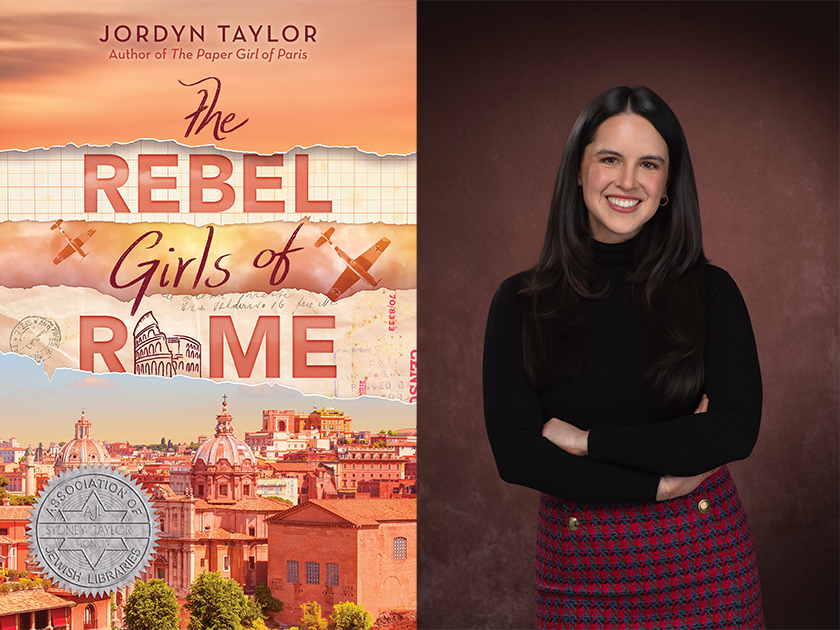
Author photo by Chad Johnson
Jordyn Taylor’s 2026 Sydney Taylor Honor Young Adult novel, The Rebel Girls of Rome, traces the journey of two young women, one narrative set in the past and the other the present, as they navigate love and survival against the backdrop of historic events. This interview is part of the Sydney Taylor Blog Award Tour. Find the full STBA blog tour schedule here.
Emily Schneider: Jordyn, mazel tov on your Sydney Taylor Honor Award for The Rebel Girls of Rome. I’d like to begin with the book’s dedication to your grandparents. Is there a connection between your relationship with them and the book’s World War II setting?
Jordyn Taylor: Thanks, Emily. There is not a direct connection, because my ancestors — who were all Jewish — came to North America in the late 1800s and early 1900s, fleeing pogroms. They emigrated to Canada and the US because of antisemitism. I’ve been very interested in Jewish history my entire life, including World War II history, and my grandparents were always supportive of my studying that. And honestly, I wanted to dedicate this book to them because of the relationship in the book between my protagonist Lilah and her grandfather. The love they have for each other mirrors the love that I have for my grandparents. I have amazing relationships with them. I’m still lucky enough to have three of them alive today. I know that my Bubby, who passed away a few years ago, would be really proud of this book, too.
ES: That dedication page invoking memory and history is also key to your recent novel, as well as to your earlier book, The Paper Girl of Paris. In The Rebel Girls of Rome, we follow two narrators. One is a young woman, Lilah, set in modern times who is actively engaged in researching the past, recovering memories, and revealing them to her family. In alternating chapters, we meet Bruna, a Jewish partisan in 1943, resisting fascism in Italy. She’s also struggling with difficult memories, including some about recent choices she’s had to make in extreme circumstances.
JT: Yes, I’ve thought a lot about the theme of intergenerational trauma, how one generation’s memory of terrible things that have happened to them can be passed down through the generations, and what we can do to break those cycles. I thought about how what Bruna went through in the Holocaust would have shaped her, and how what Lilah’s grandfather went through in the Holocaust, would have shaped him, and would be passed down to his daughter and granddaughter. We can’t change the fact that we experience trauma, but we do have control over what we do about it. It’s up to Lilah — as she realizes over the course of the book — to break that cycle of trauma, those terrible memories that have been passed down. Tommaso, the Italian student that she partners with to solve the mystery of her family’s past, realizes the same things, too, about his own family.
ES: Why did you choose the structure of a dual narrative for this novel?
JT: As a reader, I have always loved books that jump back and forth between the present and the past, or between two different characters’ perspectives. I feel that it’s a great way to create a gripping narrative. Something happens in Lilah’s timeline in the present that reveals a clue about what happened to Bruna in the past, or vice versa. It’s a fantastic way — especially in young adult literature — to keep readers engaged in a story. I also think that the dual narrative helps tie in the theme of intergenerational trauma. We can see how Bruna’s guilt for having survived the October 16th roundup of Jews parallels the guilt that Lilah is experiencing, learning things about her family that her mother (who passed away) was never able to learn. I wanted to show, in putting their two stories side by side, how both of these women deal with anxiety and guilt in different ways. But they are also connected, just as their generations are connected, through trauma.
ES: Another connection between these two female characters is their strength, which is tested by adversity. Lilah’s grandfather is a difficult man: wounded, and flawed as a husband, father, and grandfather. He’s caused a lot of pain in his family.
JT: Yes, I knew that if I was going to tell a meaningful story about intergenerational trauma, then I needed to show, realistically, how this man was impacted by what happened to him during the Holocaust. I don’t think I could have told this story as effectively if he had been a perfectly healed, comforting, nurturing grandfather figure. He had to be really shaken and changed by the things that happened to him. Of course, I did ultimately want to show that there is always time to heal from the wounds of the past. He does go through a meaningful transformation at the end of the story. As I learned through my research, there are many Holocaust survivors who didn’t even speak about the things that happened to them for decades and decades. Their own families didn’t know, until the end of the survivor’s life, or maybe never at all.
ES: There are other modes for people to communicate or work through difficult truths. Visual arts play a big role in the novel, helping to decipher a mystery about the past.
JT: I really love drawing, I always have. And I know the therapeutic effects of drawing; I know how it feels to have your pencil scratching on the page, the little details that are observed in everyday life, and that help create a vivid scene. I think it makes Bruna more engaging.
ES: Another important character is Lilah’s mother. Although she has died before the book begins, she appears throughout the narrative as Lilah grapples with grief and loss.
JT: In the first draft of this book, Lilah’s mother was alive. In revising the book with my editor, we thought about the need to make Bruna and Lilah’s stories mirror each other. One way was to give equal weight to Lilah’s story through the loss of her mother. It added an emotional layer to Lilah’s story in the present, and helped motivate Lilah to solve these family secrets, because it was so important to her mom to figure out what had happened to Lilah’s grandfather. What had made him such a distant and icy father? Knowing that her mother died without getting those answers compels Lilah to find them.
ES: Bruna’s conflicts are also intense. She is a lesbian whose life has to be to a large extent, secret, because of the time in which she’s living. You detail the oppression and murder of LGBTQ people in fascist Italy. Jews were targeted racially for genocide; if you were a Jew, whatever else your life or affiliation included, you could not escape your identity. How did you integrate, but also separate, those different parts of the threats to her life and her community?
JT: It was one of the hardest things I’ve ever had to do as an author.
I researched Jewish life, not just in Italy’s World War II period, but during their fascist regime, which is a period that began in 1922, when Mussolini took power. One of the things that made it so challenging to research queer life, was that, unlike other cities in Europe, where queer life actually flourished between the wars, the same thing did not happen in Rome, where queer life was incredibly repressed. Gay and bisexual men were deported to islands, and sent into exile. Queer women were forced to undergo exorcisms, and they were kept isolated from the outside world. There’s very little documentation of queer existence, which made my research even more challenging. I sought out the expertise of people who have dedicated their lives to studying this, including Dr. Gabriella Romano, who has been researching lesbianism in fascist Italy for her entire career. She actually consulted on the manuscript. For example, given the repression of the era, we had to balance historical accuracy in the language they would have used, with writing a beautiful, intimate, love scene. Layering in the experience of Jewish people on top of that, was a real challenge, but it makes me even more proud now to have been able to tell this story.
ES: That brings me to a broader topic, about the difficulties of writing historical fiction, as well as the responsibility inherent in writing about the Holocaust. Many of your young adult readers know very little about the Holocaust, and even less about the Holocaust in Italy.
JT: As a lifelong lover of history, I think it is so important that we continue to understand history so that we can ideally avoid making the same mistakes in the present. I’m sad to see, in so many ways, cycles of trauma being perpetuated. I hope by telling stories like this, I can inspire the next generation of readers to choose peace, to value all human life as sacred, and to promote love and equality. Historical fiction is a great way to teach history in a way that’s engaging for teen readers. I visit a lot of high schools and I talk to a lot of teenagers who say they were never interested in history until they read one of my historical fiction novels. That’s the greatest feeling. The history of World War II in Italy is complicated. The country entered the war, sided with Hitler, and then, when Italy was getting absolutely destroyed by the Allies, they decided to switch sides. Once they had joined the Allies, Germany occupied Rome.
Across Europe during the Holocaust, there are so many incredible stories of bravery and resistance and love, and I would never want any of those stories to be overlooked.
Finally, it was really important to me to tell a story about Jewish resistance, from the point of view of two Jewish narrators. I’m thirty-four and; when I was growing up, the pivotal Holocaust novel for me was Number the Stars. Looking back, I realize that this novel was actually told from the perspective of a Christian girl. I remember feeling that I wanted to tell a story about the Holocaust from the perspective of a Jewish girl. I wanted to tell a story about Jewish resistance, in particular about a queer Jewish girl fighting back.
ES: I’m sure it’s occurred to you that a book about resistance to authoritarianism has not lost its relevance. Bruna, even as she’s actively resisting, is torn with grief at the idea that she’s been responsible for someone’s death. She also suffers anguish at not being able to express her love for Elsa. Your characters may sometimes falter, but resistance is still the core of their story.
JT: Yes, I wanted to show how we tend to think of resistance as a black and white issue. You are either a perfect resistance fighter, or you’re complicit with the enemy. The reality is that most of us are in this murky gray area in between. In researching the French Resistance for The Paper Girl of Paris, I learned that only a very small sector of French society at the time was involved in an organized resistance movement. Some people were maybe doing what they could to resist, but also doing things that could be considered complicit with the occupation. I wanted to show that there are so many different ways to resist, and that there is also space for people to grow into the role of being a resistor. I also have sympathy for the fact that, like so many Jews, those in Italy were deceived by the Nazis at every turn. In Rome, they were told that if they collected enough gold, they would be spared deportation. That was a lie. Bruna and Elsa take up arms against the occupying forces. When Lilah breaks the cycles of trauma that have been affecting her family for generations, that, too, is a form of resistance. So is speaking up for what’s right, even when it’s hard to do. Having difficult conversations with your family is a form of resistance. I want to be able to show teen readers that there are so many ways to support what you believe in.

Emily Schneider writes about literature, feminism, and culture for Tablet, The Forward, The Horn Book, and other publications, and writes about children’s books on her blog. She has a Ph.D. in Romance Languages and Literatures.