I still love old-fashioned books, but every day brings another reason not just to grudgingly accept, but to feel actual joy about the e‑book revolution.
.
Don’t know the New Yiddish Library? It’s a book series owing its existence to the historian Lucy Dawidowicz, who raised money in the
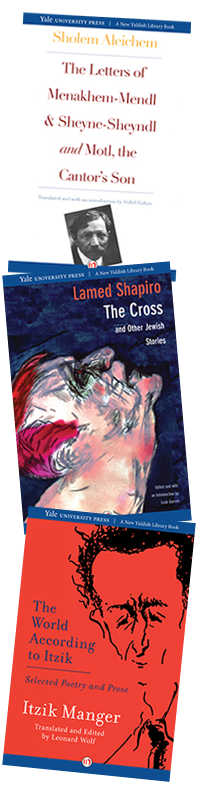
1980s for a Fund for the Translation of Jewish Literature, and who, in doing so, couldn’t have even imagined that her efforts would result in Sholem Aleichem’s Motl ending up on a Kindle.
Over the years, under the direction of the literary scholars and siblings Ruth Wisse and David Roskies, and in a partnership between
Yale University Press and my employer, the
Yiddish Book Center, the New Yiddish Library produced a series of truly excellent volumes: sharp, careful, readable translations of masterpieces of world literature, accompanied by rich introductions and footnotes by leading scholars. There are, of course, plenty of other translations of Yiddish literature by various hands and of varying quality, but the New Yiddish Library set the gold standard.
And, until now, that gold was a little pricey. Not extravagantly so — published by Yale, the volumes were gorgeously produced and inexpensive by academic press standards, but they were still mostly too costly to assign to college students. And, for that matter, more expensive than most of what’s on the tables at your local Barnes & Noble.
Thanks to a new partnership with
Open Road Media, an ambitious e‑book publisher founded by publishing veteran Jane Friedman, the books are now not just available on every device you can name (Nook, iPhone, an so on), but they’re reasonably priced. Or, to put it another way, the only thing standing between you and a genuine literary treasure — be it the stories of Mendele the Book Peddler, the gritty tales of Lamed Shapiro, or the delightful poetry of Itzik Manger — is less than what you’d spend on a movie ticket.
So, what does the e‑book revolution mean? Today it means more access to some of the signal works of literary genius in which Jews figured out how to use their language, Yiddish, to express the complexity and excitement of becoming modern. Nothing wrong with that.
Josh Lambert is the Academic Director at the Yiddish Book Center in Amherst, MA, a visiting assistant professor of English at UMass Amherst, and a contributing editor for Tablet.
Related Content: