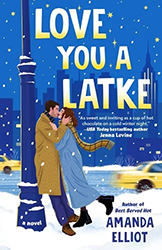
Like her previous book, Love You A Latke, Amanda Elliot’s latest novel is a romance that centers around Hanukkah. In Love You A Latke, the reader was met with an enemies-to-lovers story; in Eight Ways To Say I Love You, it’s friends-to-lovers. Shira and Leo were childhood friends, whose friendship was disrupted in their adolescence by Leo’s abrupt move out of state following his parents’ divorce. Eight years of separation then ensues, before Leo moves back to town. Unfortunately, Shira has moved across the country in that time, and is only able to see him when she returns home every year to throw her annual Hanukkah party. For the next eight years, as their careers and aspirations change, they reunite during the Festival of Lights, their romance building, receding, and building once again.
Eight Ways To Say I Love You’s structure does much to benefit the novel, particularly in the characters’ development and connection. Unlike most romances, where the lovers are placed together for a brief but intense period, this novel allows the characters to explore their lives beyond the context of their relationship, because they only meet up once a year; both struggle, at different times, to balance their desires for a fulfilling career and creative expression, and to manage the expectations of others. These periods of growth — which, unfortunately, do necessitate some expository catch-up at the start of every year — gives the characters much more depth than is typically seen in the romance genre. It also allows them, too, to swap positions, with Shira at times thriving when Leo is not, and vice versa. In that, they grow envious of the other and more reflective of their position in life, which creates compelling internal and external tension.
The novel’s focus on blending passion with career is also illuminating, if at times too on-the-nose. Shira quickly finds success in the art world, both as an artist and in working in a gallery, but mounting setbacks in failing to secure a second showing of her work and getting overwhelmed with the responsibilities at the gallery cause her to reconsider what she finds important. Does turning art into a career sap some of the energy out of it? Is chasing after a prestigious position worthwhile if it flattens your self-confidence and eats up all of your free time? These questions, which appear in Leo’s life, too, effectively demonstrate the instability that marks many twenty-something’s coming-of-age experiences, and does so in an affecting manner.
Perhaps most importantly, though, Eight Ways To Say I Love You offers endearing characters whose love for one another is earnest and well-earned. From the start, the reader can feel the connection between the two of them, the shared history, and the support they show for one another as they try to become adults in a challenging economic landscape. This is a closed-door romance, without even any allusion to sexual attraction and sexual moments, which might disappoint some readers, but it seems appropriate for a novel that focuses heavily on the holiday season and the familial warmth and wholesomeness often associated with it.
The genre of Jewish romances — and specifically, Jewish romances that center a particular Jewish holiday — is growing, and Amanda Elliot’s love-affirming writing is at the center of it.
Benjamin Selesnick is a psychotherapist in New Jersey. His writing has appeared in Barely South Review, Lunch Ticket, Tel Aviv Review of Books, and other publications. He holds an MFA in fiction from Rutgers University-Newark.