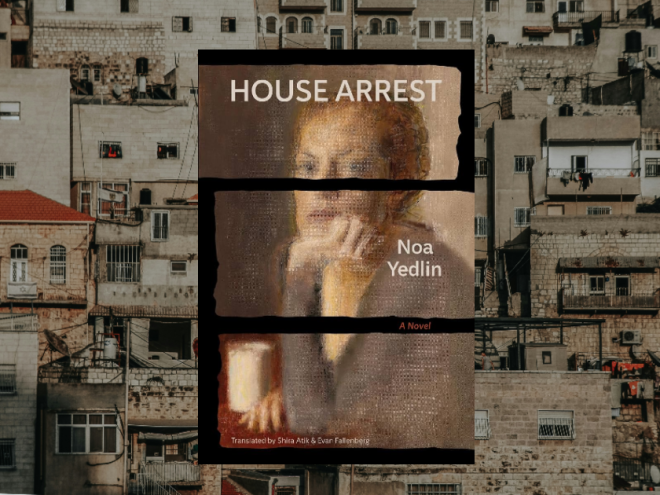
Any reader who enjoyed Jonathan Franzen’s 2001 novel, The Corrections, will likely rejoice at Noa Yedlin’s House Arrest, which recently won Israel’s prestigious Sapir Prize for fiction. Similarly sophisticated and darkly hilarious, this novel takes on the blemishes of an elite Israeli family and the decline of their entire social and political class. As resonant an Israeli comedy of manners as one could hope for, Yedlin’s novel is bursting with scathing wit, humanity, and psychological insight.
The premise of the story is simple enough: a proud, secular Jerusalem family is devastated when their matriarch Elisheva — an internationally revered cultural icon and vice-chair of the esteemed “Hirsch Center for Peace” — is charged with embezzling 3.4 million shekels. Her oldest son Barak — already unhappy in the wake of a failed marriage and struggling academic career (he bitterly resents the stature his mother effortlessly achieved as an academic celebrity) — is torn apart by the news. Matters don’t improve for him when he reaches out for guidance from his more accomplished siblings, younger brother Eitan, a renowned psychiatrist and member of the “esteemed TV doctors club,” and sister Daphna, a successful real estate agent. The adult children are naturally incredulous: “She stole money? Are you out of your mind? She’s a stick-up-her-ass Ashkenazi with a puritanical work ethic, you don’t need me to tell you that, she’s the mega-nerd from the Friends of the Philharmonic!”
Beyond its colorful portrayal of the Freudian foibles of the Fogels, House Arrest brilliantly skewers an entire cultural milieu, especially the pretensions of some liberal Israeli institutions. As one family member comes to realize: “how stuffy they all were…how conventional, despite all their glorious liberalism…They were filled with righteousness, the world was just, and they were on the right side. And they were suspicious of the weak, even if they would never admit it.” Yet alongside that caustic deconstruction, Yedlin has skillfully crafted a warmly humorous and humane novel, as empathic as it is acerbic. Her characters feel like people you know.
As Elisheva’s adult children struggle to form solidarity, the stresses of coping with the accusation of embezzled millions stir up old secrets and resentments. Rumor and rancor divide the three siblings as they anguish over the question of their mother’s innocence or guilt, what it will mean for their own lives (especially when the weekend supplements are filled with unflattering photos of their mother and barbed headlines like “Fund-Razing”), and what they owe to one another. As for the activities of the peace institute itself — a likely stand-in for The Peres Center for Peace and Innovation — the novel’s sour implication is that, aside from its lofty aspirations, it is at most an empty vessel. This may be Yedlin’s most important point when it comes to the troubled Fogel family themselves, whose material affluence is juxtaposed with so much emotional wanting and impoverishment.
One of this dark comedy’s distinct pleasures is Yedlin’s remarkable gift for sparkling dialogue; another is its fully realized characters, especially hapless Barak who confronts a devastating revelation in the novel’s final pages. Readers drawn to stories that balance both the comic and painful aspects of family dynamics will find much to savor here. If the great experimental Hebrew writer Yaakov Shabtai had chosen to write in a comic vein, this is what his voice might have sounded like, and in fact Yedlin pays him a witty homage at one point. Simply one of the best family dramas in recent memory, House Arrest is masterfully translated by Shira Atik and Evan Fallenberg, who capture all the nuances of the sharp wit and social satire of the original.
Ranen Omer-Sherman is the JHFE Endowed Chair in Judaic Studies at the University of Louisville, author of several books and editor of Amos Oz: The Legacy of a Writer in Israel and Beyond.