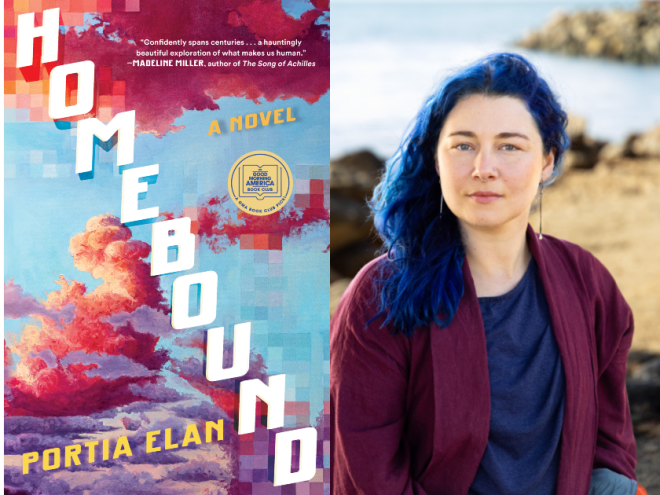
Jewish fiction is often, perhaps almost pathologically, preoccupied with the past; it’s refreshing to encounter a Jewish novel determined to imagine the future. Portia Elan’s Homebound stretches across centuries, moving from 1980s Cincinnati to a flood-ravaged world far in the future, populated by beings with artificial intelligence, scavenger ships, and fragile forms of human connection. Even in its speculative reach, it keeps circling familiar Jewish concerns: how people endure, how tradition adapts, and how stories reverberate across time.
The novel unfolds through interlocking timelines that gradually begin to reflect one another. In one strand, Becks, a queer teenager grieving her uncle — the only person who really saw her — tries to finish the text-based game he left behind. Elsewhere, a scientist named Tamar works through questions about artificial consciousness, while centuries later, a salvage captain, Yesiko, moves through a drowned world shaped by scarcity and adaptation. A mysterious figure, California Solo, threads through the book like a recurring signal.
The comparisons to Tomorrow, and Tomorrow, and Tomorrow don’t quite hold beyond the shared gaming element. Structurally, Homebound feels closer to novels like A Tale for the Time Being or Cloud Cuckoo Land, where separate narrative strands gradually begin to echo and align. Readers drawn to structurally ambitious, multi-timeline fiction will likely be more fully in step with the novel’s rhythm, and more patient with its delayed convergence. Readers might wish they had more space to live inside each character and world, though the scale of a novel like this and the coordination it requires makes that understandably challenging.
Elan’s world-building is impressive in its specificity. She writes convincingly about coding, sailing, and the practical demands of survival after climate collapse. The future she imagines feels, unnervingly, less like invention than an extension — of the flooding, addiction, economic precarity, and fraying community in the present.
In her depiction, Elan is especially attentive to how our traditions hold and evolve. At one point, centuries ahead, Yesiko encounters a Pesach plate whose symbolic foods have shifted into unfamiliar markers of loss and migration: a charred tuna bone, a shriveled round of orange, a jar of dirt. Although the ritual objects have been altered by new histories, they still signify an attempt to remember and connect.
Jewish storytelling has long been preoccupied with transmission — how stories, texts, and rituals are carried across time. This novel pushes that concern into more alien terrain, imagining what those continuities will look like years from now. With Homebound, Elan joins speculative experiments in Jewish fiction from the last couple decades, such as Michael Chabon’s The Yiddish Policemen’s Union (2007), Jonathan Safran Foer’s Here I Am (2016), and Benjamin Resnick’s Next Stop (2024). These novels explore new forms of Jewish adaptation in times of heightened pressure.
Daniella Wexler is a Brooklyn-based psychotherapist and freelance editor. A former trade publishing editor, she serves on the Emerging Leaders Council of the Jewish Book Council and offers editing services at DaniellaWexlerEditorial.com.