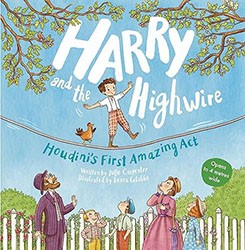
This picture book, written by Barb Rosenstock and illustrated by Mar Delmar, reveals the fascinating and little-known story of how Houdini’s enchantment with books shaped the course of his life in magic.
Rosenstock opens with Houdini in his late adult life relaxing, book in hand, at home in Harlem. Down below, a crowd has gathered in the hope that he will appear. She then takes us back to Harry’s childhood as Erik Weisz in Hungary, where his rabbi father kept his own library of perhaps one hundred books. From there, the timeline rolls forward, tracing the magician’s life in relation to books.
When Erik was four, his father moved the family with all his precious books to Appleton, Wisconsin. Rosenstock writes of the sadness Erik (now called Ehrie) felt when his father lost his
position as a rabbi there and moved east, book by book selling off the collection that Ehrie
had grown to love, too. Needing work, Ehrie cut fabric in a tie factory. One day he picked up a ten-cent biography of the famous magician Jean Robert-Houdin. That sparked Ehrie to acquire more and more used books to study and practice magic. He quit the factory to perform magic acts as Harry Houdini. Over time, he became more adept and wildly popular for escaping from myriad dramatically locked chains, containers, and situations. He performed around the world, traveling with numerous books and always on the lookout for more. Back in New York, Harry hired a librarian to help him continue to build and keep his enormous library — which totaled almost fifteen thousand printed materials about magic — in his own house.
There is sophistication of language and art in this book and that makes it appropriate for children older than the age the publisher suggests. A very young reader may think Houdini is still alive due to Rosenstock’s choice to open the book by presenting the man Houdini in the present tense. They may miss the meaning of undefined words and expressions like “prejudice” or “year after changeless year” in her spare text, but will totally understand the large “Free” when Houdini releases himself from a seemingly impossible bind.
Rosenstock’s and Delmar’s verve and care in the research and presentation of their subject captivate. The book ends with a two-page author’s note containing additional historical notes on Houdini’s collection and his life, along with online resources and a bibliography of selected sources. The illustrator follows with a two-page note, complete with details and photos about how she drew, cut, painted, and lit characters and scenes for the 3‑D diorama construction that became the book’s art. Readers of many ages will leave entranced by Houdini’s showmanship and by this book.
Sharon Elswit, author of The Jewish Story Finder and a school librarian for forty years in NYC, now resides in San Francisco, where she participates in the adult poetry community and shares tales aloud in a local JCC preschool.