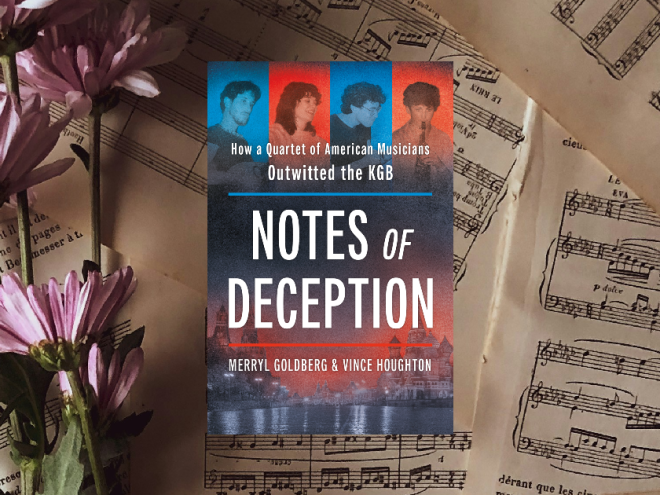
Merryl Goldberg is a professor of music and a founding member of the Klezmer Conservatory Band, one of the pioneering ensembles in the revival of the traditional music of Eastern European Jewry. In 1985, she and three of her fellow band members (Hankus Netsky, Jeff Warschauer, and Rosalie Gerut) were approached by the Boston-based group Action for Soviet Jewry to undertake a mission to visit refuseniks in the Soviet Union. Their aim was to keep open channels of communications to those who had applied to leave the USSR and had been refused permission. In many cases, the refuseniks had been subjected to harassment, job loss, and even imprisonment for their attempts to get out. Now, forty years later, Goldberg (with coauthor Vince Houghton, an expert on espionage) gives a lively and upbeat account of the band’s remarkable experience in the USSR.
Key to the success of their mission would be the group’s ability to find a way to carry information to the USSR, such as the refuseniks’ names, addresses, etc., and to take back with them details of other refuseniks and stories of their situation — all of which they wanted to hide from Soviet authorities. To this end, Goldberg (and perhaps Warschauer — their memories vary) came up with an ingenious system of using music notation to encode their information. Their system worked when several times during their trip they were interrogated by KGB agents who searched though their belongings and gave only cursory attention to their music manuscript books.
The mission was shadowed by Soviet secret police from the outset. The authorities were skeptical that these four musicians (carrying instruments as well as suitcases full of gifts and medicines for the refuseniks) were, in fact, just tourists. (Someone in the travel agency that had booked the tour may have been a secret agent for the KGB and alerted the authorities to the real nature of the trip.) In any event, the group tried to keep up the pretense for a few days while visiting Moscow, but when they flew to Tbilisi, in Soviet Georgia, they went all out to find a group of refuseniks there who performed under the name of the Phantom Orchestra, all the while being watched by agents of the KGB. After spending two music-filled evenings with the Phantoms, the group set out for Soviet Armenia to find other refuseniks, but the authorities clamped down and expelled the group.
Goldberg narrates the account in a casual, colloquial voice and presents some of their adventure and misadventures as almost comedic (as they try to outwit their ever-present shadows). But underneath the sometimes lighthearted tone is a serious tale of real dangers for the group and for the refuseniks they visited. Several of the latter wound up in prison following their visit before being allowed to emigrate when Soviet policy changed under Gorbachev.
In the long term, the movement to free Soviet Jews succeeded in permitting several million to emigrate. This book is a testament to the resilience of those who faced state oppression in order to aid Soviet Jews.