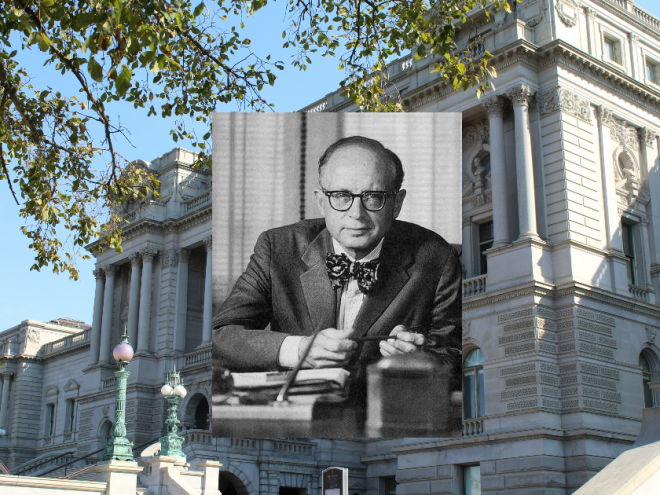
Daniel Boorstin (1914 – 2004) — a historian and Pulitzer Prize winner, and the twelfth Librarian of Congress — produced an enormous body of work, but wrote little about himself. This book, written by Boorstin’s son Jon, an Oscar-nominated filmmaker and writer, is not a definitive biography. Rather, it is a remarkable blend of biography, history, and autobiography that achieves something more important. The author effectively demonstrates that his father’s personal history bore directly upon the history chose to write, or more precisely, the history he chose not to write.
Daniel Boorstin became famous for his affirmative interpretation of American experience — optimistic and forward-looking. Yet his son reconstructs a family history involving the 1915 lynching of Jewish manufacturer Leo Frank, in Atlanta; the 1921 race massacre in Tulsa, Oklahoma; and the positive relationship Daniel’s father had with a newspaper publisher who wrote an editorial that helpedprompt the wanton carnage and property destruction in Greenwood, the prosperous Black section of Tulsa.
One might expect someone formed in the shadow of antisemitism and racial violence to produce a darker history of America. But Daniel Boorstin did the opposite. He wrote nothing about the Frank case, for example. Nor did he deal with the Tulsa massacre. Jon Boorstin argues that Daniel’s father, Sam, a first-generation immigrant, bequeathed a legacy of hopefulness to the future historian. Sam, a lawyer, who participated in Frank’s defense, concluded that the lynching of his client in Atlanta was the only possible outcome. An ambitious man, looking to help build a prosperous America, Daniel’s father shut his eyes to certain injustices and moved on. Jon argues that Sam’s resigned response to both the Leo Frank episode and the Tulsa conflagration helped shape Daniel’s “trademark optimism,” and his future as an historian who emphasized community over disaffection, agreement over dissension, and positive events over those that drove Americans apart.
In his twenty-three volumes of history, Daniel Boorstin wrote about what Jon calls the “distinctive qualities of enterprise and ways of working together that made America a unique place.” A nation built on possibility and hope. But his father omitted some of America’s cruelest episodes of injustice. Boorstin’s liberal students were irked by these omissions, and they were dismayed when they discovered that their professor, a former Communist, had “named names” in his 1953 testimony to the House Committee on Un-American Activities. Some even boycotted his classes. He experienced more of this kind of controversy in the 1960s during the War in Vietnam.
Daniel Boorstin felt threatened by what he perceived as a new atmosphere of dissension and distrust on campus. He called student protestors naïve and self-interested. He further alienated himself from student activists, feminists, and leftists in general with his stance against affirmative action. He feared, he said, the development of “the Quota States of America.” Boorstin’s political positions, and his distance from the social revolution of the late 1960s and 1970s, distinguished him from many of his colleagues and from many secular Jews, who, unlike Daniel, were more often to be found on the liberal side of the political spectrum.
Boorstein stressed continuities in American history rather than radical changes, and with his emphasis on a positive, nearly conflict-free American story, he has given us a skewed picture of our past. His interpretation is nonetheless important. Though he pays too little attention to many traumatic episodes in our history, he allows us to imagine what American society might be like if we moved toward building a society that binds us together, more than it tears us asunder.