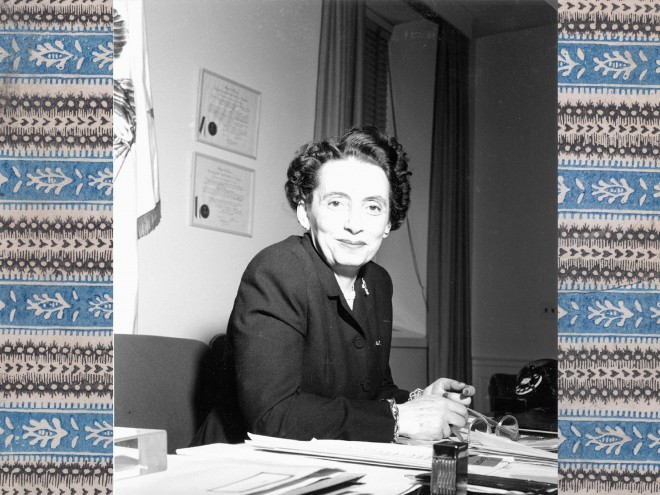
In a profile in The New York Times, a reporter described his subject as “a slip of a woman … her hair carefully dressed, her clothes chic.” As for her manner, “She radiates a spirit of friendliness.… Her straightforwardness inspires confidence, her informality cuts red tape.”
The year was 1935, and the woman was Anna M. Rosenberg, age thirty-three, Regional Director for New York of President Roosevelt’s New Deal agency, the NRA.
This was only the beginning, however. Rosenberg went on to serve Roosevelt in various capacities, and she continued her service with Presidents Truman, Eisenhower (mostly behind the scenes), Kennedy, and Johnson, eventually reaching the pinnacle of her career as US Assistant Secretary of Defense.
In 1968, after the Selma march and Johnson’s decision to not seek re-election, he wrote to her, “[T]here is no judgment I value more highly than yours.… Bless you for being a true friend across all these years.” He could be said to have spoken for the many who worked with her.
Her rise into the highest political echelons was notable not only because she was a woman at a time when such roles were largely filled by men, but also because she was a Jewish immigrant who had come to New York from Hungary in 1912.
She played vital roles advising presidents through the Depression, World War II, the Korean War, the Cvil Rights movement, the Great Society, and more. Once a household name who was regularly voted one of the country’s most admired women (often following right after her friend Eleanor Roosevelt), today, Anna Rosenberg is mostly unknown. For this author Christopher Gorham offers several explanations, including the fact that she refused to write a memoir. She also used the telephone more than the letter or memo to communicate, mostly to avoid having a written record. She was content to stay in the background.
One possible critique of Gorham’s book is that it does not linger on Jewish issues. During the war, one wonders, did Rosenberg join efforts of Jewish leaders to persuade the government to allow more Jews into the country? Roosevelt did send her to Europe in 1938 and 1944. Then, in 1945, after FDR died, Truman sent her again, and she visited the just-liberated concentration camp Nordhausen — “a scarring experience” for her, Gorham writes. What exactly that experience entailed is not clear.
Nevertheless, the story of this “pint-sized hurricane” is a remarkable one. It is told in an engaging, dramatic manner that allows the author to convey the dynamism, energy, and determination Anna Rosenberg gave to all her activities, as well as the gratitude she felt towards her adopted country.