People love pickles. This is the premise of The Pickled City, a new history of American — and particularly New York City — pickles by Paul van Ravenstein and Monique Mulder. This is the duo’s second pickle history; their first, De Zure Stad (2022), chronicles the history of pickle production and consumption in Amsterdam, which was profoundly Jewish. Realizing that this was not unique to the Netherlands, and that American pickle production was not devastated by the Holocaust, the duo turned their attention across the pond where the pickled cucumber gained greater prominence and symbolism in the twentieth century, tied to immigrant cultural identities and experiences, and most recently, nostalgia.
As Sandor Ellix Katz, the doyen of modern fermentation, explains in the foreword, “almost anything can be pickled” though none are “more evocative to me than sour pickles.” This book acknowledges the many global pickles, but focuses on the rich history of fermented cucumbers that have become a) identifiably Jewish in many parts of America, and b) the foundation for the modern renaissance in pickled food in the past few decades. They are simultaneously plebian, the most basic of preserved foods that provide robust nutrition and diversity during the winter months, and can be quite bougie. They can be enjoyed at artisanal farmer’s market stands, your local deli, and most every burger restaurant across the country, making them a multibillion-dollar industry in America.
In the nineteenth century, pickle production became “a distinct industry in New York, particularly in the immigrant neighborhoods of Manhattan’s Lower East Side.” While this may not surprise most readers who grew up with family stories of Guss’ Pickles, Russ & Daughters Cafe, Ratner’s, and the ubiquitous pickle that came with a deli sandwich, it is a story that had not been previously documented and researched. There were over 1,500 kosher delis in New York City in the 1930s, not to mention hundreds of appetizing stores, pickling companies, and pickle vendors.
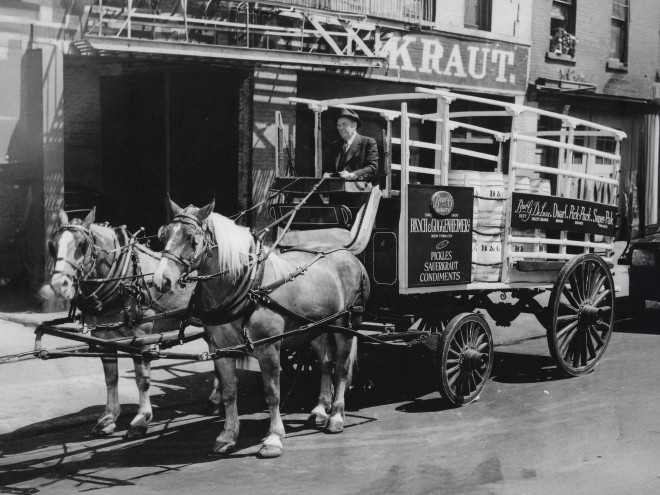
Depicted with dozens of archival images of pickle manufacturers, stores, and businesses, The Pickled City serves as an archival exhibit to the American Jewish pickle industry. In these pages you will get a taste for how Jacob Vlasik, an immigrant from Slovakia; Joseph Bloch and Julius Guggenheimer (B & G Foods), immigrants from Germany; and the Weishaus family (United Pickle), whose ancestors came from the Russian Empire, built their respective pickle empires, which are responsible for nearly one of every three American pickles today. You will also learn about the prestigious pickling lineage of Alan Kaufman and The Pickle Guys, the iconic and last-standing pickle-only store in the Lower East Side, which traces its yikhes (meritorious heritage) through Guss’ Pickles, The Pickleman (Lou Lichter), and L. Hollander & Son.
Through these pages you will learn a lot about the humble fermented vegetables, fruits, and fish that were once ubiquitous on the Lower East Side and that have sustained Jews and people around the world for millennia. It’s a delightful and light read that may also leave you salivating, ready to polish off a smorgasbord of pickled herring, horseradish, and gherkins … or perhaps just a half-sour to tide you over until your next meal.
Avery Robinson is a Jewish nonprofit professional living in Brooklyn. In his spare time, he freelances as an editor, culinary historian, cofounder of the climate change nonprofit Rye Revival, and manager of Black Rooster Foods. His writings have appeared in Marginalia Review of Books, Jerusalem Post, TabletMag, and The Forward.