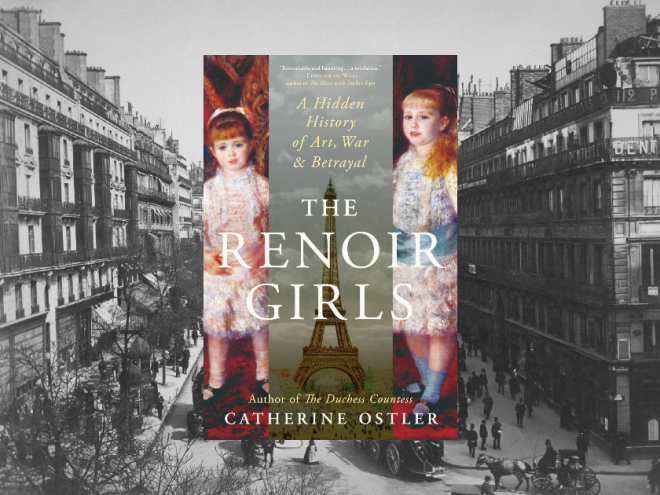
The early years of the Belle Époque were a golden age for Jews in France. With the Enlightenment, religious freedom, and the flourishing of arts and business opportunities, life seemed to be brimming with endless potential. Alas, this illusion was not to last. In The Renoir Girls, Catherine Ostler details how even the most gilded families were not insulated from antisemitism and the ravages of war.
This book explores the lives of Elisabeth and Alice Cahen d’Anvers, the subjects of Pierre-August Renoir’s 1881 dual portrait, Pink and Blue. The experiences of these sisters and their family exemplifies how rapidly French/Jewish life and society changed during this period. In the 1870s and 1880s, the Cahen d’Anvers banking family made a name for themselves in French high society. They socialized with the Rothschilds and French aristocracy, regularly hosted Marcel Proust and other writers at their salons, went hunting with European nobility, and were patrons of all the right arts and sports (notably horseracing and boating). On the one hand, The Renoir Girls is a story of the 0.01 percent, the upper crust (gratin). And on the other, it is a story of a Jewish family navigating timeless questions of love, war, marriage, and divorce, as well as pressures of modernity, including dilemmas about conversion and safety.
Ostler vividly describes the salons and parties at the Cahen d’Anver mansion in Paris and their rustic restored palace in the countryside with gusto. She also details other social events, fundraisers, and opportunities to show off the marriageable Cahen d’Anvers daughters. Ostler wonders, “How is anyone meant to flirt without dancing?”
Dancing. Horseback riding. Boating. Traveling around Europe, and across the world. This book describes a world in motion mirrored by Renoir’s impressionistic style. Impressionism, with its focus on movement and fleeting, transient light, elegantly captures such contemporary life as it is lived personally and publicly. This modern art movement eschewed the idealized and the mythic for the here and now.
Ostler similarly avoids the mythic. She mulls over the quotidian lives of the Cahen d’Anvers and their inner circle. She dwells on beautiful, vibrant, and innocent aspects of their existence — the pinks and blues, the laces and silks — but also the nearly decade-long Dreyfus Affair, increasingly toxic antisemitism, the patriotic deaths of the Great War, and the tragedies of the Holocaust. In doing so, Ostler provides a heavily detailed history of these critical junctures in modern French and Jewish life through the story of this once-renowned family and their lesser-known stories.
This is a modern biography that tends toward comprehensive over representative. It ends in Auschwitz and America, but is defined by the gilded salons and French gratin of late nineteenth to mid-twentieth century France.
Avery Robinson is a Jewish nonprofit professional living in Brooklyn. In his spare time, he freelances as an editor, culinary historian, cofounder of the climate change nonprofit Rye Revival, and manager of Black Rooster Foods. His writings have appeared in Marginalia Review of Books, Jerusalem Post, TabletMag, and The Forward.