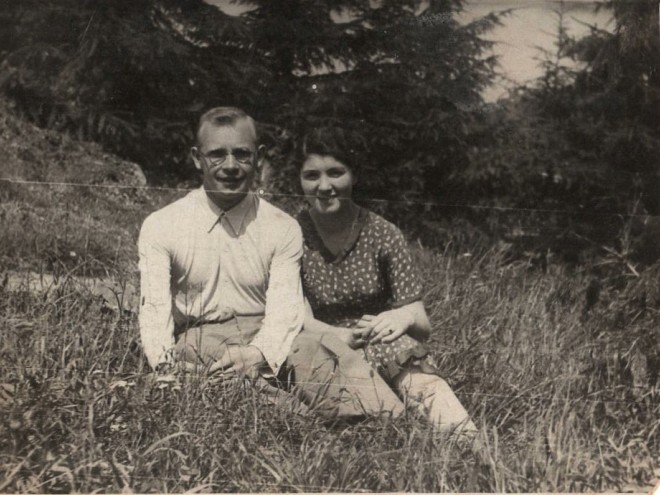
When she first met Talia Inlender, an immigration lawyer and the woman she would marry, Daniela Gerson, an immigration journalist and academic, was astounded to learn their grandparents had been neighbors in a town in southeastern Poland named Zamość — a place where Jews had lived for centuries while always “knowing the uneasy balance between tolerance and hate could tip at any moment.” Inlender was the first woman Gerson dated, and it’s their shared family connection that gave the relationship a sense of familiarity, while jolting them into a common quest to learn their family stories. Gerson’s relatives gave oral testimonies and advocated for recognition of the Nazi destruction of Jewish Zamość. The Inlenders were more closed-mouthed, but with Gerson’s persistence and resourcefulness — she even got the Kremlin to honor an information request — both families’ histories, and mysteries, emerge in The Wanderers in impressive detail.
The Nazis occupied Zamość on September 12, 1939. After the Soviets signed a nonaggression pact with the Germans, the country was divided up between the two powers and Zamość came under Russian control. Days later, the border between the two territories was moved and Zamość was once again in Nazi hands. Gerson’s family fled to Soviet-controlled Lviv. But living conditions were deplorable in the crowded city, and Gerson’s grandparents, like everyone else, dreaded the Soviet secret police. Meanwhile, back in Nazi-occupied Zamość, Jews were suffering a thousand indignities; but for the time being, at least, they remained in their homes and could work. Those who’d stayed in Zamość begged their relatives who left to come home. And so when the Communists offered Gerson’s grandparents the chance to become Soviet citizens or return to Nazi-occupied Poland, they, like almost all Jews in their position, made the decision, unimaginable to us now, to return home.
But for the Soviets, Gerson points out, there was no such thing as a refugee; “either you are a citizen or a spy.” Gerson’s family had been tricked into proving themselves ingrates, unworthy of being Russian citizens. Just as they’d originally feared would happen if they chose to stay, they were shipped to the Gulag, along with many other Jewish and non-Jewish Poles, through forests whose endlessness Gerson never lets you forget. Although her family didn’t technically end up in Siberia, that was always what they called it, the rural camp whose inmates — many of whom were unfit for the hard manual labor they were now forced to do — lived in misery under the eye of armed guards. Any idealism Gerson’s grandfather once had about workers’ paradises was gone.
In August 1941, after Germany attacked the Soviet Union, the Soviets allied themselves with the Polish government in exile and were obliged to free Polish political prisoners, a quarter of whom were Jewish. The Gerson siblings and their spouses knew that they must find their way back — but how and to what? They’d been shipped in hellish boxcars thousands of miles east, and now they headed in the other direction, across the vast dry Central Asian plains.
The Wanderers sometimes reads like an action thriller, where Gerson, pursuing a lead, moves from one exotic (to me) locale after another — Zamość, with its huge tourist-friendly market square, Lviv, Tashkent, Warsaw, Vienna, Tel Aviv. Inlender’s family went to Israel; the Gersons, the United States. Gerson’s deeply personal family story also traces the steps taken by hundreds of thousands of other Jews, including future Israeli prime minister Menachem Begin, who survived the Holocaust in a way that’s little known today. But with the creation of the state of Israel, a new round of suffering and displacement began, with Arabs as the wanderers, an irony that Golda Meir ruefully acknowledged. The Wanderers is a book that can’t fail to stir the reader’s conscience, especially today, when nationalism is on the rise and immigrants are demonized.
In the end, only about four percent of Poland’s 3.3 million Jews who remained in the country survived, compared to ninety percent of those who’d fled to the Soviet Union. The latter “had suffered deportation to the Gulag, forced labor in communal farms, or conscription into the Red Army. But they were alive.” The beautiful life that Gerson shares with Inlender and their children was made possible by the struggles of their ancestors, their determination to keep moving until they found a home where “they could be free to live with those they loved, to protect and grow this spark of life from one generation to the next.”
Jason K. Friedman is the author of the story collection Fire Year, which won the Mary McCarthy Prize in Short Fiction and the Anne and Robert Cowan Writers Award. His article on the Solomon Cohen family, published in Moment magazine, won an American Jewish Press Association Award. He lives in San Francisco, with his husband, filmmaker Jeffrey Friedman.