Join a community of readers who are committed to Jewish stories
Sign up for JBC’s Nu Reads, a curated selection of Jewish books delivered straight to your door!
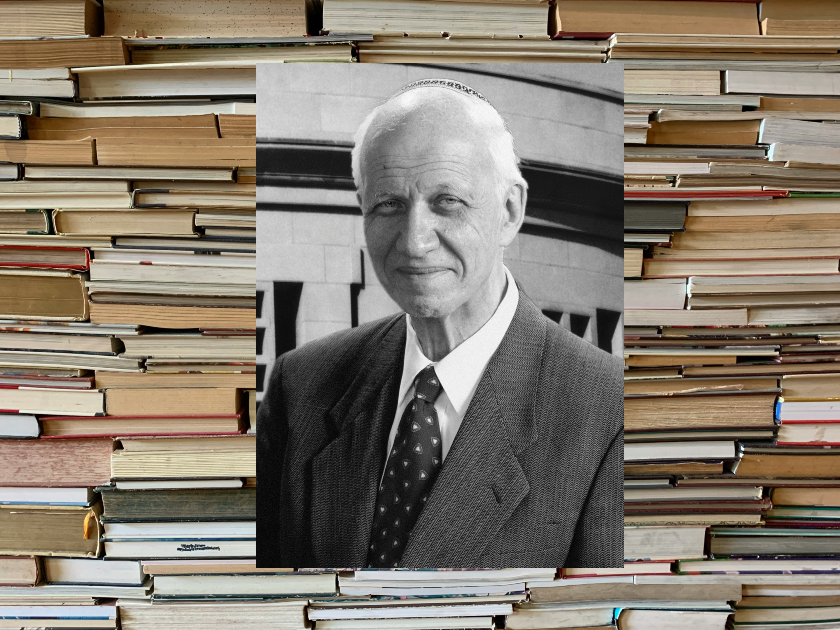
Rabbi Irving “Yitz” Greenberg, winner of the 74th National Jewish Book Award for Lifetime Achievement, is a pivotal figure in modern Jewish thought. His theological work has played a key role in redefining post-Holocaust Jewish identity and theology. His latest book, The Triumph of Life: A Narrative Theology of Judaism, is the culmination of a lifetime of scholarship and leadership in Jewish life. It is a compelling, inspiring, and powerful articulation of a Judaism rooted in the sanctity of life, the dignity of every human being, and the moral imperative of tikkun olam.
Using the format of her podcast, The Five Books, host Tali Rosenblatt Cohen interviews Rabbi Greenberg about the books in five categories that have profoundly influenced his life and work.
Tali Rosenblatt Cohen: What is a book you read as a child that helped shape your Jewish identity?
Yitz Greenberg: I would say Megillah, a tractate of the Talmud. Let me start with some background. My father was born in Poland to a very poor family, and his father died when he was five or six. He was the youngest child, and his mother couldn’t support him, so she sent him to a yeshiva at the age of eight or nine. For boys who were brilliant enough, the yeshiva would waive tuition and provide housing and food. However, they couldn’t offer regular meals. My father depended on families inviting him to eat with them; if they did, he ate, if not, he went hungry. Because of his wit and his ability to entertain, he literally sang for his dinner.
When he grew up, he came to America, where he taught Talmud. He was a loving parent but he struggled with the day-to-day. He never played basketball or chatted with us children. He expressed his love by studying Talmud with us, including my sisters; he was ahead of his time in that way. Being loved through Talmud study was a deeply positive experience for me.
One summer, when I was eleven or twelve years old and in the highest elementary yeshiva class, we had an excellent Talmud teacher. In the summer, he invited us to study a full tractate of Talmud — Megillah Esther, about twenty pages — with him to give us the joy of completing a whole book of Talmud. This launched my lifelong study of rabbinic texts, which is tied to feeling loved, family, and appreciating the big-picture perspective.
That emotional attachment to Talmud made studying pleasurable beyond school and prepared me for my studies at Beis Yosef, a yeshiva of European-level intensity founded by refugees — something I otherwise wouldn’t have managed. And without that background, I wouldn’t have pursued smicha, rabbinic ordination. While I cherish the Bible, the Talmud became central to my personal life, career, and Jewish vision.
TRC: What is a book you read as an adult that has impacted your relationship to Judaism?
YG: The most religiously influential books I read in college weren’t written by a Jew, but by the great American author Nathaniel Hawthorne. I fell in love with his works and read them all.
Hawthorne emerged from the Puritan evangelical tradition. He anticipated the question of divine presence, showing that religious questions persist even in a blank, uncaring world. To this day, Hawthorne influences me as I keep wrestling with those questions despite my modern influences and my rational tendencies.
In graduate school at Harvard, I came into the orbit of Rabbi Joseph B. Soloveitchik. When I became the rabbi of the Young Israel of Brookline, I grew close with his sister Anne Gerber’s family. Anne gave me a copy of Halakhic Man, which had been published in Hebrew in an obscure journal and wasn’t translated into English until the 1980s. I was lucky to read it early. This book shaped my adult religious vision more than any other.
I was particularly struck by the idea that Judaism identifies with life. In the Bible, life is supreme — you can’t enter the Mishkan, the Tabernacle, if you’ve touched death. Priests avoid funerals. Rabbi Soloveitchik’s PhD in philosophy helped him learn to ask big questions: How do you approach life? How do you experience God’s presence?
A major theme in Halakhic Man is that Jewish law is not just about routine observance. On the contrary, it’s supposed to be highly creative, inspiring us to constantly reconceptualize our experience of life.
TRC: What book, not necessarily Jewish, changed your worldview?
YG: The Structure of Scientific Revolutions by Thomas Kuhn was that book for me. I struggled to reconcile modernity and tradition — Western culture and ancient Jewish rabbinic culture; it was a great challenge to integrate the two.
Kuhn, who was a historian and philosopher of science, challenged the notion that science was objective, based on data and the mastery of reality, while religion was thought to be based on myth and hope. He argued they both are built on paradigms, organizing narratives that shape what evidence is collected and how it’s interpreted.
This insight transformed my view and became central to my work. Science and religion give us different ways of organizing reality, but they don’t conflict. Facts of one don’t contradict the other. This way of thinking became a model for how I understand all disciplines — science, medicine, culture, and religion.
TRC: I’d like to hear about your latest book, The Triumph of Life: A Narrative Theology of Judaism.
YG: The central paradigm guiding my understanding of Judaism is redemption. The paradigm for redemption is the story of Exodus, and is about perfecting the world, which is also an expression of messianism — the promise to overcome all enemies of life. When you look at Jewish observances, you might see some harsh or troubling aspects. There is unequal dignity for women, values hostile to gay people. The question is whether this data is definitive or decisive, or whether you can understand these ideas as organized around the theme of the triumph of life. The desire to perfect the world means that we can overcome poverty, hunger, discrimination, inequality, injustice, and war.
This broad understanding of Judaism as a religion of life is the central theme of my work. I believe only such a version of our religion can survive and flourish. We are living through one of the great transformational ages of history, where every religion and way of life is exposed to every other. The only form of Judaism, or any religion, that can survive is one that is able to open itself up to and develop distinctive values that fully embrace and celebrate life — not presenting others as evil or inferior, but with Judaism as a vital alternative.
I believe this leads to a higher level of religion. I’ve tried to write a book that articulates the great themes of life’s supremacy, the universality of the image of God, and the intrinsic dignity of every person. I think the Torah was always meant as a guide not just for the Jewish people but for the whole world. It doesn’t start with the first Jewish law in Exodus, but with the creation of the world.My central claim is that tikkun olam is not a modern liberal invention or a political slogan dressed in Jewish language. It is the contemporary articulation of messianism, which means that we don’t accept the world as it is, but work to repair it. The Jewish promise says that this world can be repaired. God wants it repaired and has offered us a partnership — a covenant — to restore the world to a place where life overcomes hunger, poverty, war, and sickness.
Don’t accept the status quo; transform it. Work with allies — God, past generations who began this process, and non-Jewish groups committed to repair. Judaism says you can win; you have God’s promise — but you must do your share and work hard.
That is the theme of the book: the promise to turn the world into paradise in our hands. This partnership with God has existed in three stages: the biblical stage, when the Jewish people were more passive and directed by God; the second stage of equal partnership, when God self-limited and humans took more responsibility; and the third stage — now — when God is completely hidden and yet everywhere — in your home, hospital visits, daily life — and so you must uncover that presence.
God does more miracles than ever, but these are not supernatural violations of nature. They are human achievements: Zoom calls, open-heart surgery, pacemakers. These are miracles derived from understanding and harnessing natural laws.
This attempt to perfect the world applies to all human activities, for example, work that pays fair wages and provides dignity versus labor conditions that cause harm. We must prioritize life in every action, continually studying and maximizing life while minimizing death and harm. This is the core of halacha; it’s not just ritual law, but a guide to ethical living.
TRC: Tell us about a book you are enjoying at the moment.
YG: I’m in the middle of The Art of Diplomacy: How American Negotiators Reached Historic Agreements that Changed the World by Stuart Eizenstat. It’s a study of how diplomacy and a vision of soft power can make major contributions to improving the world. Stuart Eisenstadt explores how America’s diplomatic engagement has had powerful effects. Eisenstadt himself helped secure reparations for Holocaust survivors and pressured Swiss banks to release huge amounts of money taken from Jews killed by Nazis. His achievements exemplify how diplomacy and human effort can create a better world or peacefully resolve great challenges
Tali Rosenblatt-Cohen lives in NYC with her family. Her writing has been published in New York Family Magazine, The Forward, The New York Jewish Week, and Lilith Magazine.