Join a community of readers who are committed to Jewish stories
Sign up for JBC’s Nu Reads, a curated selection of Jewish books delivered straight to your door!
Background photo by Christina Deravedisian on Unsplash
“Have you ever heard of a shiviti?” Emily asked as I shrugged bashfully. “It’s a typographic ornamentation of the Torah that was once deemed heretical but is now received as sacred.” Inspired by this inversion of value and meaning, Emily, a fellow Philadelphia comix maker, took the passage in Exodus about invading frogs and reimagined it as the ICE-protesting mascot frog pictured below. Emily’s reinvention of the shiviti resonated with me, especially now, as the season of Purim is upon us and the rebellious ribaldry of the story of Esther reappears in our lives. But like a whitefish-filled hamantaschen, something about this season of code-switching feels especially peculiar, and kinda off.
The revenge fantasy within the Book of Esther hits differently in a post – Oct. 7 world. And when the authoritarian king’s sinister, xenophobic advisor is the Jewish character , it makes one wonder what an Elphaba-style treatment of Haman would look like.
The world we live in is more topsy turvy than the streets of Shushan. How do we flip what’s already flopped?
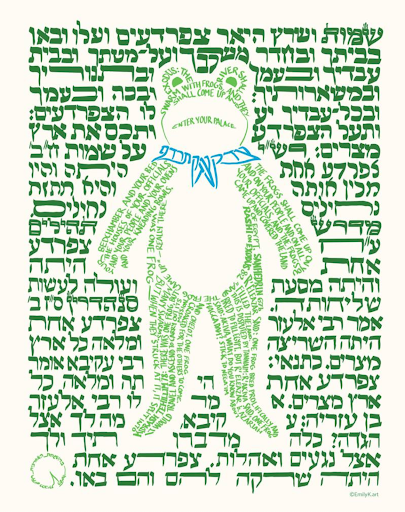
Tzefarde’a Tzedek (Frog of Righteousness) — Illustration by Emily K, 2025
If ever there was a moment to challenge our preconceived notions about our relationship to Purim, it is now. It’s time to read against the grain of the text and move past the surface tale of racial prejudice and court intrigue. Taking a page from rabbinic pedagogy, let’s utilize the Pardes framework to delve into the narrative in new and unique ways. How can we drash (wander) our way to new aha moments with Esther?
In this tale that postulates that one member of the tribe can imperil us all just as another can lead to our salvation, can we find the blessings of a skinned knee? Alone and together, like our Jewish ancestors of the Persian empire, we know the stress of having a precarious status among other nations. Alienated from our homeland for millennia and now from each other and our cohabitants on earth, we feel the fracture. Like every character in Megillat Esther, we as a people are in rebellion. As the Jewish electroclash icon Peaches recently proclaimed, “We need lube to smooth out the friction in the world.” What better time to rail against ourselves and the machines that made us?
To sensitive readers, Megillat Esther is akin to maneuvering through a minefield of stereotypes and cliches about women, queerness, and being “Judean.” From Vashti and Mordechai to Bigtan and Teresh nearly every character is engaged in some form of rebellion. And our protagonist? She is the boss bitch who kills her enemies’ sons and then hangs them on a tree, Vlad Tepes (the historical basis of Dracula) – style. “If I perish, I perish,” she cavalierly quips like a modern day heroine. Esther joins a long lineage of badass women in Jewish literature who rebelled against the status quo. From the nonchalant transgression of Eve tasting a forbidden fruit to the more John Wick approach of Yael or Judith, one can almost imagine Esther shouting, “Fair is Fair!” like a defiant Helen Slater in the 1980s classic film The Legend of Billie Jean. Both casual and deadly, Esther is defined by a series of rebellious acts. Just like the shiviti, she becomes the opposite of where she began, the outsider ruling from within;she is like tzitzit gathered together during tefillah, the fringes touching the whole.
In his early-aughts polemic, Nothing Sacred, Douglas Rushkoff posited that “radical reinvention was not merely Judaism’s birthright, but the ongoing and defining character of the Jewish experiment. It is a way of maintaining continuity with the past while allowing for a faith to evolve into the future.” Rushkoff articulates what fuels conspiracies about Jewish people while also driving the engine of our survival. We’re still here. Welcome to the rebellion.
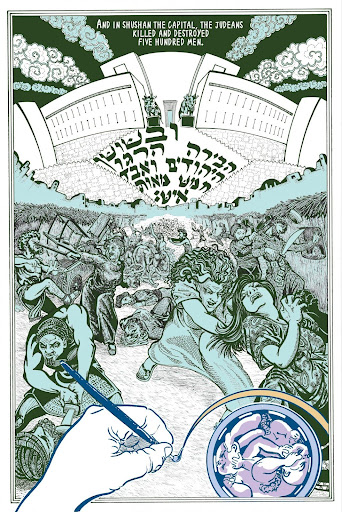
Art by JT Walduman from Megillat Esther: The Graphic Tale
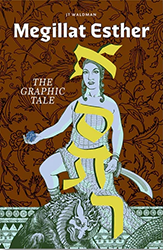
Megillat Esther: The Graphic Tale by JT Waldman
JT Waldman is a comic book creator and educator. In addition to Megillat Esther, he is best known for his collaboration with Harvey Pekar, Not the Israel My Parents Promised Me (Hill + Wang, 2012). He has contributed to several edited volumes that detail the intersection of comic books and Judaism, including From Krakow to Krypton (JPS, 2008), The Jewish Graphic Novel: Critical Approaches (Rutgers, 2010), and Colonial Comics (Fulcrum, 2014). In 2015, Congregation Keneseth Israel in Elkins Park, PA commissioned Waldman to create a site-specific comic book that decoded the monumental stained glass windows in their synagogue. JT conducts lectures and workshops around the country on topics ranging from comic books and religion to visual narratives and midrash. His current project, America’s Chosen Spirit, is an alternative history webcomic and transmedia project about untold bourbon backstories. He lives in Philadelphia.