Join a community of readers who are committed to Jewish stories
Sign up for JBC’s Nu Reads, a curated selection of Jewish books delivered straight to your door!
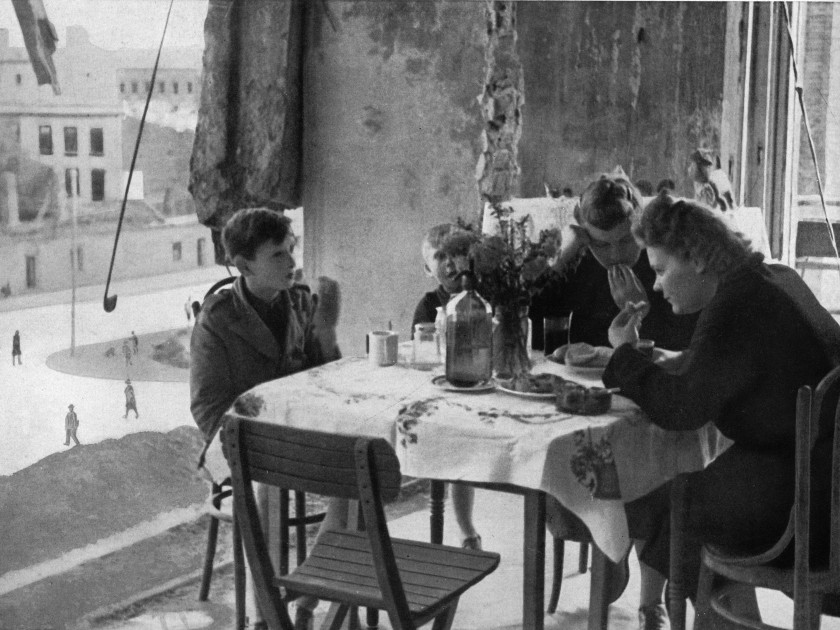
Daily life rising from the rubble, Warsaw 1948
Karol Szczecinski, East News
Feliks Haasman stepped off the train at Łódź Fabryczna and did not look around. Because what for? He could have found his way back to his childhood home if he were blind.
Thumbs hooked under rifle strap, he took Targowa Street up to Piłsudskiego, and hung a right onto Kilińskiego. If he chanced on a familiar storefront, he calmly refocused his gaze. A different man might have searched the faces passing him, but Feliks considered himself a realist. He already knew he would recognize no one he wanted to see.
The entrance gates to his building’s courtyard on Piotrkowska Street stood open. He crossed the cobblestones and stepped inside the vestibule. It smelled, as always, of damp stone and boiled carrots. The stained glass of the stairwell’s windows had been knocked out in places, and as Feliks took the stairs to the fourth floor, unfamiliar slashes of white light fell onto the winding banister, exposing a layer of dust.
As he’d expected, the mezuzah on his family’s doorframe was gone, as was the brass plate inscribed with their name. A modern lock had been installed above the old keyhole. But the carved art deco numbers on the door had been left alone. Feliks ran his fingertips over the four and the two. A sculptor friend had brought over the chunk of Cuban mahogany one afternoon when Feliks was just a boy. Tata had gone to work on it immediately, dancing his knife through the sweet-smelling wood right in the middle of the salon.
Sweetheart, have you lost your mind? I just had that rug cleaned yesterday!
Mama’s voice, its teasing lilt, sounded so real … He shook off the memory and knocked. Firmly but, he hoped, not arrogantly. He’d heard the stories: people killed for the crime of showing up unmurdered at the doorsteps of their family homes. But if being a soldier these last six years had earned Feliks anything, it was the right to take an impulsive risk, and call it bravery.
Eternities passed before Feliks heard footsteps shuffling toward the door. He’d been waiting, against all reason, to hear the sharp click of the heels Mama had always insisted on, even inside the house.
The door cracked open. Darting eyes peered out. A woman — slight, inconsequential. Good. Feliks was quick to make his business clear. “I want nothing, ma’am. I’m here only for an old tin my mother left in a credenza … in the second bedroom on the left?”
The door closed. He heard the scrape of metal as the chain was unlatched. When she’d let him inside and locked the door behind him, the woman drew her cardigan tightly across her chest and set off down the hallway. Feliks followed, settling his gaze on a hole in the beige wool at her shoulder.
Even as he did his best not to look, he could not help noting:
The mottled pink splotch in the corner of the dining room, where his brother, Bruno, had chucked a freshly peeled beet when Poland was knocked out of its first World Cup.
Curiously shaped patches on the walls where the paint looked brighter. It took Feliks a moment to realize they were where his father’s metalwork had once hung.
That the floor still creaked in the same spot in front of the bathroom.
And that all his parents’ furniture was gone.
Feliks lowered his shoulder, letting his rifle slide down into his hand. If the apartment had been pillaged, how was he to believe that the one thing he came for remained? Was this meek, mute creature leading him into some sort of trap?
The woman entered Bruno’s room. Feliks came up behind her and scanned the space over her shoulder. There it was: the walnut credenza, a phone book where one of its fluted legs used to be. In the corner, next to the window, stood Bruno’s bed. A sullen adolescent leaned against the headboard, his bony knees pulled up to his bare chest. Gently, Feliks placed the rifle back over his shoulder.
The woman crossed the room. “You’ll excuse us, Officer.” She wrestled an undershirt onto the boy’s narrow frame. “My son, he’s unwell. He removes his clothing, picks wounds into his own skin. He won’t answer if you speak to him … There’s nothing I can do.”
“Please, don’t concern yourself for my sake.”
When his mother finished dressing the boy, Feliks nodded at him. But the child did not respond. His attention was focused on a length of thread that he was winding tightly around his slender index finger.
The woman knelt before the credenza, and pulled open a door by a twig wedged into its keyhole. Feliks noted that the delicate rosette moldings that had once adorned the piece were gone. “It’s a miracle, really — my husband threw the photographs away at first. He thought it was morbid to keep them in our home, but the truth is, this isn’t our home, is it? We were only just placed here. They’re of your family, then?”
“Who else’s, ma’am?”
The woman reached inside the cabinet and pulled out the blue tin. “I brought them back up from the street. I knew … it’s odd, but I knew that one day you would come. I was certain of it. Such a beautiful family, a joy to look at, all those lovely children. How many of you are there?”
“There were four of us.” Feliks could not help the rancor that had crept into his voice. The woman looked down at the tin in her hands. “I’m sorry.” She wiped the dust off its lid with the baggy sleeve of her sweater. Feliks heard whispering. He turned to the bed. The boy winced and again averted his gaze.
The woman handed Feliks the tin, and moved to lead him out. At the door, she turned back to him. “You know, Officer, three families shared the apartment when we first got here, but the others were moved. I don’t know where. And now it’s just us. Our village was destroyed. You understand, we had nothing. Nothing.”
She mentioned the name of her hometown, but Feliks had never heard of it. The beige sweater she was wearing, though — he recognized that. It was Tata’s. Mama had bought it for him at Vogel’s, up near the intersection with Jaracza Street, but Tata had hated it. He had something against cardigans — they reminded him of schoolteachers.
“My husband works for the railways, laying track. He works very hard. It’s a month sometimes before he comes home. Because of his job, we were pushed up the list for resettlement and … well, here we are. Where else could we go?” She looked helplessly at Feliks.
A cloying odor permeated the room. Lily of the valley. But how, when this was almost October? Feliks yearned to be back outside. He should say goodbye. But the walls bore down on him, immobilizing him. Blaminghim. For the rot that had appeared on the floorboards, the water stains spreading across the ceiling. The scent intensified, a field of putrescent flowers, and now he heard a hum, as if from very far away. A woman’s voice. He strained his ears, and the melody took shape. A Tuwim piece? Yes, a cabaret song, out of an old spy film. One of Mama’s favorites. It grew louder. He could make out the lyrics. Love will forgive you anything …
He saw her then: a tall figure in a long, satiny blue dress standing with her back to him in front of the credenza. Her dark hair was swept up in a bun, loose tendrils at her neck. She positioned a vase of white flowers, their tiny bowed heads shivering, on a hand-embroidered doily.
A loud crash cut off the song, and Feliks saw he was alone. Alone, that is, with the birdlike woman, who rubbed her hands against Tata’s sweater, asking him if he was okay, if he needed a glass of water, if she should call someone — there was a doctor two courtyards away, a gynecologist, but very kind. At Feliks’s feet lay several dozen photographs. He had let the tin drop to the floor.
He couldn’t find the words to make the woman stop talking. She knelt down in front of him. Her fingers raked the scattered images into a pile. There was Bruno, between goalposts on the school’s football field, frozen in mid-movement, poised to spring back to life.
The woman picked Bruno up, returned him to the tin.
The hum sounded again, faint now. Feliks made out only snatches of melody punctuating a discordant buzz. He took one last look around the room. There was no doily on the credenza, and certainly no lily of the valley.
If being a soldier these last six years had earned Feliks anything, it was the right to take an impulsive risk, and call it bravery.
Feliks adjusted his rifle strap. He took the tin the woman had refilled with his family photographs out of her hands and, saying nothing, left the room.
The woman came up behind him as he spun the new lock. “Please, Officer. There’s a trick to it.” He moved aside, and she let him out of the apartment.
In the hallway, he found his voice, and his manners, and thanked her.
“There’s nothing to thank me for,” she said. “They are your photographs, after all.”
Feliks could not bear what he saw in her eyes. He clenched his fist to keep from reaching for her pasty neck. Cursing, he raced down the stairs. He should be grateful. He knew he should be grateful. But he couldn’t stand it, not from someone so pathetic. He swore that he would one thousand times take death over pity.
In the courtyard, a small girl, skirt cinched tightly at her waist with a man’s belt, pounded a rock against the iron rail of the carpet hanger. The clang shook Feliks out of his fury. He took several deep breaths of crisp air and, glancing up at the window to Bruno’s room, regretted the scene he had caused in the apartment. Imagine, a soldier of the II Corps, losing his composure before a woman and her sick child … The only consolation was that he never needed to see those people again. He tugged at his earlobes, as if that might dislodge the hum that had followed him down the stairs.
Feliks tossed the girl a coin. “And where have they brought you from, child?” he asked, but she only slipped the coin under her tongue and gawked at him. It didn’t matter. The information would tell him nothing about the children who had once reigned supreme in this courtyard.
The train back to Warsaw wouldn’t leave for a few hours, so Feliks circled through the unchanged streets. Łódź had survived the war almost entirely unscathed, thanks to the tens of thousands of Germans who had made it their home. The air was a balm to Feliks’s lungs. In Warsaw, dust still hung in thick clouds over the city, months after the Germans had gone. The stench of bodies rotting beneath the rubble could knock the breath out of you if you started down the wrong avenue, or if you happened on one of the squads charged with disinterring the dead, as they trudged home with their shovels after a shift.
On Wólczańska Street, a sharp crunch drowned Feliks’s hum. Beneath his boots, curled brown leaves blanketed the ground. He stopped short. Trees. It had been months since Feliks had seen them rising from between the paving stones of a city street. There were no trees left in Warsaw. The Germans, during their retreat from the city, had firebombed them out of existence. He placed his palm on the knotty bark of a linden and stared up at the boughs arching over the street, oblivious to the humans who moved across their shadows.
Feliks paced along the edge of the platform. The train was nearly an hour late. Feeling eyes on him, he turned to find a man in civilian clothes sitting on the backrest of a station bench, blowing rings of smoke in his direction. Feliks took a step back from the tracks and leaned against a pillar. He scanned the articles on the slips of week-old newspaper with which the babushka outside the station had wrapped his yeast cakes: chopin’s heart safely returned to holy cross church; lectures resume at warsaw polytechnic: All Forty Students to Prepare Diploma Designs on Reconstruction of Destroyed Capital.
A whisper just behind his ear: “Nu?”
Feliks spun around and saw the wiry man, cap pulled low, who had been watching him from the bench. He’d spoken the first word of Yiddish Feliks had heard since Palestine. “Do I know you?”
The man shook his head. “No, Officer. But now you do.” He chuckled, and put out his hand. “Leonid Szyk.”
Feliks didn’t appreciate the trick. “Feliks Haasman.”
Leonid pulled a pack of American cigarettes out of his shirt pocket and offered one to Feliks. “They’re worth their weight in gold.”
Alongside them on the platform, a group of soot-encrusted workmen cursed loudly, complaining about a malfunctioning gin at the cotton factory. Feliks glanced at them, and then switched into Polish. “I don’t smoke.”
Leonid shrugged. “Your loss.” He pounded his chest with the side of his fist. “Good for the spleen.” Slipping his cigarettes back into his pocket, he asked, “And you’ll be back from, Officer?”
“The Western Front. Injured at Bologna.”
Leonid whistled, impressed. “We haven’t seen many of General Anders’s boys back from the front yet. Word is they’re refusing to come home after Yalta.”
This was true. Soldiers were hesitating to return from the front, afraid of what they might find. The end-of-war negotiations at Yalta had not been kind to Poland. The men planning the future of Europe — Churchill, Roosevelt, and Stalin — seemed to have forgotten the massive sacrifices Poland had made since the very first days of the war. Feliks shrugged in resignation. “What does it mean, Mr. Szyk, to ‘come home’ when the land on which your home stands has been wrapped up with a bow and given to the Russians?”
“But you did. Come home. ”
“For me it’s different. They can shift the borders a hundred miles this way or that — my Poland is still Poland.”
“You’re an optimist, then?”
Feliks was not sure whether by optimist, Leonid meant Communist. It was hard to gauge where people stood on the matter these days. Poles on both sides of the ideological spectrum were still being killed, not by the Germans or the Russians now, but by their own countrymen. And for what? Different visions of the future of the country? The only idea that Feliks held strongly now was that he wanted the killing to stop. “I’d hardly go so far,” he said, avoiding Leonid’s gaze.
Leonid took a notepad out of his pocket. “But regardless, you’ll allow me?”
Feliks glanced at the paper. These lists his countrymen carried around saddened him, partly because he did not have one of his own to share. But also because a man who carried such lists was giving in to fantasies. And of fantasies, Feliks did not approve.
Still, how could he say no?
Leonid proceeded to recite a list of names. After each, he looked up, and Feliks shook his head. Then Feliks heard, “Emil Zielinski.”
A face materialized. “Zielinski!” Feliks said, incredulous. “Small? With a nose like a cauliflower? Bit of a joker?”
“Yes, yes! Eyebrows like two river leeches! He’s my sister’s boy.”
“Artilleryman … Last I saw him was just before we were deployed to Italy. Decent sort, Emilek — always generous with his arak. He stayed back when we were deployed to Italy, but he’s alive, in Palestine. At least as of early ’44.”
“A deserter? Emil?”
“Many men stayed back. Official releases, with General Anders’s blessing. Some of our best soldiers.” Feliks shrugged. “A man can only fight one battle at a time. Emil found something for himself in Palestine.”
Leonid thought about this.
“You did not find something for yourself in Palestine, Officer?”
“No.” Feliks looked down the track, hoping the train would soon appear. He longed to be alone, with his photographs. “My battle is for Poland.”
“Ah, well.” Leonid did not bother turning his head to exhale, and his cigarette smoke filled Feliks’s nostrils. “I hope your Poland proves herself worthy of such loyalty.”
Feliks glanced back, and saw that the ranks of the workmen on the platform had doubled. They were red-faced, as if they’d been drinking, and their talk had grown louder and increasingly vulgar.
“They may look stupid,” Leonid said in Yiddish, “but in some ways they can be absolute geniuses. When I came back to Poland, I wasn’t in uniform like you, Officer. I came from Theresienstadt. My countrymen looked me up and down when I reached Kraków and knew exactly what I was. Made me pay for it, too.” Leonid tugged down the collar of his shirt and showed Feliks a patch of yellow-green skin, and the ragged remnants of a gash at his shoulder.
It was a shame. But not much compared to the injuries Feliks had seen in battle. “You ought to have had that stitched. Any village doctor could have done it for you.”
Leonid moved so close that Feliks was forced to take a step back. “I plan to leave a Leonid Szyk – sized hole in this land just as soon as I’m sure that I’m not leaving any of these good souls behind.” He jabbed at his list with his forefinger before closing his notepad, and slipping it behind the cigarette pack in his shirt pocket.
Feliks responded in Yiddish. The words were clay in his throat, a struggle to form after years of underuse. “You let evil win, then. You let them chase you away. Out of your home, off your land. Where’s the honor in that?”
Leonid laughed. “You can keep your honor, your Poles, and your Poland. I’ll take my dignity.”
______
In Warsaw, Feliks slept in a storeroom off the kitchen of a wheelchair-bound former air force colonel. When he got to his room that evening, he threw himself on his pallet on the cold floor.
Feliks spun around and saw the wiry man, cap pulled low, who had been watching him from the bench. He’d spoken the first word of Yiddish Feliks had heard since Palestine. “Do I know you?”
His west-facing wall had been blasted open, but as most of the surrounding neighborhood had been leveled, Feliks, five floors up, still had plenty of privacy. The hole would need to be boarded up — the colonel had been asking Feliks to take care of it for weeks. But for the moment, Feliks preferred to suffer the winds and keep his view over the northwest of the city.
Skeletons of buildings dotted the vast expanse of rubble, their roofless tops crooked jaws, gaping in horror at the sky. Warsaw’s angles had been softened by fire and explosions; many of the protrusions rising from the ground were so diminished that they looked like decaying yurts in some distant oblast. And the decomposition of the metropolis continued, nearly a year after the fighting had stopped. Feliks saw chunks of mortar yielding to gravity and crumbling off buildings far in the distance.
In the street below Feliks, a former liaison officer from the ’44 Uprising ran a makeshift restaurant from the shell of a bombed-out streetcar. He heard the young woman’s powerful voice echo through the ruins, announcing the evening’s dishes as she slopped soup into tin bowls for the rag-tag group of injured veterans, grandmothers, and stray dogs gathered around her.
When the restaurant closed for the night, silence fell over the ruins, and the hum that had followed Feliks back from Łódź took up in his head again. There was no melody at all now, just a monotone moan, distinctly female.
Feliks lit his oil lamp, and pulled over the tin of photographs. Its lid bore the chocolate factory’s logo: a yellow-haired boy in a romper riding a zebra, with planks of chocolate strapped to his back. Feliks had wanted to open the tin on the train, but he hadn’t been able to shake off Leonid Szyk, who had been determined to recount every unfairness that had befallen him in Poland. These men were a type, Feliks thought, and perhaps the country would be better off without them.
Feliks loosened the lid. Even all these years later, the smell of cocoa still wafted out. The photograph at the top of the pile inside was of Estera, his older sister, in a white blouse with a scalloped collar. She sat on a photographer’s stool, staring wryly out at him, her delicate fingers clasped around her knee. Feliks slammed the lid back on the tin.
A week after he’d returned from Łódź, Feliks was called up for an appointment at the army barracks. Soldiers returning from the Western Front were viewed as security risks by the People’s Army, and Feliks was interrogated about his political views. He proclaimed, “I am a Jew by birth, but a devout secularist by conviction,” and was met with dour nods of approval by the Soviet-influenced officials. (It was not actually his own declaration: he’d stolen it from a French sculptor who had once summered with his family at the Masurian Lakes.)
At his checkup with the military doctor, Feliks brought up the hum. He couldn’t be the only soldier who suffered this way. The doctor sent him for a battery of hearing tests. When his hearing proved perfect, Feliks dropped the matter.
He reenlisted, but did not move into the barracks. The colonel had to be carried up and down the crumbling stairwell, and Feliks was told to stay with him until construction on the Military Home for Incurables was completed.
Feliks was assigned to keep the streets free of civilians while sappers were defusing mines and clearing shells. When disoriented repatriates straggled back into Warsaw, climbing through the rubble and searching in vain for landmarks, Feliks was often the first sign of officialdom that they encountered. He liked to believe, despite evidence mostly to the contrary, that he gave them hope. With a stick, he drew in the mud that coated the streets the routes they could take to resettlement offices, survivor registries, and soup kitchens.
When he wasn’t working, he watched the city from his perch in the colonel’s storeroom. Packs of dogs prowled the alleys; children scaled piles of rubble in spirited games of Communists vs. Home Army. Feliks tried not to think of his family. The apartment, though … he kept seeing that woman in Tata’s sweater.
Nights were a torment. Once, he dreamed of his sister Rosa; she pressed her face against a dirty window. Feliks could see her dark curls flattened between her pale skin and the glass. He rushed toward her, but the closer he came, the more her face blurred. He banged on the window, called her name, but the image further dissolved, until there was nothing behind the glass but a murky liquid. When he woke, he still couldn’t recall the contours of her face. He lit his lamp, tore open the tin, and dumped the pictures on the floor. He found a large, high-contrast print of all four children, lined up for one of Tata’s photographer friends, who was experimenting with film stocks he’d brought back from St. Petersburg. Rosa was only six at the time, and while the others stood at an angle to the camera, the photographer had sat her atop the credenza. Feliks, Bruno, and Estera looked put out to be standing in the silly pose, but Rosa smiled sweetly at the camera.
________
When the woman in the Piotrkowska Street apartment opened the door for Feliks, she untucked her hair from behind her ears. “You’ve come back,” she said. Even in the dimness of the foyer, Feliks could see she was blushing. He couldn’t help feeling flattered. He didn’t consider himself particularly handsome — he always thought he lacked breadth, both across the shoulders, and ear to ear. Bruno had had the stronger features, and the athletic build. But Feliks supposed he cut an impressive enough figure in his army uniform, especially with the long military overcoat he’d brought back from Italy.
The woman led Feliks into what had once been the dairy kitchen, and invited him to sit down for a cup of tea. She apologized at length for having nothing more to offer. Her husband had run into difficulties when trying to send her money. Feliks surveyed the room. Its greying walls begged for a fresh coat of paint, but the space was tidy, and brightened by a colorful, embroidered tablecloth and a vase of dried flowers. On the wall next to the window hung a wooden crucifix.
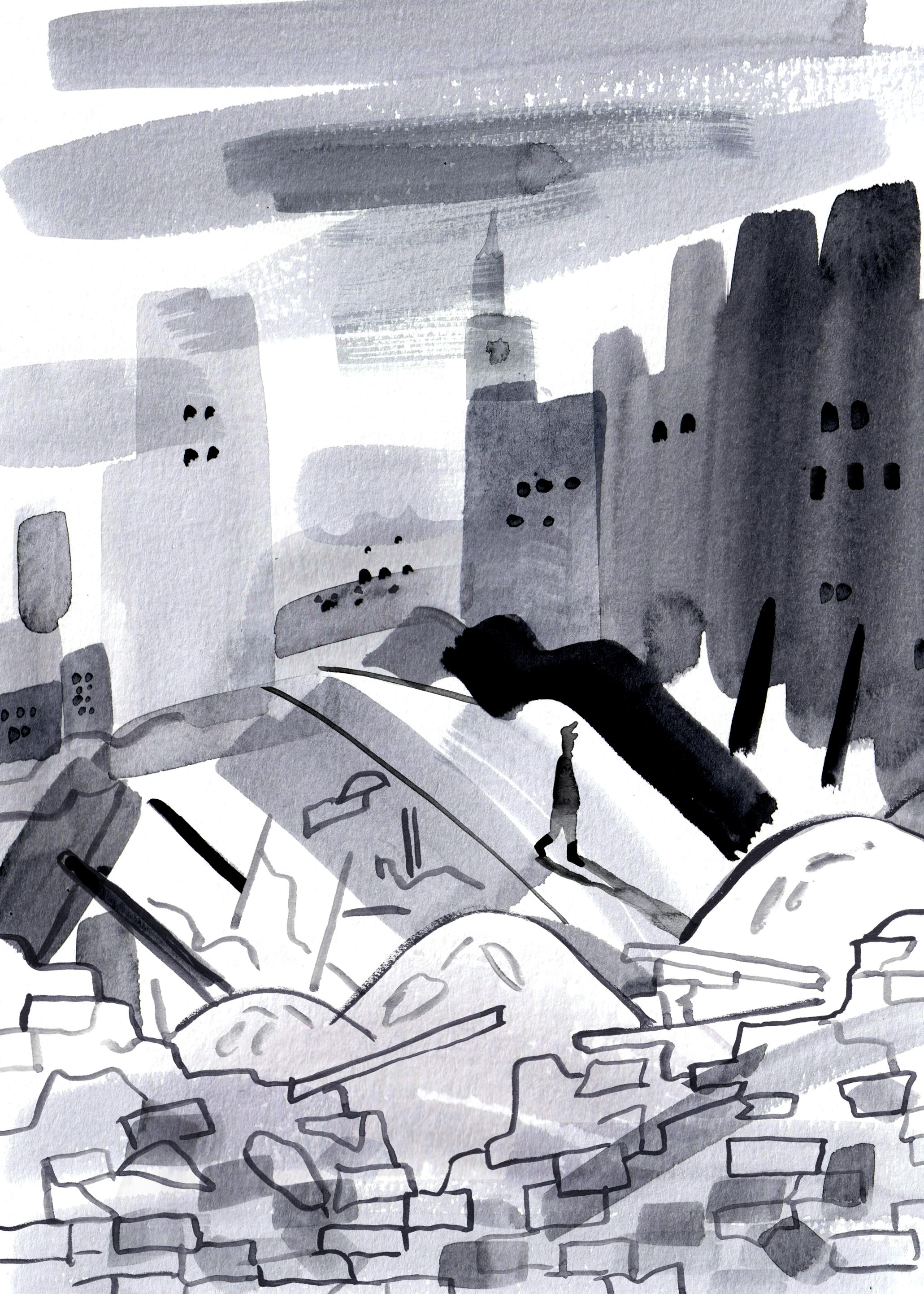
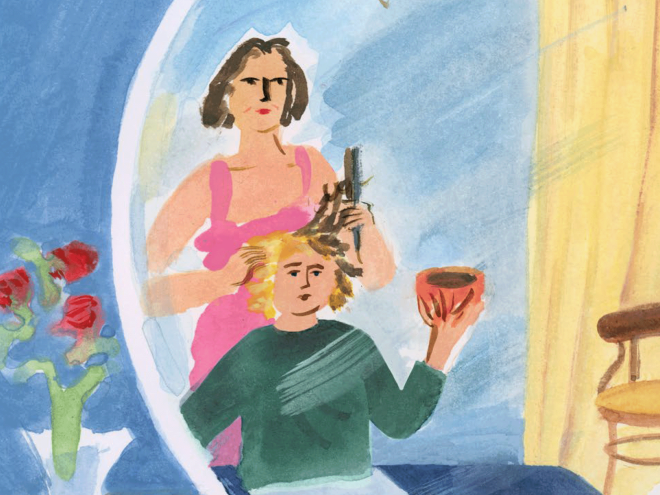
Illustration by Laura Junger
The Haasmans had not been religious. Feliks only ever saw Mama with her head covered on the High Holidays, when she took the children to shul. The family had occasionally eaten outside the home, in restaurants and even at the tables of Catholics. But Mama had insisted on certain things. Among them was keeping Shabbes, and having separate kitchens for dairy and meat. Feliks was by far the most literal-minded of the Haasmans. He had made up his mind when he was thirteen that the belief in an omnipotent God who watched over men was absurd.
Still, a crucifix on the wall was too much, even for as devout a secularist as he was. He changed seats so he was facing away from it.
His hostess moved on to the topic of her unfortunate son. He’d been a normal, happy child before the war. It had been the hunger, or the cold, or the typhus, or the terror that had left him stunted and half-deaf and dumb. There had been an older son, too, with a stronger constitution. He had not come back from the war. As she talked, she covered her mouth with a trembling hand.
Feliks took a pouch from his pocket, pulled out a pile of bills, and placed them on the table. “It’s for the credenza.”
The woman lowered herself into a chair across the table from Feliks. She stared at the money.
“If it’s not enough, you will of course let me know.”
She shook her head. “You must have the credenza. It’s yours, after all. But I couldn’t possibly … ”
Feliks pushed the money toward her. “You must. What would your husband say if he found you’d been giving the furniture away to strangers?”
“My husband.” She looked up at Feliks. In the light from the window, he noticed the spattering of youthful freckles across her nose. “He’s on the tracks near Szczecin now, I believe.” She shrugged, and then placed her hand over the bills. “I could go to the shop and pick up a bit of meat, some barley. Perhaps you’d like to stay? It’s been so long since anyone has joined us … My son and I, we know no one in this city.”
The woman was so close that Feliks could hear her irregular breathing. She smelled of naphthalene, and vinegar. She was younger than he’d remembered. Still, her shoulder blades jutted out of her bent back like the wings of a starved chicken. Or a sparrow. Feliks somehow found himself both attracted to and repelled by her smallness, her vulnerability. She met his gaze when he touched her cheek, and tilted her face so her lips grazed his palm. Relief coursed through Feliks — the relief of feeling another human’s warmth after all this time. But just behind it came the hum. It rose in volume, and in pitch. He willed it away, but it couldn’t be controlled. He took back his hand, pushed the chair away from the table, and stood.
The most charitable thing he could do was to take his credenza and go.
Leaving the woman alone with the money, he went downstairs to fetch the porter he’d hired at the station.
The burly fellow backed his way out of Bruno’s bedroom holding one end of the credenza; Feliks followed with the other. He now saw the extent of the damage the piece had suffered. Some German had etched the birth and death dates of a Private Arik Blau into the wood. A second fluted leg had come off when the credenza was lifted, and it now banged around inside a drawer.
As they passed what had once been the salon, the porter, far drunker than Feliks had guessed at the station, grunted under the weight of the wood. “No wonder they left this piece of shit to rot in here. They’re not idiots, those Germans, are they now?”
Feliks glanced apologetically at the woman. Again he saw pity in her eyes. But also something else.
“I wish I could’ve taken better care of your cabinet, Officer,” she said. “But the damage was already done when I got here.”
Shame. The woman felt shame. For the swastikas etched into the walnut of the credenza. For living in his home. For accepting the money he’d left on her table. And for witnessing what surely must seem an act of madness — so much effort for a credenza that was all but falling to pieces in his arms.
“Sir,” the porter cut in. “If you wouldn’t mind too terribly — are we moving this monstrosity, or are we playing tug-of-war with it across this kind lady’s living room?”
It was impossible, Feliks thought, as the freight train chugged eastward. Impossible, a normal interaction. An interaction free of shame or pity or anger. Of suspicion. Of disgust.
For six years, the country had endured the most salient expression of hatred that any Pole — Catholic or Jew — had ever imagined. They had lost families, homes, and land. Finally, the nightmare had ended. As in a fairy tale, or dream, evil had been defeated. Yet what, really, had changed since 1939?
He sat down and let his feet dangle from the open doorway of the boxcar. Behind him, the credenza was strapped safely to the wall. With the wind whipping his face, he watched the land rumble past him. Murky streams, clogged with duckweed. Out-of-use stations surrounded by the sun-bleached ruins of razed villages. And children. Children everywhere: banding together to roll fallen tree trunks into streams, chasing smaller versions of themselves, lobbing rocks at the train with slingshots.
In the distance, the browns and greens and greys of the flat landscape leaked into one another. This view of Poland did not steal Feliks’s breath as had the shimmering deserts of Persia, the turquoise gem that was the Dead Sea, or the Alpine peaks that breached the heavens. But the country pulled his insides taut in a way that no other ever could. It was an honest land, unassuming, and sometimes it could be sad and strange. He didn’t blame those who no longer saw anything here but a vast cemetery, who felt they needed to leave. But anger like Leonid Szyk’s was misguided. Of course there was evil in Poland, but there would be wherever man walked on earth. Feliks’s duty was to stay. Not just for his own good, but for Poland herself.
It was dark by the time the train reached the outskirts of Warsaw. The trip back to Łódź had not relieved the hum in his head. He rose to unstrap his cargo. Where would he even sleep with it in his room? The credenza was a huge weight that he’d carried into a life whose only real advantage had been its near total lightness.