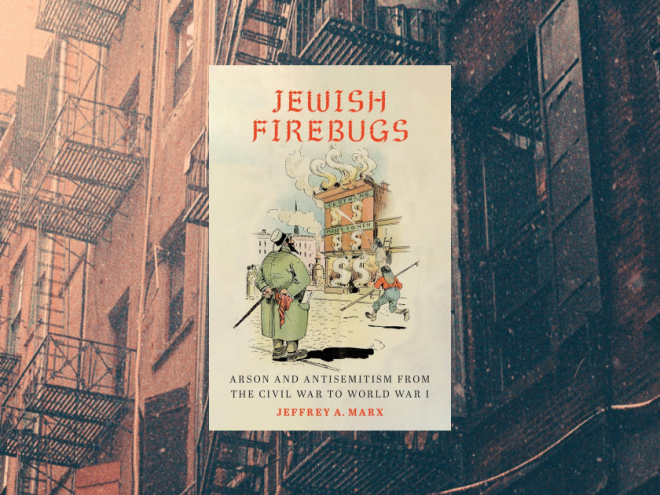
Jeffrey A. Marx’s Jewish Firebugs: Arson and Antisemitism from The Civil War to World War I offers a detailed and engaging analysis of the history of Jews and arson in America from the late nineteenth through the early twentieth century. Through his extensive research into primary sources — newspaper reports, cartoons, films, theatrical productions, and communications from political leaders and insurance officials — Marx’s book offers a window into both the reality and the myth of “Jewish arson” and the extent to which fact and fiction overlap.
In Chapter One, Marx traces the emergence of accusations of Jewish arson from the antebellum period through the close of the nineteenth century. The earliest accusations of Jewish arson were not grounded in any provable instances of arson. Instead, they reflected growing anxieties about Jewish wealth, fueled by the increased visibility of Jewish merchants in urban centers and ancient stereotypes of Jewish greed and dishonesty. Chapter Two then traces the persistence of these accusations from the 1870s onward, noting how insurance leaders and government officials sustained and amplified fears of arson fraud.
Chapter Three delves into actual cases of Jewish arson in major cities in the later nineteenth and early twentieth centuries, unpacking the unique organizational structure of Jewish arson teams. As Marx demonstrates, it was a confluence of social and economic factors — concentrated ethnic neighborhoods, lax investigative procedures by fire insurance companies, and an open market with little competition from other criminal gangs — rather than any innate proclivity for fraud that drove Jews to engage in arson. Marx also clarifies the distinctions between informal Jewish arson “criminal teams” and more traditional organized gangs and trusts, painting a vivid picture of how Jewish arsonists fit within larger patterns of criminal activity in the era.
Chapters Four and Five turn to cultural and media representations of Jewish arson in the late nineteenth century, spanning vaudeville productions, photographs, silent films, humor journals, and sensational newspaper coverage. These portrayals were informed both by real reports of Jewish arson, which themselves were often highly sensationalized, and by nativist fears of immigration and of Jewish economic success. Marx argues that these depictions showcased distinct antisemitic tropes targeting Jews while simultaneously illustrating an overarching societal unease regarding rapid social and economic change in American life.
One of the most fascinating aspects of Marx’s book is his detailed and honest account of Jewish responses to the bigotry and systemic discrimination they faced. In addition to calling attention to inspiring instances of mass mobilization from Jewish communities and solidarity from non-Jewish neighbors, Marx also pinpoints moments of division within Jewish communities over how to respond to such accusations. Ultimately, Marx is careful not to simplify or lionize Jews as perfect victims of antisemitism, and instead acknowledges internal tensions and varied forms of resilience in the face of discrimination.
Jewish Firebugs provides a detailed look at an underexplored and relatively time-bound episode of antisemitism in America while also revealing the long-standing beliefs that sustained it. Marx shows that while the stereotype of the Jewish arsonist largely faded from view after World War I, the underlying characterization of the Jew as untrustworthy, greedy, and threatening to neighbors and the general welfare of a community stretches back into ancient times and continues to threaten Jews in America and worldwide. Marx’s book thus contributes meaningfully to the field of antisemitism studies by underscoring how a historically specific manifestation of American antisemitism stemmed from enduring tropes that continue to harm Jews in America and worldwide.