Join a community of readers who are committed to Jewish stories
Sign up for JBC’s Nu Reads, a curated selection of Jewish books delivered straight to your door!
“Where there’s smoke, there’s fire,” goes the old expression. And sometimes when there’s fire there’s an insurance policy involved, as well. In the years following the Civil War, Americans increasingly took out insurance policies to protect their businesses from fire losses and, so, too, there was an uptick in the number of arsonists who deliberately set fires to collect the payout on the policy. This was especially true in urban areas, such as New York City.
Arsonists in New York usually got away with their crimes, up until the early 1900s. In 1907, the causes of roughly 3,500 out of 14,000 fires (25%) was declared to be unknown, though the Chief of the New York Fire Department declared that the majority of them were arson related.
Since most buildings in New York City during this time were not fire-retardant, by the time the horse-drawn steam fire engines arrived and the firemen brought the fire under control, incriminating evidence (like oil-soaked rags) was often consumed by the blaze. An 1895 New York City fire report stated: “Upon the arrival of the first companies the fire was found to have control of the building.” Without incriminating evidence, if witnesses had not spotted a possible “torch” (the person likely responsible for starting the fire) entering or leaving the building, and if the business owner was away from the premises at the time of the fire, it was difficult to prove that a fire had been deliberately set. Then, too, it was also possible that the fire had been caused accidently, perhaps set off by a kerosene lamp.
By the late 1860s, kerosene (refined from petroleum) had not only replaced candles but sperm oil, as well, as the primary source for lighting homes and businesses across America. It was shipped in barrels from the oil fields of Pennsylvania to retail stores in large towns and cities. It was then siphoned into small oil cans that the customers brought in with them. From there it was poured into kerosene lamps, facilitated by the narrow spout of the can.
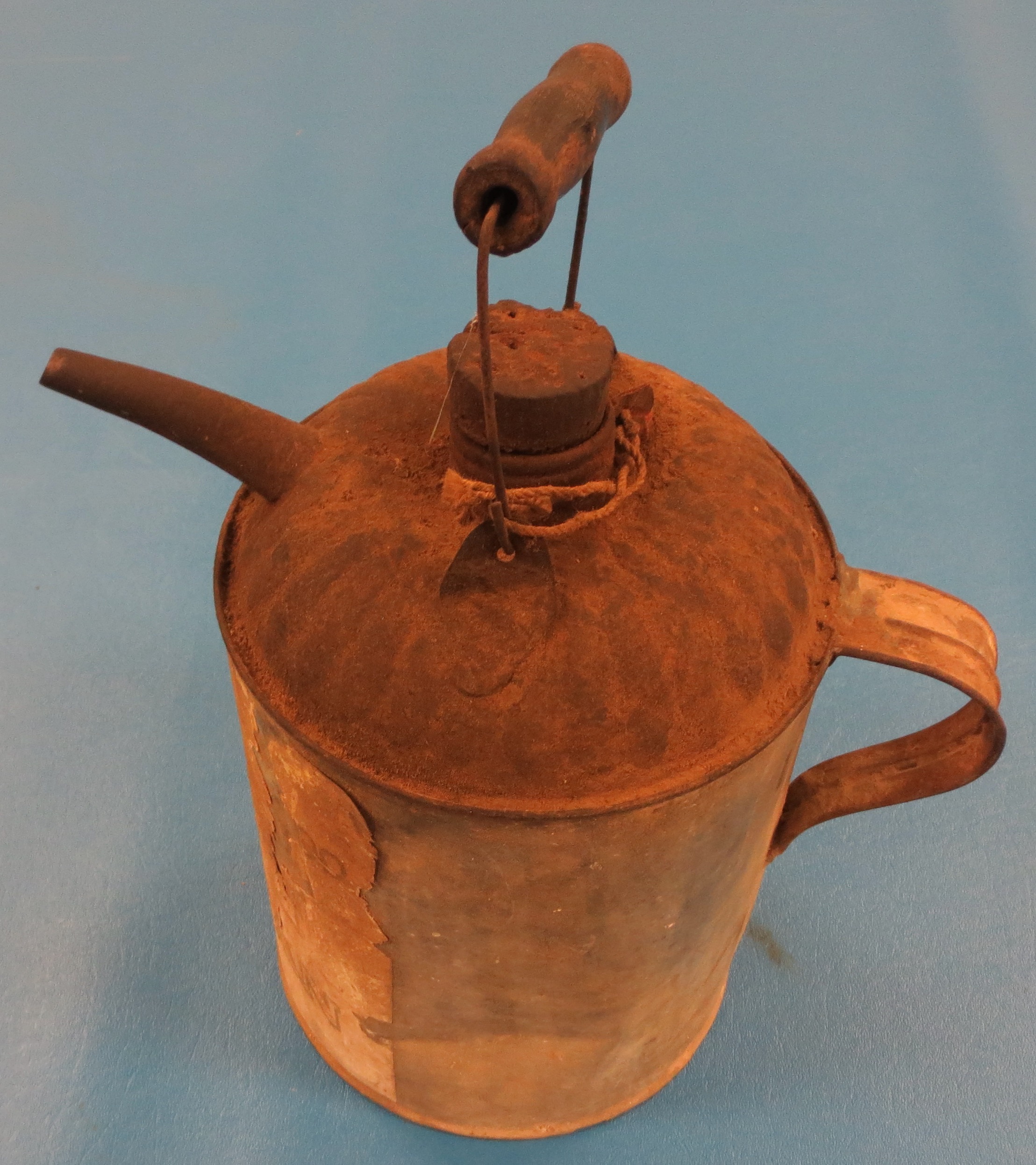
One Gallon Kerosene Oil Can. Tempe History Museum.
Though the kerosene lamp produced a bright light (the equivalent of sixty to eighty candles), kerosene, initially, was a dangerous substance. In its pure form it posed little danger but when adulterated with leftover petroleum products (so a refinery could make higher profits), it was extremely explosive. While the vapor from good quality kerosene could be heated up to 100 degrees without exploding, vapor from adulterated kerosene could ignite at 40 degrees. The heat from a nearby stove, for example, could cause the lamp to explode.
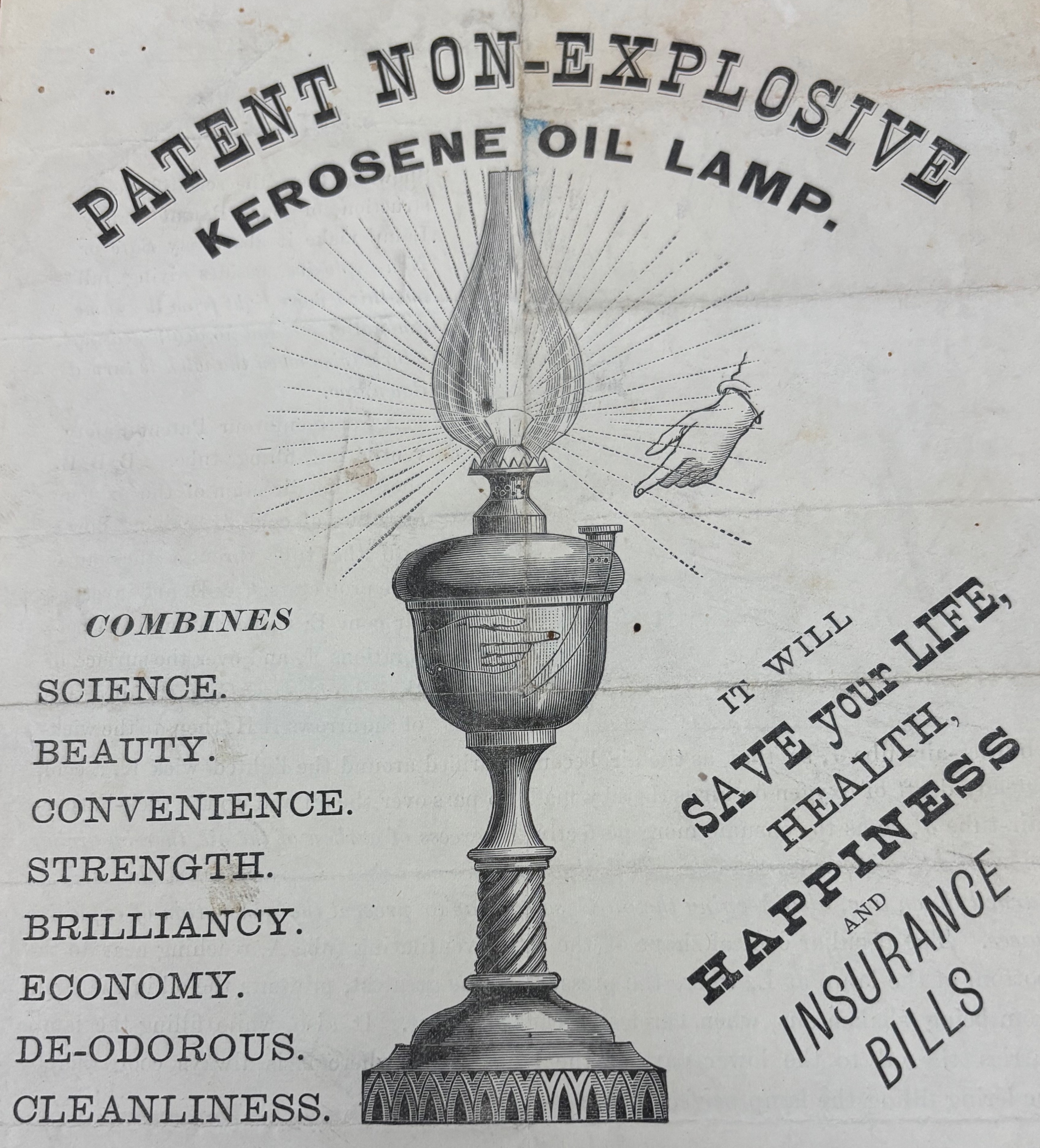
Advertisement for Kerosene Oil Lamp c.1885, Warshaw Collection of Business Americana, Lighting, Box 3, folder 24, Archives Center, National Museum of American History, Smithsonian Institution.
While by the 1890s New York regulations, as well as quality inspectors, eliminated most adulteration, care and caution were still needed. But lighting provided by kerosene lamps, despite their danger, was deemed to be absolutely necessary, especially since buildings and multi-story tenement apartments in New York often contained rooms with no or little direct light. In addition, kerosene lamps were used for other purposes. By the 1880s, small kerosene lamps with a metal plate on top, called “babies,” were found in tiny tenement rooms (often containing straw mattresses) that were rented out to boarders. The boarders used these stoves for cooking, as well as light, in these small, cluttered spaces.
Well into the twentieth century, fires started by kerosene lamps were, thus, a common occurrence. Small wonder then, that some arsonists at this time deliberately left a broken kerosene lamp at the scene of their crime, to suggest that accident, not arson, was the cause of the fire.
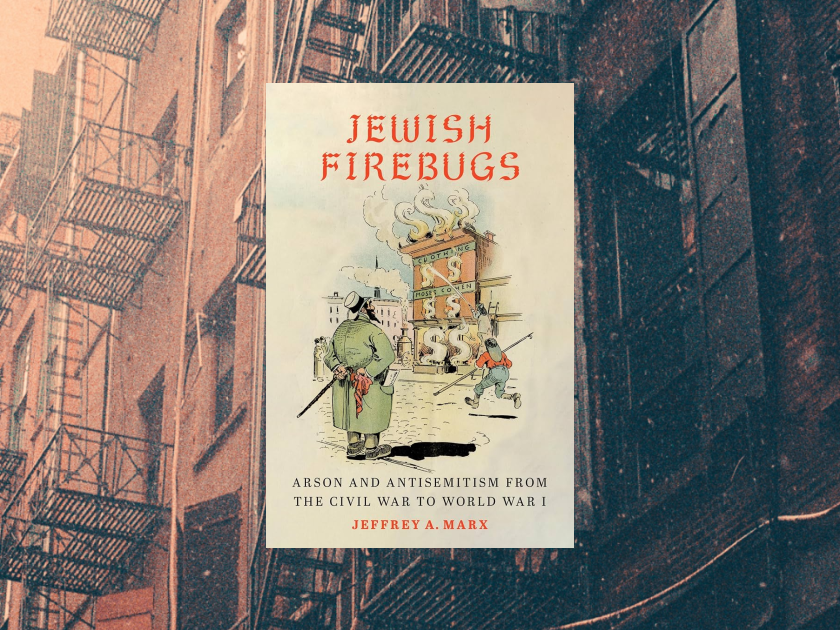
My new book opens a window into the lives and activities of Jewish arsonists in New York, Boston, and Chicago at the turn of the nineteenth century, and examines how spurious charges against the Jews as arsonists began just after the Civil War, appeared on the vaudeville stage, in silent movies and cartoons during the late 1800s, and finally in sensationalized stories in newspapers across America.
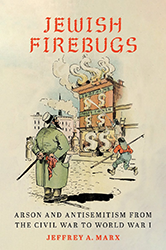
Jewish Firebugs: Arson and Antisemitism from the Civil War to World War I by Jeffrey A. Marx
Jeffrey A. Marx is an Independent Scholar and the author of Smoothing the Jew: Abie the Agent and Ethnic Caricature in the Progressive Era.