In Memories of a Good Meal, a new cookbook by American Israeli chef Alon Shaya with food historian June Hersh, cooking becomes a way to remember, to mourn, to celebrate, and to reconnect with family histories that were brutally interrupted by World War II. The cookbook, a compilation of interviews with survivors of World War II interwoven with family recipes, demonstrates how recipes can be passed down, safeguarded, reconstructed, and reinvented; how they can document a family’s prosperity or bear witness to struggle.
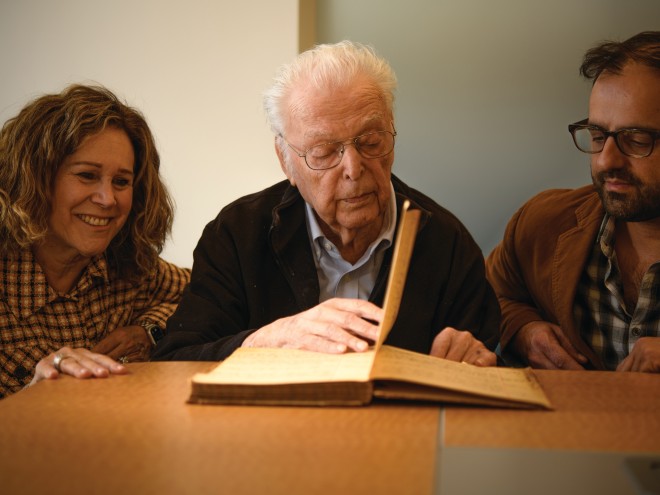
Memories of a Good Meal begins with Steven Fenves, a Holocaust survivor from the Yugoslavian – Hungarian border, and his family’s beloved cookbook. The cookbook was lovingly saved by their non-Jewish cook, Maris, after the Fenves family was brutally removed from their home and sent to Auschwitz-Birkenau. After the war, Steven was reunited with the cookbook thanks to Maris, and decades later, Alon Shaya brings those recipes — among them, shatteringly crisp semolina croquettes, plush lamb and potato doughnuts, and baklava-stuffed dates — to the home cooks of 2026 and back to Steven, as well. Shaya describes how making the baklava-stuffed dates for Steven, which he had never eaten before the war because they were delicacies reserved for adults, began to mend some of the torn threads of the Fenves family history.
Elsewhere in the cookbook, recipes emerge from conditions of survival. Partisan Shalom Yoran hid in the unrelenting Polish woods, where finding food meant, on some days, risking his life. This part of the cookbook includes a herring and potato salad featuring the preserved fish that sustained the partisans through harsh winters. In another chapter, Sue Kunitomi’s experience in the Manzanar internment camp in California is brought to painful reality in dishes such as chicken teriyaki with sage and rainbow trout shioyaki, adapting classic Japanese cooking to ingredients that would have been accessible in the arid climate surrounding Manzanar. This section also includes a recipe for rose-scented butter mochi cake, a reminder of the roses families in the internment camps planted around their barracks to beautify their grim locale.
Later in the cookbook, Shaya and Hersh let us in on Navajo code talker John Kinsel’s story as an American soldier in Guam. This interview is accompanied by a recipe for Navajo fry bread, which Kinsel fried on his helmet while a soldier. The story of a Jewish woman, Celina Hecht, who was sheltered by a Catholic family, is preserved in a recipe for chilled blueberry soup — a reference to the woman’s memories of foraging for berries in the Bialowieza Forest on the outskirts of Bialystok while in hiding.
The final chapter in the book ends on a relatively sweet note, describing the experience of Jewish refugees who built a new life in the Sosúa colony in the Dominican Republic. Here, Shaya offers us recipes for green plantain latkes, red snapper schnitzel alongside mango salsa, and, truly ending on a sweet note, a chocolate-apricot tres leches cake (marrying the prized apricots of Austria’s Wachau region, where many of the Jewish refugees in Sosúa came from, with the Latin American classic).
In Memories of a Good Meal, Shaya and Hersh craft a book in which food does not simply illustrate history — it carries it. Each recipe is carefully modernized without losing sight of the people who made, preserved, and remembered it. These are stories of forced movement, ingenuity, loss, and hope, held together by the enduring human impulse to eat and to remember. Shaya and Hersh are excellent guides through this global history.
Hannah Kressel is a current fellow at the Pardes Institute of Jewish Studies in Jerusalem. She holds a Masters in Art History from the University of Oxford and a Bachelors in Art History and Studio Art from Brandeis University. Her research examines the intersection of contemporary art, food, and religion. She is an avid baker and cook.