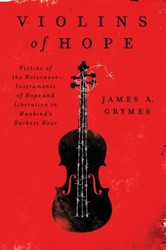
Moshe Gildenman, a renowned musician and city engineer, was conscripted into forced labor when the Nazis invaded his town of Korets in July 1941. The factory and quarry work was grueling and the workers were starved and beaten. But because they were capable of hard labor, they were exempted from being loaded into the dushegubka (Russian for “soul killer”), a mobile gas chamber, or from being driven to the outskirts of town to dig their own graves. His wife Golda and thirteen-year-old daughter Feigala were not so lucky. They were among the more than two thousand Jews who were executed in Korets. When Gildenman’s nephew was ordered by the Germans to sort through the clothing the victims left behind, he found Golda and Feigala’s coats. From that moment on, all Gildenman wanted was revenge.
Gildenman and his son Simcha decided to escape and join the partisans. A former choir leader, Gildenman wrote a song, “Come to the Forest,” hoping that many would join him, although only a few did. Gildenman was armed with only one revolver and a knife, but he carried his Yiddish song book. Undaunted, they planned to meet up with guerrillas from the Soviet Red Army who were organizing partisan units in German occupied territory.
Moshe’s unit only had sixteen men and four women, but with brilliant strategic plans they were able to fool the enemy into believing that they were many more. They ambushed German patrols and stole their weapons. They identified Ukrainians that were collaborating with the Nazis, raided those villages and took stores of food, medicine, and ammunition. They sabotaged telephone lines and railroad tracks, and blew up bridges and targeted military garrisons, killing hundreds of Nazi soldiers. Their courageous deeds became legendary, and Gildenman took on the name of Uncle Misha. Soon others, most seeking revenge for the murder of their families, sought out Uncle Misha’s Jewish Group.
The book is an exciting read not only because of the white-knuckle exploits, but also because of Grymes’ colorful and compassionate descriptions of the wide variety of people who populated the forest guerrilla groups. There were soldiers from the Red Army, Jewish refugees, Ukrainian and Polish peasants who refused to become collaborators. By 1943, it was estimated there were thirty thousand partisans in Ukraine.
Uncle Misha took in one little boy whom he found in the forest, tattered and alone. The boy was clutching a violin, which endeared him to the former Korets children’s choir leader. He said his name was Mitka and that he had escaped from his village after his parents and sister had been shot in retaliation for burning a German grain storehouse. He was desperate to join the partisans. After hearing his beautiful playing on the violin, Uncle Misha and Mitka devised a plan for Mitka to perform during dinners at a canteen for German officers. The drunken soldiers did not realize that the young violinist had planted a powerful bomb in the basement. The explosion was so loud the partisans could hear it across the river.
The only drawback to this excellent history is its lack of an index. Grymes introduces each chapter with a verse from Uncle Misha’s book of Freedom Songs, underscoring the surprising role that music played in the dangerous, bold actions of Uncle Misha and the Jewish Group.
Elaine Elinson’s historical novel Radiant as the Stars, inspired by her grandmother’s diaries, will be published in August by Sibylline Press.