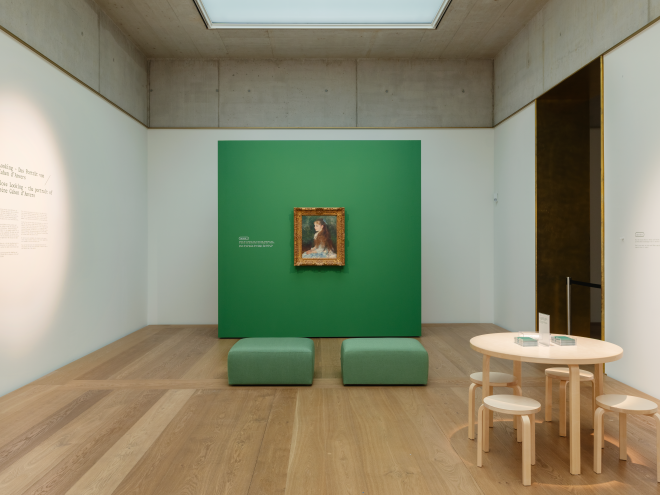
The Cahen d’Anvers family were French Jewish aristocracy — immensely wealthy, titled, prominent collectors; the hosts of a weekly salon frequented by financiers, intellectuals, socialites, and writers, including Marcel Proust. The French press regularly reported on family members’ nights at the opera, extravagant cotillions, elegant Worth gowns, lavish marriages.
By focusing on this family, Doreen Carvajal, a journalist based in Paris, makes personal the long-standing antisemitism in France and the brutalities of the Vichy regime. Based on newly uncovered documents; extensive research in archives, libraries, museums; and interviews with many Cahen d’Anvers descendants, Carvajal unfolds the story of La Petite Irène and the woman who was the young girl in the painting.
Irène Cahen d’Anvers (1872 – 1963), the oldest of the three Cahen d’Anvers daughters, was a rambunctious girl of eight living a picture-book life when she sat for Pierre-Auguste Renoir.He caught her in profile, her amber hair flowing over her shoulders and her eyes looking pensively into the future. But Irène’s future was already determined: from her mother she learned the social requirements that would lead to marriage to a similarly prominent young man and carry on the family line. In 1891 Irène was married to Count Moïse de Camondo, twelve years her senior, in an opulent wedding sanctioned by finance and heritage.
But Irène had always plotted her own path. The marriage stultified her and was, for all intents and purposes, over years before she divorced de Camondo, leaving her young son and daughter. Within a year she married Count Charles de Sampieri, Moïse’s horse trainer. That marriage also ended in divorce. Irene spent the war living quietly in Paris, alone, never going far for fear of capture. She left no records.
It is easier to trace the life of La Petite Irène. It was shown in public at the Salon of 1881, charming viewers with its delicacy and Irène’s blue eyes. La Petite Irène went to appear in every major Renoir retrospective, lent by whichever family member owned it at the time. But it did not appear in Renoir’s centenary. By then it was packed in a crate and stored in a chateau established by the French museums for safekeeping; it was soon removed by the Germans with all the crates belonging to Jewish owners. A few later moves took it to the Jeu de Paumes, which had been emptied to become a storage facility. On a special tour arranged for him, Hermann Göring selected the painting, which he considered valuable currency. He sold it to a dealer with Swiss connections who trafficked in looted art.
After the war, La Petite Irène finally came home to Irène, who was the sole survivor of her family. In a web of shady dealings, unfounded documentation, and outright lies, the innocent young girl in the painting fell into the hands of a voracious Swiss collector who made his fortune selling armament to the Germans, all the while buying looted art. He was able to meet Irène’s price. The painting now hangs in a foundation in his name in Zürich.
The Girl in Blue reveals how a patriotic family was betrayed by a country that never fully accepted it. In addition, the book tracks duplicitous dealing in looted art during the Nazi era, an issue still being dealt with. Although La Petite Irène comes alive, Irène herself does not come through as clearly. The reader, like the author, comes to know her largely through the memories of her younger relatives. In this well-documented book, Caravajal also exposes the cultural war the Germans waged, a less well-known aspect of the war.
It is interesting to note that earlier this year a book about Renoir’s portrait of the two younger Cahen d’Anvers sisters was published. That portrait hangs in a Brazilian museum.
Maron L. Waxman, retired editorial director, special projects, at the American Museum of Natural History, was also an editorial director at HarperCollins and Book-of-the-Month Club.