Join a community of readers who are committed to Jewish stories
Sign up for JBC’s Nu Reads, a curated selection of Jewish books delivered straight to your door!
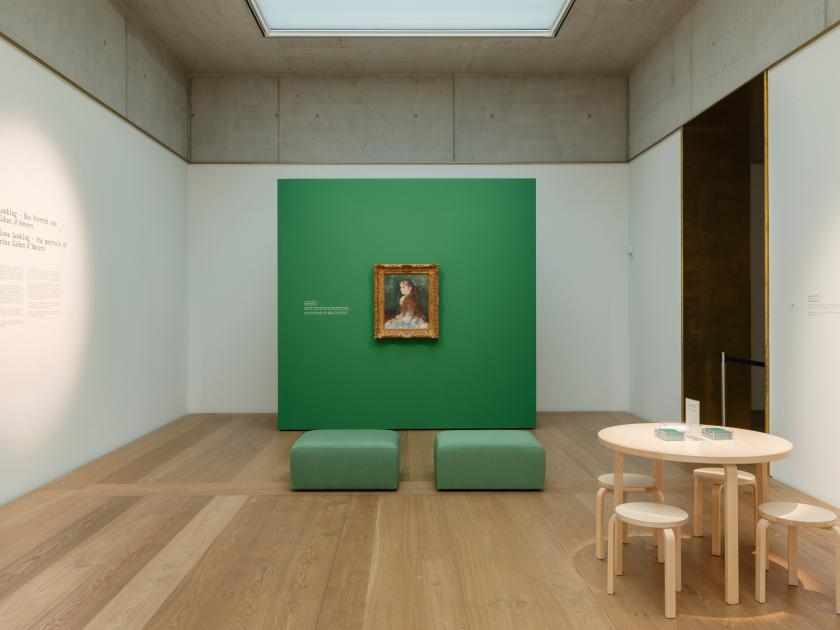
Installation views of the exhibition „In transition. The Bührle Collection“, Kunsthaus Zürich, 2025 — 2027/28
Photos: Franca Candrian, Kunsthaus Zürich
I noticed her in 2019 at the Musée Maillol, when a middle-aged man stood transfixed before the frame, biting his nails. Her dress was a pale, washed cobalt blue. Her blue-green eyes, their irises delicately touched with white, seemed suffused with melancholy.
It was the first time in nearly seventy-three years that Renoir’s coveted portrait of the ginger-haired La Petite Irène had returned to Paris for public display. During those decades it had been stolen, recovered from a Bavarian farmhouse in 1945, and exhibited after the war among looted French master works at the Musée de l’Orangerie. Yet there was barely a whisper about the life of the eight-year-old girl in the frame, Irène Cahen d’Anvers. I found myself wondering: Who was she?
That question changed the way I looked at the painting. I began to read it more closely: the lips pressed red, almost as if bitten; the distant gaze; the tension beneath the prettiness. I began to realize that looking at a portrait could have two stages: first, what the artist gives us to see; then, what history allows us to discover. We cannot uncover the story behind every portrait. But when one holds our attention, we can follow it beyond the frame.
Once I began looking differently at Irène, I went searching for the other portraits of her family, a Jewish banking dynasty who thrived during the Belle Époque. They had been painted repeatedly by Renoir, Bonnat, Whistler, Béraud, Boldini, and others. At first glance, they are elegant society portraits that declared their status and belonging. Look again, and other questions emerge. What did the artist notice? What is being performed, and what might be concealed? Who was this person beyond the pose? What happened after the sitting ended?
No one imagined these paintings would one day function almost as a family archive, scattered across the world’s museums in Paris, Zurich, Los Angeles, and São Paulo. Once we know the lives behind them, they become more than Renoirs, Bonnats, Whistlers, or Boldinis. They become Irène, Élisabeth, Albert, Louise, Louis — people looking back at us across a rupture in history.
Renoir’s portrait of Irène’s uncle Albert Cahen d’Anvers, surrounded by dense blue floral wallpaper, looks different once we know about the hidden life behind his intellectual public persona as a composer. Albert moved within a close circle of men who used coded references to cultivating flowers (such as oleanders) in nineteenth-century letters to speak discreetly about homosexuality.
In Pink and Blue, Renoir painted Irène’s younger sisters as two exquisitely dressed children in lace and sashes. Élisabeth, her fingers pinching at the ruffles of her dress, seems almost tense amid all that froth. She later converted to Catholicism, yet decades afterward the Nazis classified her as Jewish by origin and deported her to Auschwitz. After the war, when her son sought legal redress over the forced sale of her house, a court rejected the claim on the grounds that Élisabeth was technically not Jewish.
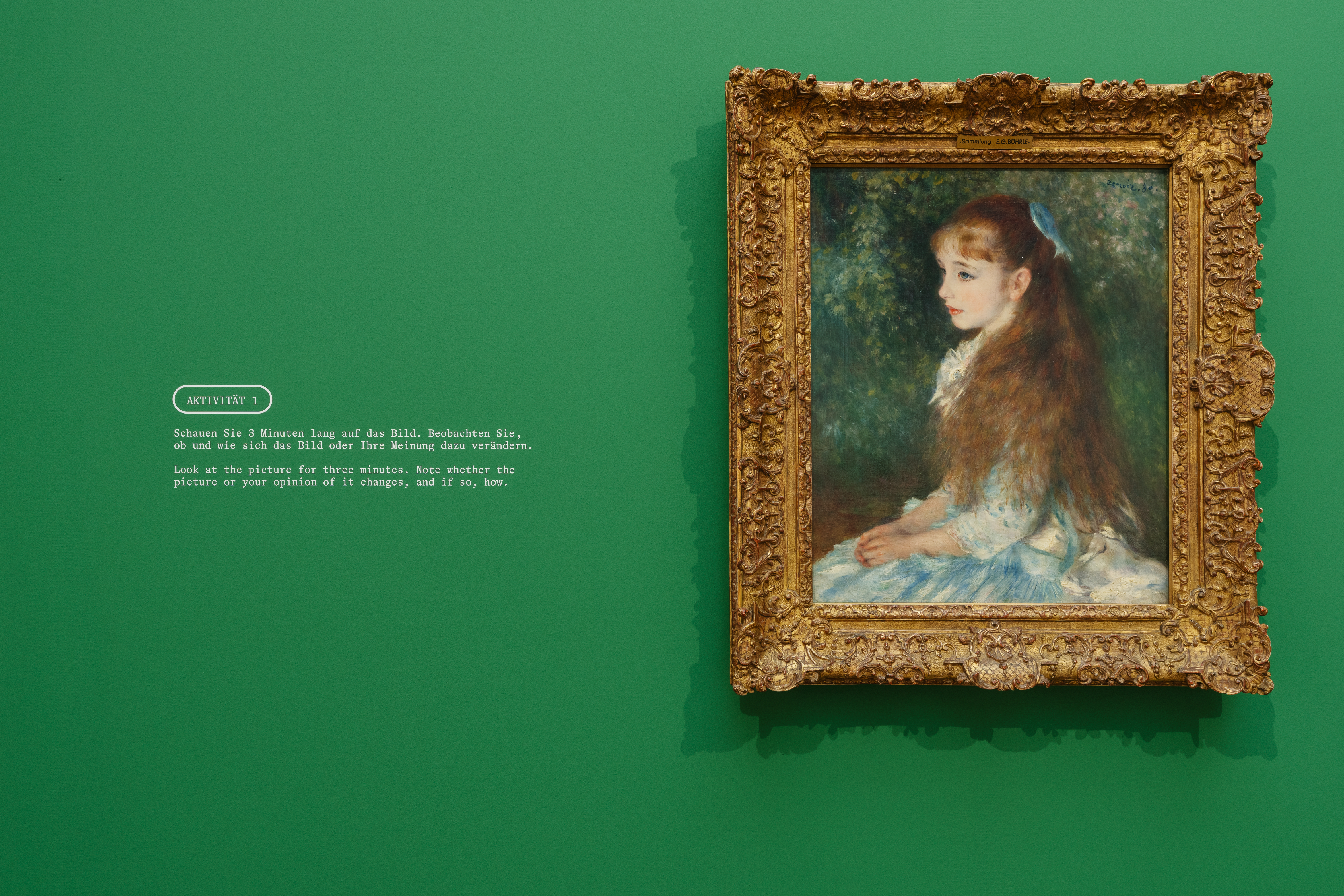
Installation views of the exhibition „In transition. The Bührle Collection“, Kunsthaus Zürich, 2025 — 2027/28
Photos: Franca Candrian, Kunsthaus Zürich
Irène’s portrait bears witness in another way. Irène survived by hiding in plain sight, while her daughter Béatrice and two grandchildren were deported and murdered. Béatrice was put to work in an ammunition factory at Auschwitz and was among a last group of more than 800 prisoners murdered in a crematorium only weeks before Soviet forces liberated the camp on January 27, 1945.
The painting of Irène was swept into that history. Seized by a special Nazi art-looting unit in 1941, it passed through Hermann Göring’s network, was recovered by the Monuments Men military investigators from a Bavarian farmhouse, and in 1949 was sold by Irène through an art broker to Emil Bührle, the German-Swiss industrialist and arms manufacturer.
The object that preserves the face of an eight-year-old Jewish girl thus carries within its own history the forces that nearly destroyed her world.
Knowing this sends us back to it to look yet again. The pale blue dress is still there, the distant gaze, the delicately painted eyes. But we are no longer looking only at brushwork or beauty. We are looking at a child, a survivor, a family — and an object that passed through catastrophe.
The Kunsthaus Zürich recently redesigned its display of Irène’s portrait to encourage just such a second look. It now hangs alone against a deep green wall in a gallery arranged for contemplation, with soft seating, a table and chairs, and a digital screen tracing the story of the family behind the painting. Beside the portrait is a caption in English and German: “Look at the picture for three minutes. Note whether the picture or your opinion of it changes, and if so, how.”
That is the power of the second and third look. Most of us will never trace a portrait through archives and wartime files. But when a face stops us in a museum, we can pause before moving on.
Look closely. Read the label. Notice the details. Ask the name. Follow the thread.
Sometimes the story outside the frame allows us to see a painting with entirely new understanding.
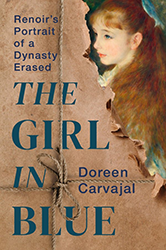
The Girl in Blue: Renoir’s Portrait of a Dynasty Erased by Doreen Carvajal
Doreen Carvajal is a journalist and author who worked for more than twenty years at the International Herald Tribune and The New York Times, reporting from Europe on culture, media, and international affairs. Her first book, The Forgetting River, traced her search for her Catholic family’s hidden Sephardic Jewish roots in southern Spain. She lives outside Paris in impressionist country in a stone farmhouse.