Join a community of readers who are committed to Jewish stories
Sign up for JBC’s Nu Reads, a curated selection of Jewish books delivered straight to your door!
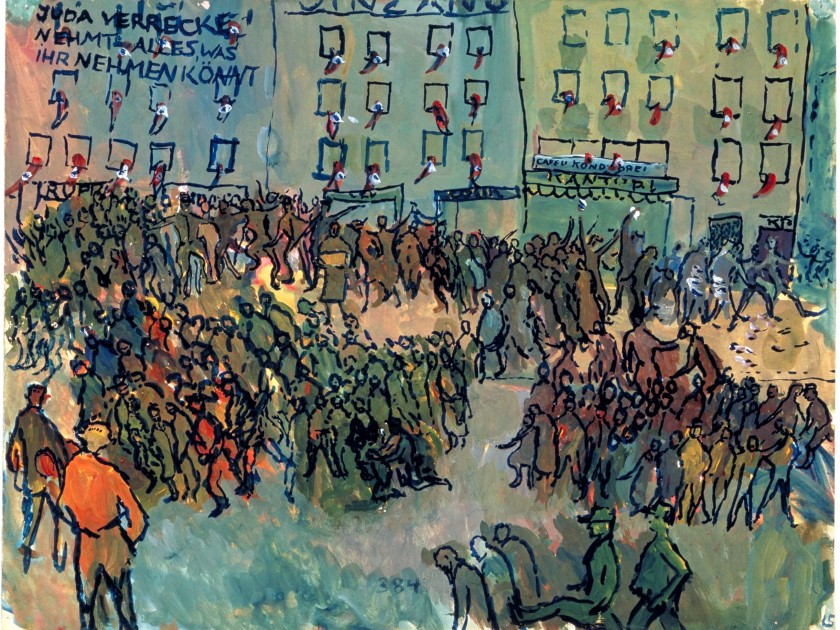
Kristallnacht by Charlotte Salomon, 1940 – 42
The painting was one of the masterpieces of the collection, but until that summer I hadn’t spent much time looking at it. A forest landscape so dense it appears dark, as though the children in frothy pink dresses and straw boaters deep in the canopy have been released to play after dinner and have lingered long into the night. A fragment of blue sky in the painting’s upper left corner — where the eye is led by the long lines of the tree trunks — tells us it’s more ordinary than that: it’s daytime, and the children and their chaperones are safe, where they should be.
This is La Ronde Enfantine, and it was painted in 1862 by French artist Gustave Courbet (1819−1877). The museum where I worked as a curator had just received dramatic new information about the history of the painting: it had been looted from the Parisian home of Jewish resistance hero Robert Bing and had entered the collections of high-ranking Nazi officials. I recall reading the report on the painting’s provenance with unease. The painting was here, in the museum with me, but in my mind it was also there, in the private rooms of Göring and Ribbentrop. There was a strange, unwanted intimacy in looking where those men had looked, in taking pleasure in the same expressive brushstrokes and daubs of colour. Though, as I came to realise, we weren’t really seeing the same Courbet. My Courbet, who I suspect was also Bing’s Courbet, was a leftist visionary interested in the raw physicality of nature; theirs was a painter who produced hymns to rural life consistent with blood and soil ideology.
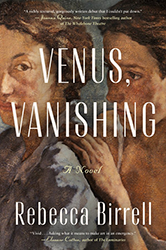
This restitution case at The Fitzwilliam Museum in Cambridge was one of several starting points for my debut novel, Venus, Vanishing. I had rarely experienced so intensely (and disturbingly) the collision of my identities as a Jewish woman and an art historian. Where the Courbet painting had been, what it had witnessed, the lives it had touched, the conversations it had sparked, were confronting. But it also suggested a thought experiment about fascism and taste. Did artists labelled “degenerate” by the regime because of their ethnicity or religion all make the same kind of art? Or were there artists who found themselves absorbed by the regime’s ideological machine, misappropriated in the same way as Courbet?
I might have answered this question through a straightforward research project, combing through the artists associated with the Degenerate Art Exhibition, which toured until 1941, and its Aryan sibling show, The Great German Art Exhibition, which held its last edition in Munich in 1942. But my instinctual curiosities about the period took me elsewhere. I became more interested in European Jewish artists who had their lives and careers destroyed by the Third Reich. There were tragedies I already knew to mourn. Charlotte Salomon (1917−43) grew up in an assimilated Jewish family in Berlin. Life? Or Theatre? consists of 1,325 gouache drawings — an illustrated autofictional account of her family’s history of poor mental health — created within two years after she escaped Germany for the South of France. She was murdered in Auschwitz aged twenty-six. Salomon has rightly received a huge amount of posthumous acclaim, and Life? Or Theatre? has toured the world — I was fortunate to see the exhibition when it came to London in 2019.
I wanted to write about Jewish life, about the ambitions, pleasures, and love felt in defiance of the dehumanization inflicted upon Jewish communities by the Third Reich.
But there were many other artists who captivated my attention precisely because they had faded into obscurity after being murdered, their work lost or destroyed. At the end of my novel, there is an (unexhaustive) list of these artists: I still find myself adding to that devastating ledger now. As an art historian who had written a non-fiction book about overlooked British women artists, dutifully visiting archives and public collections to produce new research on their work, my first instinct was to apply my usual historical methodologies to these artists. But I quickly realised that there were too many artists and too little trace of their lives and work for this approach to succeed. Perhaps I would have to invent a character — a composite who drew on many of these slain artists’ lives — and a narrative of creativity, resistance, and hope to honor these men and women. I was an avid reader of fiction, but I hadn’t written any before. The energy and motivation to attempt this daunting task came from a place of grief. I wanted to write about Jewish life, about the ambitions, pleasures, and love felt in defiance of the dehumanization inflicted upon Jewish communities by the Third Reich. I don’t flatter myself that one novel can do much to mitigate the Holocaust’s catastrophic losses of life and culture. But there was some small consolation in assembling my protagonist Hannah from the rubble of all that foreclosed possibility — and giving her a different ending.
Fortunately, there were some Jewish artists who somehow managed to survive, either through fleeing Europe at an opportune moment or going into hiding. One who stuck with me from the beginning of my research was Lotte Laserstein (1898−1993), who left Germany for Sweden in 1937, and later for California. She was one of the only women artists associated with the New Objectivity movement, and her paintings are highly accomplished and startlingly intimate insights into everyday life in the final years of the Weimar Republic. In her 1929 self-portrait, I and my Model, Laserstein meets the spectator’s gaze with an ambiguous expression that in some moods I’ve read as defiance, in others as trepidation. The political situation was deteriorating, but she can’t know what’s coming. I felt Laserstein’s look as an invitation, just as I had felt the chorus of murdered Jewish artists as a rallying cry, and all the while the awful journey taken by La Ronde Enfantine continued to jostle at the edges of my mind. Venus, Vanishing was the medium I arrived at for connecting these histories, artworks, lives, and ideas.
Adapted from the author’s historical note in Venus, Vanishing (Henry Holt and Co., 2026).
Rebecca Birrell is an art historian and a Bye-Fellow in the History of Art at Murray Edwards College, University of Cambridge. She was formerly the curator of nineteenth and twentieth century paintings and drawings at the Fitzwilliam Museum and has occupied curatorial positions at the Jewish Museum London, the Department of Prints and Drawing at the British Museum, and at the Charleston Trust. She studied English literature at University College London, followed by a master’s in women’s studies at the University of Oxford and a PhD from the Edinburgh College of Art. Venus, Vanishing is her debut novel.