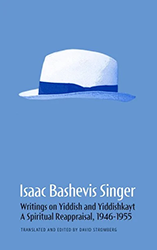
The third volume in Isaac Bashevis Singer’s Yiddish and Yiddishkayt essay series, translated by David Stromberg, explores all of the essays Singer wrote for the Forverts and other Yiddish publications from 1956 to 1973, synthesizing Singer’s thoughts on the state of Yiddish literature during that period. The first two volumes of this series concern Singer’s postwar attitude about the importance of Yiddish and his firm belief that Yiddish literature cannot be secular, respectively. But A Final Reckoning is just that — a dissection of Singer’s position on where Yiddish literature was headed long-term, and why it mattered a great deal when considering the plight of the Jewish people.
This volume needs the prior two in order to be fully contextualized, but it can also stand on its own, thanks to Stromberg’s introductory commentary for each essay. In this collection, Singer retains much of his religious and cultural zeal that has become familiar throughout his essays — he considers the future Yiddish to be of the utmost importance to the survival of the Jewish community. As the introduction states, this final volume is Singer’s “fiery love letter to Yiddish” in a world that was moving away from its normalized use.
Singer’s appreciation for the intricacies of language — the words themselves, apart from their cultural and communal value — is part of what makes him a writer, rather than a sociopolitical commentator, at his core. He sees the value that a specific choice of words brings to a larger, cohesive thought or phrase — he feels an almost existential level of concern for words. Are they being used correctly, to the extent that they are most impactful? Are they properly understood by both the reader and the writer? These details are considered throughout the book, a constant reminder that language must be intentional. Once he establishes his reverence for the words, Singer turns his focus to their significance in a larger context. “Language is a lot more than just a medium for basic communication,” he writes. “Nations put their treasures and memories inside it.”
In his essays, Singer covers a variety of topics, such as righteousness and sin, literary translations, intellectualism and provincialism, and more. Perhaps one of the most fascinating takeaways is Singer’s belief that “Jews studied their whole lives in languages they did not properly know,” and that they are hindered by speaking, learning, and writing in languages that are not exclusive to their own culture. His argument suggests that Yiddish — at least for Eastern European Jews — was something innate, as much a part of their Jewish identity as their religious customs or shared history. He believed that movements towards integration with the rest of the world following the Haskalah (the Jewish Enlightenment) — including speaking common languages and deprioritizing religious observance — all contributed to the Jews’ inability to truly thrive in their society.
In his many arguments regarding the perils of assimilation, Singer does not leave much room for nuanced perspectives; to him, assimilation is an enemy of the Jewish people. As a Jew in the United States who had watched the destruction of his homeland and its people from afar, he chafed against the pressure to assimilate into American culture, believing instead that retaining his traditional Jewishness — especially his Yiddish — was essential. He writes that Yiddish is a much richer language than Hebrew or English, due to its many words and diminutives that add character to speech, and that it is as much (if not more than) a “holy language” as Hebrew.
Yet, despite his critical nature, Singer does see the complexities of humanity, especially in the wake of the Holocaust. The truth is, many of Singer’s essays — in conversation with one another, at least — are rife with contradictions. Singer, like any other writer, had views that were constantly shifting, whether he realized it or not. Readers of this volume will watch as Singer loses hope for the future of Yiddish, while still holding fast to his fervent love for what the language symbolized for the Jewish people as they moved into the latter half of the twentieth century.
Isadora Kianovsky (she/her) is the Membership & Engagement Associate at Jewish Book Council. She graduated from Smith College in 2023 with a B.A. in Jewish Studies and a minor in History. Prior to working at JBC, she focused on Gender and Sexuality Studies through a Jewish lens with internships at the Hadassah-Brandeis Institute and the Jewish Women’s Archive. Isadora has also studied abroad a few times, traveling to Spain, Israel, Poland, and Lithuania to study Jewish history, literature, and a bit of Yiddish language.