Join a community of readers who are committed to Jewish stories
Sign up for JBC’s Nu Reads, a curated selection of Jewish books delivered straight to your door!
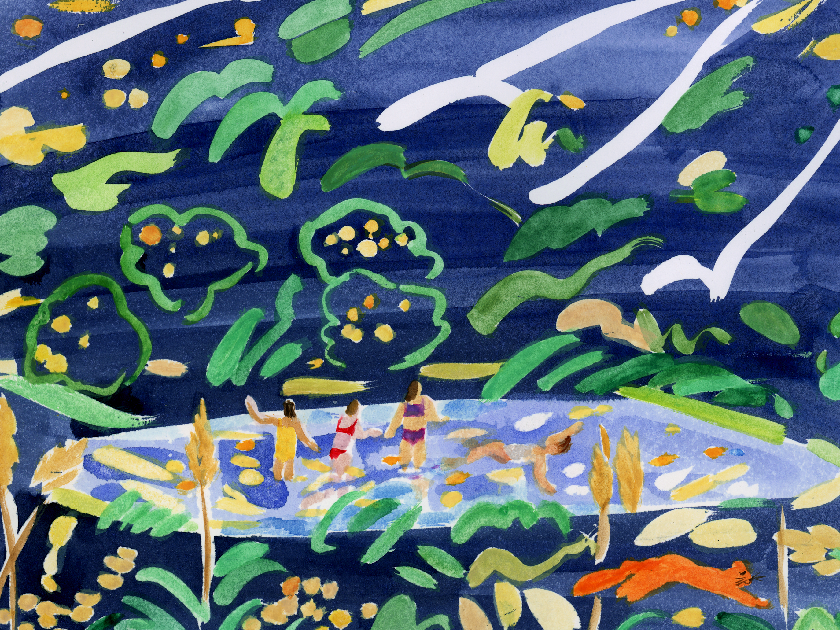
Illustration by Laura Junger (cropped)
Before the fire, there is glitter. There’s glitter on the sign outside the girls’ cabin—G‑3 So Free! And in the wood grains of their cabin floor. They glue glitter onto paper chains and tape them to the slats under the top bunks. The girls wake to glitter on their pillows and in their sheets, sparks of gold and red catching in the corners of their eyes. They roll glitter oil across their pubescent skin so their arms and legs glow at dusk. They brush glitter onto their eyelids — fine and frosty and rising to their brows. They have glitter jelly sandals and Lip Smackers and milk pens. Their moms send them glitter headbands that prop their short, thick hair back — hair they will later learn to singe with four-hundred-degree flat irons. But now it’s 1999. And they are twelve, and at sleepover camp, and believe they are on the precipice of a life that, at the very core, sparkles.
They go to Camp Ahava, a Jewish camp in the Santa Monica Mountains, where peaks rise three thousand feet high, their faces bare and craggy like wet sand dripped from clenched fists. Below, dense brush circuits the slopes. And neat squares of charred earth are knit into the scrub from the controlled burns of that winter.
The camp was founded in the 1950s for the children of immigrants, survivors, and secular-leaning Californians who believed their religion was best learned through hiking, singing, and an oil-sopped schnitzel. Thirty years later, their grandchildren sleep five or more to a cabin — the bravest next to the glass windows that rise to the rafters.
The girls’ cabin has not been updated since 1956. So it is old and wooden and built on the slant of a creek valley. It is made level by a large platform, under which sleep raccoons and squirrels and, on very hot days, rattlesnakes. Whenever the girls hear one hissing into their gap-toothed floorboards, they keep the snake’s presence a secret. They have seen all too often the male counselors hiking to the creek bed with a shovel. They have heard the crunch of a reptilian neck being sliced clean.
The girls know the names of the bugs: aphids, earwigs, mealybugs, and crane flies. They know the names of all the plants and trees, too: sage scrub, coyote bush, chaparral, coastal live oak, sycamore, and maple.
They stick their noses into the brush and inhale the floral spice of the shrubs, the sweet ashiness of bark. They have forgotten the smell of their Los Angeles suburbs fifteen miles away — the tarry exhaust of lawnmowers, the sting of mulched grass.
They make friendship bracelets for the oak trees outside their cabin. They tie them to the edges of the peeling bark, but always in loose knots, in case the trees have sensitive skin. They sweep up the fallen leaves into mounds and sing their favorite prayer—Hashkeveinu … Shelter us beneath your wings, guard us from all harmful things—which they are certain is about the trees. They dig a wide hole at the base of the oaks and slide the leaves into it and feel better all at once.
Their counselor, Marnie, sings to them while they’re walking to activities and when they’re getting up in the morning or brushing their teeth. She insists they are special — the smallest cabin in the whole camp. Five campers instead of eight or twelve like the other bunks. Five out of two hundred children, so they must stick together.
Marnie teaches them to spell woman with a “y” and to dab vanilla perfume on their wrists and in the crooks of their necks. She has a habit of stalling in the sun thrown down through the trees and turning her face up to the golden light. Whenever Marnie stops walking, the girls pause, arms flung across chests. They halt each other mid-stride, certain that any sudden movement might cause Marnie to beam up to the sky.
When Marnie leaves at night for her staff meeting, the girls sit on a top bunk. They prop their flashlights in their laps and contort their faces. They open their mouths wide until they become gaping shadows that seem endless. They bow their foreheads into the light until their pupils become glinting silver ovals.
Their pubic hair, which they have now — four tufts of black, one auburn — glistens under their flashlights. They cup their hands over their hair until the heat rises into their palms. They slide their fingers through the mossy strands and giggle when it curls over their knuckles. They pull each hair taut, in search of the gold and silver veins they’ve seen. They swear they all have some quality in them that makes them sparkle — that they will go on in life to get everything they want: a husband who will let them run their noses through his cheek stubble like their dads do, and children who will go to this very camp, and dogs who will live until they’re thirty.
Behind the dining hall lies Boys’ Side, where squat russet cabins huddle in a circle. Errant bathing suits, boxers, and socks are strewn across the packed dirt, oak leaves clinging to mesh and cotton. The girls must cross Boys’ Side to get to the amphitheater and the ropes course and the hiking trails. More than once, the boys’ septic tank busts, and the girls must wade through the rivulets of sewage. Oh, the muck swallowing their jelly sandals! And the rotten egg smell! And the knowledge that, yes, this is, in some part, human waste. But these girls are clever. Every problem has a solution. They find a way to circumvent the sewage, taking the fire road above the boys’ cabins instead.
They didn’t plan it this way, but from up here, they can see into the boys’ windows — only the top bunks. They see sleeping bags balled up on the white and blue pinstriped cots. The back of a boy scrunched, shrimp-like, on his bed.
They have a crush on a boy with black hair. They love how his bangs gather into a crest and fall across his eyes, which are so blue, they must be made of glitter. They love his Teva sandals and cargo shorts and the baby blue shirt he wears that says, “No Duhhhhhhh.”
They do not know how to talk to him, but they want to know everything about him. What does his neck smell like, and why does he have two crooked teeth? Did he never get braces? Do his counselors sing him to bed at night, and does he know how to kiss? Will there ever be a time when they can be alone with him? Will he know what to do? Will they? When he forgets his backpack at Arts and Crafts, they find his raspberry ChapStick and lick the face of it clean.
The girls think God is in the mountains. They think God smells like the sunset — wild mint and sage. They aren’t told what to believe or not to believe. They are told to find God for themselves, and so they decide God is, in fact, one body of glitter, and that at night, she spreads herself out across the sky.
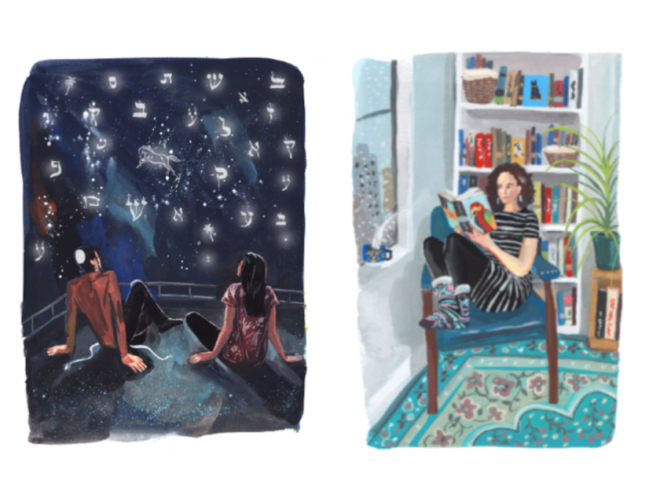
At dusk, they go to Banana Point and peel off their shirts and socks and shoes. They lie on the cliff, the rock warmed from the day. The mountains become shadows of crests and valleys pitched against the sky, like giants sleeping above them. They hear the squeak of beetles in the cool dirt and the quiet inhale of their breaths next to one another. They hold hands and watch the sky fill with stars.
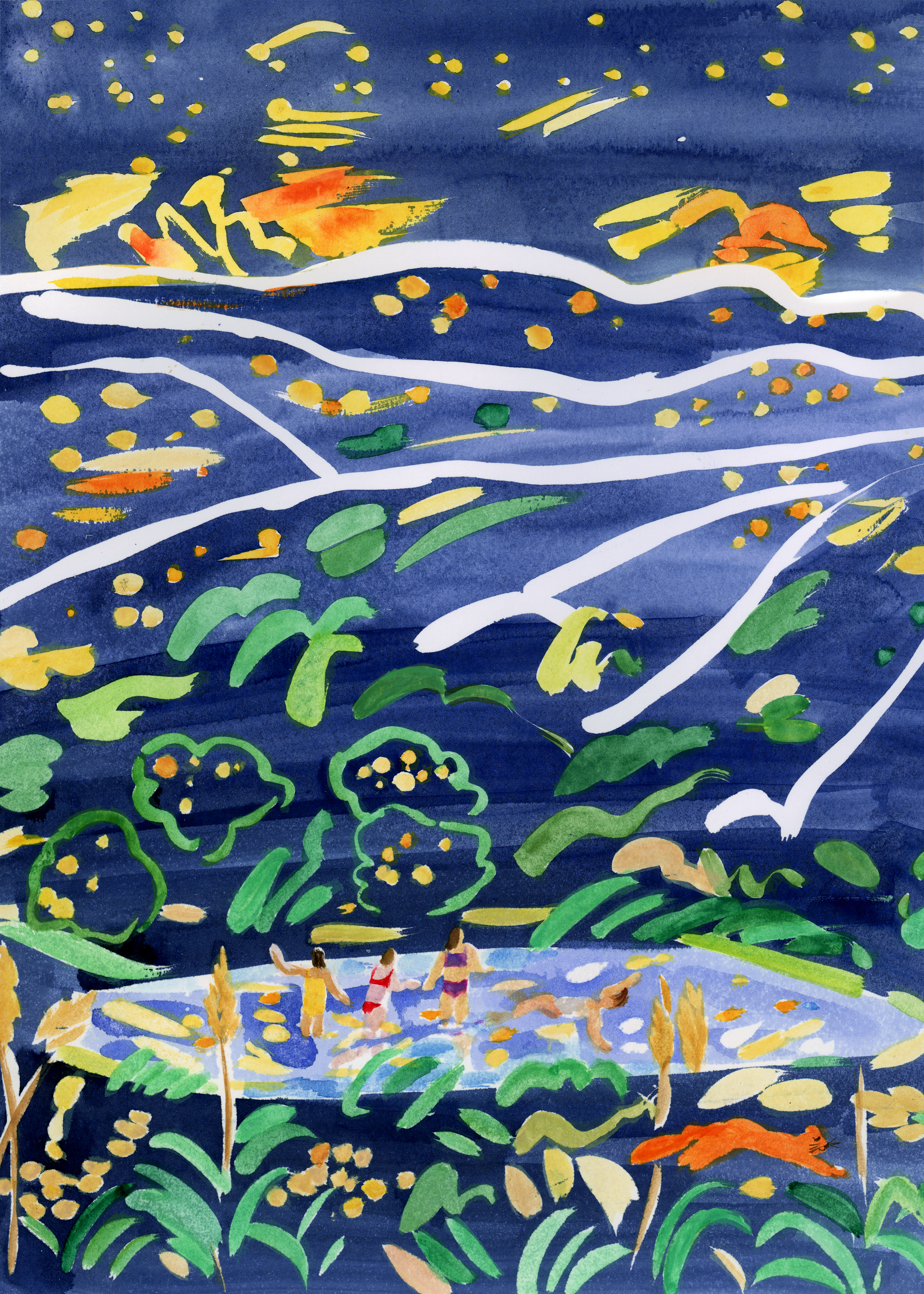
Illustration by Laura Junger
They change their definition of God. It’s more mature! Wiser! God is in the stars, yes, and also in the animals skittering in the bushes, the pulpy flesh of their palms, the swell of glee in the girls’ stomachs. They decide that no matter what, their lives will always be this magnificent. That even when they grow up and get husbands and have babies, they will hold this well of joy in them. They will always be, in this way, alive.
The heat arrives in the morning — eighty-five degrees in the shade but ninety in the sun. The grass on the lower ball field yellows. The oak trees shake off their weakest branches. The ground sucks in the water from the creeks, leaving the flies and bugs to find other things to stick to, like the girls’ skin.
Marnie stays naked after her showers for longer than usual. She’s naked as she runs gel through her hair and applies lotion to her face and arms and legs. She reads books and writes letters naked. She puts on her socks and shoes to walk on the dusty floor of the cabin, but never a bra or a shirt. The girls know they aren’t supposed to look at her body, but they do.
They see nipples the size of Hershey’s Kisses. The soft fuzz below Marnie’s bellybutton. The moles on her collarbone, beneath her breasts, on the lip of her waist. They ask her why her pubic hair is gone and, in its place, bare skin. Marnie shrugs. She says she doesn’t like it when the hair reaches past the seams of her bikini. Or falls onto the floor, shriveled, sticking to her feet. The girls want to know if boys like her this way. Waxed. If one day, they too, will be expected to be calm and unaffected, their bodies smooth and shiny. But Marnie only grins and says they are perfect the way they are.
The next time the girls shower, they shave their pubic hair, bronze and black clumps sliding down their thighs. They can’t believe how quickly their hair collects over the frothy drain, how fiercely it stitches together. They pluck up their fallen hair and cup it in their palms like a kiddush cup filled to the brim. They’ll throw it in the trash can next to the sink. Or they could waft it into the bushes! No, no, they will give their hair to the trees so that this essential part of them may be absorbed and reborn and live in the circuit of nature.
The next morning, a rash spreads across their pubic bones and labia — small red bumps with hard tops. They have never seen this before — not on their moms or the older girls or Marnie. Why is their skin so strange? Why does it burn? Marnie says it’s only a matter of time until they get used to shaving down there. Better to start young and train their skin to toughen up!
The girls press unopened Otter Pops to their inflamed skin and forgo swimming to avoid the sear of chlorine. They miss their mothers terribly. They want nothing more than to wedge their heads beneath their mothers’ chins and feel the vibrations of their cooing.
They try not to touch the rash. They know what happens when they poke skin that itches. So, they busy their hands, making friendship bracelets, playing Cat’s Cradle and Spit and Mad Libs. Marnie tells them to try slapping their necks, their arms, their bellies — anywhere but the sores between their legs.
But at night, they slip their fingers below the elastic of their underwear. Never mind the fine line of dirt below their fingernails and that the bathroom ran out of soap. Forget the Deet that leached into their hands. They scratch and scratch.
The next day, a helicopter circles over camp. The girls follow it up the rutted trail to the top of a waterfall, where a creek trickles over a cliff and slips between two boulders many feet below. The counselors are already there, huddled at the edge, their chins tipped to the sky. The girls shout hello to the helicopter and wave with both arms, and hope, if at all possible, the pilot will give them a thumbs up. Except the counselors tell them to stop. To go back down, where they can be watched. It’s not safe. Not right now. But the girls were just here yesterday! They know these trails! They can help! What is going on?
The girls pinky swear to stay silent, which is how they learn that a counselor from G‑9 fell from the waterfall.
Later, Marnie tells them to sit in a circle on the cabin floor. As long as the girls promise not to hammer her with questions, she will reveal what she knows. The girls pinky swear to stay silent, which is how they learn that a counselor from G‑9 fell from the waterfall. She had been walking along the cliff when she slipped, plunging between the boulders. And her body — wriggling, sweating, and then very still — became jammed. But the firefighters freed her and flew her
to the hospital. And she is strong and she is brave and that is how they are, too!
But the girls want to know if she is going to be okay. How did they get her out? Was it like when their heads would get stuck between the banister railings above the stairs? And their parents would rub margarine in their hair to help them slip out? And is she coming back to camp? But Marnie reminds them they swore they wouldn’t ask questions, and they quiet down, knowing that if they can’t keep this promise, they won’t be trusted to make others.
Still, the girls are forbidden from going to the waterfall. Or to any other waterfalls, including one Marnie had taken them to the week before. The one that spilled over three cliffs, ending in a fifty-foot drop. So the girls insist. Let them go, just this once. That waterfall is outside of camp bounds. No one will know. But Marnie says that for now, they have to follow the rules.
The girls, though, can’t leave nature all alone. That night, they take their flashlights into the wild mustard behind their bunk and scramble up the hill. They dig a hole at the base of the largest tree and place notes in it. Don’t miss us, we’ll be back. We are sorry we couldn’t visit you today. We don’t blame you. We’re not really that far away.
The next day, they slip out of camp just as Free Time begins. They follow the fire trail behind Girls’ Side and then the singletrack cutting up the mountain. They hike to the base of Marnie’s waterfall and count the tadpoles skittering in the sepia-toned shallows. They cup their hands over the frogs until the girls can no longer stand the wet tickle on their palms. They take turns watching the waterfall drip at different angles. They are delighted by the colors flitting through
the spray — opal, turquoise, and magenta.
They write poetry. They write songs. They scream as loud as they can and hear their voices echo off the boulders. They promise they will build matching houses in these mountains and live out their days together, lavender growing wild in their backyards.
Returning to camp, they walk along Mulholland Highway, a narrow road made up of switchbacks descending to the coast. The SUVs whizz by them, going fifty, their winds tugging the girls’ small frames. They brace. They hold hands. They swear they will not, by any means, get swiped under a piece of machinery.
They dip down to a trail that takes them to the upper ballfield, a dirt lot at the top of the camp valley. From there, they’ll trek down the bare slope behind the pool and onto the road leading back to the center of camp. But on the upper ball field sits the security guard on a plastic folding chair. He’s wearing a bathing suit and reading a magazine.
They are Jewish women, returning from the wilderness. Kol ha’olam kuloh, they hum under their breath.
The girls know this could be the end of their adventures. A shuffle down to the camp director’s office. A stern talking to. Supervised for the last ten days of camp, no canteen either. But if they can hold their breaths, and if they can freeze, step, freeze, step, like coyotes stalking their prey, they won’t get caught. And so they do, tiptoeing along the rim of the field. They are Jewish women, returning from the wilderness. Kol ha’olam kuloh, they hum under their breath, keeping their eyes set on the water tank pressed into the mountain beyond, gesher tsar ma’od.
That’s when a low voice calls out to them. Where have you girls been? Why are you all the way up here? What’s going on? They tell the security guard they’d only just arrived there by accident. They had meandered up from the bunks, the lie its own delicious reward. The guard keeps his face turned to the sky and raises two fingers — a peace sign — and the girls hurry off.
It becomes the hottest summer on record — one hundred and ten in the sun. The girls take long naps during Rest Hour. They slink into the shade during activities. They can find it anywhere, these girls. During Israeli Dancing, they slip beneath the ping pong tables. They sit with their backs against one another’s to prop each other up. They plunge their fingers into the cool dirt.
They are told to drink water every ten minutes. To sing “Happy Birthday” in their heads as they’re doing it. To apply sunscreen before breakfast and after lunch. To watch for signs of dizziness or confusion in their friends. As water becomes scarce, they promise to spend only two minutes in the shower. To sleep on top of their sleeping bags lest they sweat too much and lose what little water their bodies can hold. They write down all these precautions and take turns carrying the list in the cuffs of their socks.
The only thing they love more than shade is the camp hose unwound on the lower ball field and sputtering water, which the camp allows once a day. They grab the head of it and spray water into the air, taking turns running through the flash of cold. The ball field becomes a thick swamp, small bees floating in the muck. The girls get stung on their toes and ankles and even on their heels. They spend the afternoon in the infirmary icing their swollen feet, which have grown so itchy that their mouths water at the notion of scratching them.
One morning, they wake up very early, and Marnie is not in her bed. They don’t know where she is and if she’s okay. Did she get in trouble, or is she sick? Did she find a waterfall that held her in its narrow jaws? But before breakfast, she returns.
The girls ask her where she’s been, and Marnie pulls down the collar of her shirt to reveal a pink disc flexing on her neck. The girls know what that is — they’re no fools. They touch her raised skin, the warmth a surprise on the fingertips. They ask if hickeys hurt. Of course not! They feel great! You should have seen the guy, how long he stayed on my neck, how loudly he moaned. One day, the girls will be old enough to get a hickey themselves. One day, they’ll be wanted so badly, they won’t come home.
That evening, the temperature dips and clouds gather above them. The girls hear the rain before they see it. The sound of soft clapping, small fists on glass. The smells find their noses — the musk of dampened dirt, the tang of mustard, the smokiness of oak wood. The life that returns and returns.
They run outside barefoot and head to the wide trail that runs along the side of their cabin. They sling their arms around each other’s shoulders. They jump up and down together as if greeting the water. The rain tumbles onto their hair and skin, a cool deluge, a sudden relief.
Marnie stands on the deck of their cabin, beneath the warped roof, its edges smirking in the rain. She leans against the railing. Her naked figure chalks the night. She lifts a boom box to the ledge and blares techno music at the girls.
They toss their heads back. They are oak trees quivering in the wind. See? Nature always has a way!
The bass vibrates up the girls’ legs and into their chests, knocking their ribs. Without thinking, they weave their arms through the air around their bodies. They toss their heads back. They are oak trees quivering in the wind. See? Nature always has a way!
The next day, the girls sense the boys watching their mouths when they’re eating and their breasts when they play Ga Ga. They do as Marnie told them and let their eyes linger on the boys longer than expected. Until their bodies swell against the seams, their veins and ligaments and bones humming beneath the skin that separates them from the boys.
In the pool changing room, the girls discover eyes blinking at them through the thin gaps in the wood. They grab their towels and burrito their bodies. They huddle. They take turns peering over their shoulders to see if the eyes have been replaced by glinting pool water. They notice a lid close over a hard brown eyeball and snap open again. A wink?
They aren’t sure whether they like the attention or not. They want to dance or run or scream. What is happening? Why are they so nervous? Why are their bodies not listening to them? Be still, relax, stay calm!
They push their bikini bottoms over their knees and let them fall to the ground. They wriggle their toes on the damp concrete. They lift their towels so the boys can see their butts, and then they swing their hips. They push their foreheads together and laugh louder than they ever have. Their bodies no longer belong to them, and somehow this feels good, this shucking.
They spend more time in the bathroom than they used to. They learn to straighten their hair without burning their necks and how to shave their legs in the sink troughs when the showers are full. They learn how to use matte eyeshadow instead of glitter and apply black and gray tones to the creases of their eyelids to produce a smoky appearance.
They lie on wood benches pressed to the walls of the bathroom and pass Judy Blume’s Summer Sisters between them, reading out loud the part where Vix and Bru make love. They want to know everything about sex. What does it feel like? What should they do? When will it happen? Why do they want it, and why are they scared of it, too? They bite their lips and arch their hips toward the fluorescent panels on the ceiling, whispering Bru’s name over and over.
The next day, a dry wind picks up. It carries a silt that lodges in the creases of their necks and in their nostrils and eyes. They hear all sorts of rumors from the boys: There’s a fire in Santa Barbara! No, Agoura Hills, a few miles away! It’s in Thousand Oaks, just over the mountain! It doesn’t matter how far away it is! The boys tell them a fire can travel five football fields a minute.
A fire is attracted to body heat. The more people in one place, the greater the chance a fire will get them. The boys even whisper that all of their parents signed a waiver saying that if they died in a fire, their families couldn’t sue the camp.
Marnie tells them that’s B. S. They’re in good hands. Let the adults deal with it. But they’re in a canyon. There is only one school bus and three SUVs for two hundred campers. If the fire comes, how will they get out? Why won’t someone tell them the truth? They’re smart. They’ll get it.
During Rest Hour, they hear the frantic ringing of the gong. The blunt end of a hammer, two beats per second, pounding metal. The girls clutch hands and walk single file from the cabin. Marnie counts heads as the girls pass her and instructs them to stay silent as they had practiced. To think of their favorite song, but their thoughts stall on a single word, synced to the rhythm of the gong — where, where, where. They join a longer line of silent campers, their eyes fixed on one another’s, asking the same question. They are told to circle on the basketball court, and then to sit, at once.
The camp director holds his mouth close to the microphone when he talks, making his voice deep and muffled as if he were whispering into their ears. He tells them this is just a drill. The fire is far away. It’s many towns over. Also, he reminds them that it just rained. A rare midsummer weather event. The ground is saturated, and the creeks are rising. They will be safe here.
But the next day, the air smells like a campfire. Smoke gauzes the sky, and the sun becomes a Ritz cracker. Parents begin to pull their children out of camp. First, a girl in cabin G‑1, then two in G‑2, followed by three girls in G‑6. Their minivans appear in the center of camp, wheels churning dust. The parents open the doors. Cool air skates toward the girls.
They imagine pressing their noses into the air vents, driving to the deli outside of the canyon and ordering matzah ball soup. They want to be kissed goodnight by their moms and bound tightly in their sheets. They want to wake up to their dogs clicking across their hardwood floors.
The counselors roll their eyes. These parents are overprotective! Just because you can smell a fire doesn’t mean it’s nearby! They’re not even in a voluntary evacuation zone, let alone a mandatory one!
Still, the girls decide they must prepare for the worst. They fill up their Nalgenes with water and hide them below their beds. They take their boy band posters down. Won’t they catch on fire? They take their hairspray off the shelves — can’t it explode? And their bug spray, too. Bombs! All bombs!
At night, they place their shoes next to their bunk beds with their flashlights inside. They sleep in their sports bras and underwear, their clothes folded neatly below their pillows. They take shifts staying awake so they can hear the warning ring of the gong and wake the others. This makes them feel better, this routine. The notion that, yes, if they just follow protocol, they can circumvent danger. Is that not what they learned in school?
There is a strange energy in them now. They fidget with their prayer books during services, creasing and flattening the pages. When they sit cross-legged, they flap their knees up and down. Marnie doesn’t like seeing them this way. They’re just girls. They’re scared. Come on, babies, I’ll take care of you! I’ll show you what’s right and how to be.
Marnie takes them on hikes — never too far and always at dusk. She tells them to focus on what’s in front of them. Reality will present itself if they just let it. But the bushes are too still. Animals no longer scurry through the branches. (The girls used to call out greetings—Shalom finches and gophers and snakes! Ma nishma?!) Now, they can’t even find the stink bugs. Where have the bees gone? Why aren’t they suckling the purple sage?
Above them, the sky glows periwinkle and coral. And Marnie wants to know — would the sunset really be that beautiful if something were so wrong?
They arrive at a clearing with a small pond, where cattails rim the shore, their auburn tufts torn open by the wind. A boulder rises from the reeds, and the girls and Marnie scramble to the top. They find nooks into which they can burrow. In front of them, the mountains fall into a narrow valley, giving way to the smudged horizon of the Pacific. Above them, the sky glows periwinkle and coral. And Marnie wants to know — would the sunset really be that beautiful if something were so wrong?
Marnie stabs the side of an apple with a pen and clears out the fruit from the wound. She plucks the stem and bores a hole down the center of the apple, then fills the divot with brittle leaves from a Ziploc bag. Marnie tells the girls it’s ganja, Mary Jane, marijuana. Do they know what that means? Of course they do. Some of them have older sisters and brothers. They watch TV! But is she really going to do that? Right now?
Marnie thumbs the lighter until the leaves spark orange. She places her lips to Marnie thumbs the lighter until the leaves spark orange. She places her lips to the opening she’d carved with the pen and inhales, her eyes closing gently. Her chest blooms. Her body becomes still and silent and held. And then she exhales a ribbon of smoke that coils around the girls. But won’t she get in trouble? And won’t the drugs make her sick? Will she become a burnout, like the drug addicts they see on TV, forever in a veiled room, the blinds closed?
Marnie laughs and says they’ll love weed soon enough. They’ll love everything about it. They’ll love being older. They’ll love having sex. She tells them their vaginas will expand, bringing the base of her thumbs together, her palms winging out.
She tells the girls to ask her anything, and the girls want to know how, exactly, they’ll know when they’re ready to have sex. Won’t they be scared? And won’t it hurt? Should they tell their mothers? And Marnie says that their desire will arrive as instinct and that no mother has to know about it.
They look behind them to the mountains beyond the camp, dividing the wilderness from their hot concrete suburbs. Strange clouds are forming on the ridge line. They have thin bases that shoot into the sky and grow into gnarled fists. The girls have never seen clouds so tall or so dark. They know not to ask what’s beneath those clouds. Marnie tells them to try the weed. Just one puff. They’ll be okay. So, they inhale and hold. They let the burn sear their throats, and then they cough.
The girls take off their clothes and wade into the pond, up to their calves. They splash each other with the sour water. They make wigs out of the algae, pretending to be their moms. Oh, how we missed you! Camp has been good to you, my dear. Oh my! Did you lose weight?
The girls hadn’t realized how different they’d become from one another. Some of their stomachs have slackened and rippled; others are now pulled taut against their ribs. Acne crawls over the backs and shoulders of two of them. And their nipples! One girl’s look like fingers pointing. Another’s resemble Tic Tacs, hardly breaking skin.
They call out for Marnie to come down to the water. To join them. But Marnie smiles at them from above, her legs teetering over the edge of the rock, her lips latched to the apple. An ember glows and lifts into the wind.
The girls push deeper into the pond. They float on their backs. Their stomachs whirl into their throats. Their skin will soon peel off. Their blood and tissue and all the liquid contents of their bodies will dissolve. They will become one with the water.
But after twenty minutes, they grow bored and pad onto the shore. They part the reeds and climb the boulder again, their muscles loose, letting them go farther up than before. The girls find new hollows to settle into. The warm stone dries their skin.
They can’t wait to tell their friends back home how much they’ve grown. They’ll explain how far they hiked — seven miles! — how far into the smoke they went, how they tried weed, how they swam and laughed, how they stayed unafraid. Isn’t that what it means to be Jewish? The whole world is a very narrow bridge.
It flickers in deep tangerines and ambers and golds. How beautiful, the girls think, like the mountains are wearing glitter. How far away, of course, like Marnie said all along.
The wind rakes through the brush, chorusing like a freeway. The 101! The 405! The 5! An orange line swoops across the crest of the mountains. It flickers in deep tangerines and ambers and golds. How beautiful, the girls think, like the mountains are wearing glitter. How far away, of course, like Marnie said all along. And meager. That will be easy to put out — one helicopter, a short deluge. The flames will dim into the darkness of the mountains. They should stay to watch it! Yes, nature is strong, but not as strong as firefighters and carefully laid plans.
Smoke buries the stars. When the wind turns, the girls cough, and their eyes water. They can no longer see Orion’s Belt. But if they look very hard, they can see three stars — two along a diagonal, the third at the end angled sharply above. They tell Marnie to look. Just squint your eyes and hold your breath and, now, don’t you see it? The handle of the Big Dipper.
They confide in Marnie that they used to think the stars were God. Marnie winces. God! Please! Do they know what stars are? Do they know? Dead gas! Big ol’ space farts! They’ve been manipulated by their religion. It’s all just a farce, one big show, to appease the masses. Don’t they see it? Don’t they see it now? The world’s a lie! And there’s nothing they can do about it!
They cackle like coyotes.
Ali Littman is a fiction writer and playwright based in San Francisco. She is currently finishing a short story collection about the girls and women of a Jewish sleepaway camp, of which “Coyotes” is the seminal story. Her work has appeared in the Brooklyn Review and Barren, and her play, Banana Point, is a finalist with the Bay Area Playwrights Foundation.