Join a community of readers who are committed to Jewish stories
Sign up for JBC’s Nu Reads, a curated selection of Jewish books delivered straight to your door!
This piece is part of our Witnessing series, which shares pieces from Israeli authors and authors in Israel, as well as the experiences of Jewish writers around the globe in the aftermath of October 7th.
It is critical to understand history not just through the books that will be written later, but also through the first-hand testimonies and real-time accounting of events as they occur. At Jewish Book Council, we understand the value of these written testimonials and of sharing these individual experiences. It’s more important now than ever to give space to these voices and narratives.
Monday afternoon, 2 March 2026 / 13 Adar 5786
The whole building trembles
and I can’t tell if it’s the children
tripping up and down the stairs
in their Purim costumes,
or more missiles
screaming through the sky.
The whole world wails,
everything but the dead,
even the land
and my heart,
(my God, how human)
while I stand here at the table,
chopping vegetables and imagining
how thin the walls must seem
from outside those grieving homes today,
in Tel Aviv, Beit Shemesh, Tehran, and Minab,
from whatever horizon the outstretched fist fell. [2]
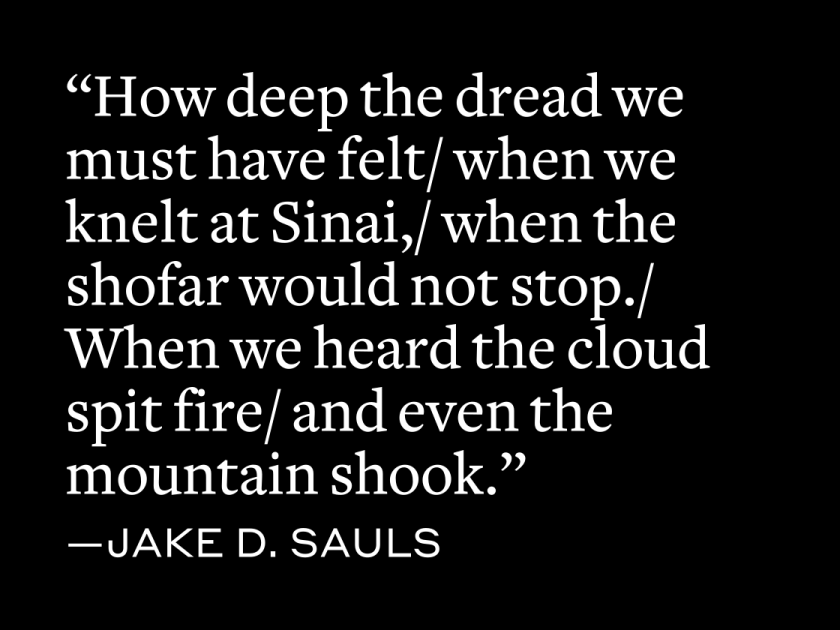
How deep the dread we must have felt
when we knelt at Sinai,
when the shofar would not stop.
When we heard the cloud spit fire
and even the mountain shook. [3]
Monday late afternoon, 2 March 2026 / 13 Adar 5786
A knock at the door and my heart stops,
knife suspended midair.
Someone will have complained, I suppose,
about all the noise.
But it’s just the old Arab who tends the grounds
and he holds up his hand–no, don’t worry, please–
he holds out a box of halva cookies–
for the children, he says, for the chag. [4]
It’s the 13th day of Ramadan; it’s the fast of Esther, [5]
and the sun sits just behind the Temple Mount
like rival gods, hard shimmer answering hard shimmer,
and his eyes smile when I offer a cup of coffee.
He looks over his shoulder at the little house
on the edge of the parking lot where his wife waits, pious,
where his family has lived in the shade
of a little green lemon tree for 103 years.
And the cookies melt, sweet as hot coals, [6]
on both our tongues. Ah-meen, he says with a sigh,
and I surprise myself by answering:
Ah-meyn. [7]
Last summer, [8] in the middle of the day,
the kids pointed at a falling star
and I did not correct them.
I called it beautiful,
let it land softly
magical
upon their memories.
[1] “Negative Space” is an art term for the shape made by absence, the space around an object. In a Jewish-mystical register it can also suggest concealment and contraction, the way meaning is shaped by what is withheld as much as what is spoken.
[2] “Outstretched fist” inverts a common biblical idiom, “an outstretched hand/arm” (yad netuyah, zeroa netuyah), used for overwhelming power, deliverance, or judgment (especially in the Exodus language). Here the image is recast as a human-made force falling from the horizon.
[3] Echoes the Sinai theophany: the shofar blast growing louder and louder, and the mountain trembling (Exodus 19:16 – 19, 18). In the Sinai story sound and shaking mark a moment of overwhelming revelation, when the people recoil because unmediated power is so terrifying.
[4] Chag (חג) is Hebrew for a festival or holiday.
[5] The Fast of Esther (Ta’anit Esther) is observed on the day before Purim; Ramadan is the Islamic month of fasting.
[6] “Hot coals” evokes two coal-on-the-lips scenes in Jewish tradition: Isaiah’s purification and commissioning when a seraph touches his lips with a live coal from the altar (Isa. 6:6 – 7), and the midrash in which the infant Moses burns his tongue on a glowing coal while being diverted from grasping Pharaoh’s crown, and thus becomes “heavy of mouth and heavy of tongue” (Exod. 4:10; Shemot Rabbah 1:26).
[7] Arabic Amin and Hebrew Amen are near-cognate responses meaning “so be it,” used after blessings or prayers.
[8] During the “12-day war” with Iran in July 2025.
The views and opinions expressed above are those of the author, based on their observations and experiences.
Support the work of Jewish Book Council and become a member today.
Jake D. Sauls is a writer and educator based in Jerusalem. He is currently completing an M.A. in Jewish Studies at the Hebrew University of Jerusalem, where his research traces the ketoret incense ritual through Jewish rabbinic and mystical traditions. His short-form work has appeared in publications including THEM, The Independent, Bellevue Literary Review, Bloom: Journal of Queer Arts, Duende, Autumn Sky Poetry Daily, and Judith Magazine. He is the best-selling author of The Passover Princess, Those Witches’ Winds, and other books. He is also a co-creator of Small Books for Big Feelings, an early chapter book series developed with his team at Ink & Or Bookworks. His novel Where Letters Swim and Swallows Burn, a work of Jewish “mystical realism” set in Jerusalem after October 7, is forthcoming.