Join a community of readers who are committed to Jewish stories
Sign up for JBC’s Nu Reads, a curated selection of Jewish books delivered straight to your door!

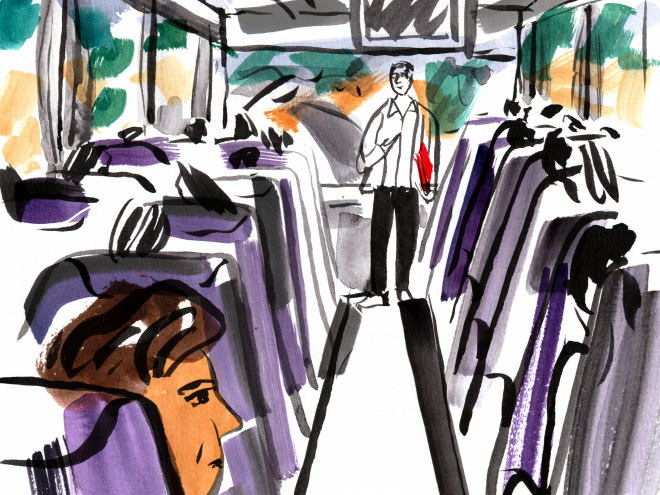
Illustration (cropped) by Maya Ish-Shalom
Join us on May 5 at 12:30 p.m. ET on Zoom for Paper Brigade Presents: The 2026 Celebration of the Short Story, featuring Nicole Hazan and Ali Littman. Get your free ticket here!
____
The hotel breakfast buffet has flaky almond croissants, labneh with za’atar and olive oil — 5 percent and 22 percent fat — three types of bread (rye, brioche, sourdough), but you can’t enjoy any of it because wherever you go, the ghosts won’t leave you alone. Savta Sara stands next to the salad bar, and when you put an omelet onto your plate, your hand brushes her veiny right arm. You don’t feel her skin against yours but the contact makes you smell burning, taste thick smoke. You jerk your hand back, stammering an apology, and she tuts, but at least moves out of your way. Back at the table, your parents sip cappuccinos, Mom’s hand resting on Dad’s thigh. They have always been that way; you’ve never seen two people so dependent on one another, and you feel a flash of irritation. Your nephews, Ari and Eitan, are at the table, too, powdered sugar dusting their mouths. You put your plate down and Ari leans back, kicking the table leg, his chair nearly tipping onto the tiles before he falls forward again. He continues rocking, knocking the table edge, spilling Mom’s coffee onto the tablecloth.
“Ari,” Mom says, absently.
The table is full of food that no one is eating. You check your watch. When Ari keeps kicking the table, you slap down his leg. He slaps your leg back.
“Go wash your hands,” you tell him, looking at your denim shorts, which have white smears all over them. You only have two pairs of shorts with you and knowing you now need to take this pair, still stiff from the dryer, back to the launderette makes you so angry you want to tip over his chair yourself. Ari races away through the tables in the opposite direction of the bathrooms, and heads turn. Most watch him with the same vacancy as Mom, but others smile.
Approaching you from the buffet, Savta Sara tuts again. She takes Ari’s empty seat at the table and you shift your chair away from hers. She studies his half-eaten croissant. Her translucent fingers twitch, as if she wants to pick it up and finish it.
“What are we doing today, Naomi?” Savta Sara asks, cheerfully. “Are we going home?”
She already asked you the question twice this morning, three times yesterday. You summon patience, a smile. You don’t want to be short with her, and even if you felt like snapping, Dad would never allow it. “Not yet,” you say.
“That boy will have an accident,” she says, nodding after Ari. She often lectured your brother about keeping his seven-year-old in check. You were her favorite grandchild; you had the patience to play shesh besh with her and listen to kibbutz gossip. When you were a kid, she picked you up from school and made you lunch and let you watch hours of TV. Even after she started forgetting things, you still went over twice a week.
Savta Sara is wearing her blue nightgown covered with swirling suns. She was murdered in it and you wonder why she hasn’t changed into something else. There’s no blood on her now. All her limbs are intact. Her white hair shines under the restaurant lights.
“Do you want to go to the pool?”
“Maybe later,” you say. You wish your parents would intervene, but although Dad glances up, smiling thinly at Savta Sara, he goes back to murmuring with Mom. You can see the pool through the restaurant windows, water flashing. A woman sits fully clothed on a beach chair, staring straight ahead, her towel folded in front of her. Her kids shriek inside the pool, as if for help.
“What else are you doing? Going to a disco?” Savta Sara asks. She looks at you suspiciously and you have a moment of panic, but apparently, it’s a rhetorical question because she doesn’t wait for an answer. She leaves the table — you think in a huff, but then you see her friends Shmuli and Benny in their pajamas, waiting for her. The three of them were always inseparable, gathering in one of their front gardens, watching the rest of you walk past, pretending to drink Turkish coffee instead.
When you look at the dining hall entrance, the ghosts are gone. “We have to do something about them,” you say to your parents.
A baby wails and you stiffen, as if the noise were a siren. Leah Cohen undoes her blouse to breastfeed and your heart rate slows. When you look at the dining hall entrance, the ghosts are gone.
“We have to do something about them,” you say to your parents.
“They want to be with us, Naomi.” Dad drains his coffee, pushing his glasses up his nose. His cup leaves a brown ring on the tablecloth. He tilts his chin, looking for a challenge. You fold your arms, ready to fire back.
“Where else have they got to go?” he asks.
You lower your gaze. You pick up your fork and take a bite.
____
In the hotel room, there’s a knock at the door. You feel a shiver of excitement. When you open it, Tal grins at you. You glance behind his head before letting him in.
“To the minute,” you say, tapping your watch.
“I’m on army time,” he says, slinging off his M‑16 and propping it against the wall.
You aren’t used to seeing him clean-shaven. He stands awkwardly, one hand in his pocket. He’s always been a terrible dresser, walking around the kibbutz barefoot, scissoring off the necks and arms of his T‑shirts so half his torso is visible. He’s in one of those T‑shirts now, paired with faded jean shorts, too big for him, that he’s had since high school. He pulls his hand out of his pocket, fist clenched.
“I brought you something.”
“Really?”
You fight back a smile. It’s too soon for presents, isn’t it? But when he opens his hand, it’s Yoshi the dinosaur, with his green body and orange boots. It takes you a moment to get it. That high school Purim party, when you all dressed up as Mario Kart characters. You’d hoped to be Princess Peach so you could wear a dress for once, but of course Ori claimed her. She wanted to match Tal, who was going to be Mario (even though she’d just broken up with him again), so you wound up as Yoshi, whom neither of them wanted to be. Still, as a trio, you had an effect. People took pictures of you together, walking around like that.
You laugh.
“I saw it and I couldn’t resist.”
“I didn’t know they had these anymore.”
“It was in some random stand on the beach.”
You take the plastic toy out of his palm. You feel the little shock of electricity as your fingers graze his. He’d seen it and thought of you. That has to be a good sign, doesn’t it? Tal looks around the hotel room, the cream walls and bland artwork, the little wooden side tables, your bed next to your parents’ with its rumpled sheets.
“How’s reserve duty?” you ask.
“It’s good to see the guys again,” he says. His eyes are red-rimmed. They fix on you in that way that makes it hard to focus on what he says. He talks a little about guarding the Lebanese border, how they sleep in the woods because the army bases are a target. He’ll sleep well in the hotel bed, even if it’s just for the weekend. You tell him jokingly that it’s too crowded to sleep well here; your mom stares at the ceiling most of the night and Savta Sara tries to share your bed, singeing the covers so your hair stinks of smoke the next day. Your nephew in the adjacent room starts kicking his football against the wall at 7:00 a.m. with the precision of an alarm clock. But saying this out loud, a hard knob of guilt forms in your stomach. Six weeks before, on that terrible day, Ari hid in the shelter for seventeen hours, with no air conditioning and only a packet of cereal bars, and your brother told you that when the shelter door was shot at, your nephew stayed rigid and silent. When the army finally rescued them, his mother made him close his eyes and hold the strap of her backpack as they left the destroyed kibbutz, stepping past bodies with limbs hacked off. But he must have smelled the burning. How can you begrudge him kicking a football around, for getting your shorts dirty, for playing games on his phone with the volume blasting so that the soundtrack sticks in your head?
You trail off and Tal doesn’t fill the silence. He’s never been much of a talker; neither of you is. Ori was the extravert, with her bright clothes and loud laughter, the way her hands moved when she spoke. You and Tal sometimes exchanged looks over her head, smiling as she went on and on.
Tal takes your hand. Your heart gives a thump. He’s nervous, biting the inside of his cheek. You draw the chain across the door. He’s tall and skinny and has lost so much weight in reserve duty you can feel the knobs of his ribs under your fingers. His breath is hot against your neck, his tongue slow in your mouth. You peel off each other’s clothes as if you have all the time in the world, although your parents could come up from breakfast any moment. You press the small of his back, pushing him further into you, and you think of Ori. You imagine her bent over, a hand on her neck, blood on her thighs, but you work hard to force the images away and eventually, the world is blank and white. You make sure you’re quiet when you come, but he gives a mournful grunt, and when he collapses onto you, his ribs press into your stomach.
You hold each other but he turns his head and a muscle works in his cheek. Is he thinking of Ori, too? He kisses you and your eyes close and you think it might start all over again, but he gets up to pull on his boxers.
“See you tonight,” he says, “after dinner?”
You nod; of course you do. You’ve been waiting years for him to want you like this. You stand at the door kissing a while, then you slide back the chain. He walks down the carpeted corridor and you check for ghosts coming out of the bedrooms, hoping none have seen him leave. More are showing up every day as bodies from the kibbutz are identified, and word gets around fast here. It wouldn’t matter to everyone that you fell in love with Tal first, before Tal and Ori even kissed, how from when you were fifteen, you and Tal spent Saturdays together, hitch-hiking to the beach just the two of you because Ori didn’t like the sand. You saw how he noticed you in your bikini and if Ori hadn’t stepped in, something would have happened then. Even after they
became a couple, Ori broke things off every five minutes, and a year ago, after she left for Tel Aviv, it seemed like she forgot Tal in an instant. She was more interested in men with three roommates and tattooed calves who sent texts to come over at midnight than in Tal, who bought her engraved jewelry and leapt up to bring her water every morning, asking how she’d slept.
But being with Tal the last four weeks has stirred up the most terrible excitement you’ve ever felt. Everyone said Tal and Ori were destined to be together, but you were sure they had it wrong. It was always meant to be you.
____
That evening, you have Friday night dinner early, the dining room crowded with kids. Mothers fight back tears, clasping their children tight as they say Kiddush. Afterwards, you and Tal leave the hotel separately to avoid anyone seeing you together, an unnecessary precaution since it’s well known you’re old friends. On the promenade along the beach, you relax, pointing out plants as you go — acacia, palm, guava, floss silk — laughing at your obsession with different types of trees. You’re studying to be a tour guide, which, now that there is no tourism, seems like a waste of time. All those facts you’ve learned about Israel, its history, its climate. Everything is closed because of Shabbat so you take off your shoes and trudge close to the sea, and in the dark, Tal slides a hand into your shorts. Something about being outside the hotel makes you freer, more energetic, and more than once Tal urges you to be quiet, afraid people might notice, though there’s no one around. Afterwards, you lie there a while, talking, and when you get up, you shake the sand out of your hair and taste its grit in your mouth. You only unclasp hands as you approach the hotel, Tal drifting off toward the pool deck alone. You wish he was with you as you slip through the knot of men gathered outside the main entrance, thick tefillin spread across their shoulders, bobbing as they pray, chanting about the coming of the Messiah. They showed up weeks ago as soon as word spread about the ghosts, coming into the hotel lobby to gawk and pray until you all demanded they leave. Now, they stand vigil outside, sweating through their suits. One of them tries to talk to you, asking to be let inside — to see the ghosts — and you shake your head, pushing past. At reception, you complain again about the men blocking the entrance. The hotel manager nods sympathetically but you doubt he’ll do anything about it.
Getting ready for bed, your parents already asleep, you replay the night over and over. How Tal looked at you when you were having sex. (Men don’t usually do that.) Your lips still burn from kissing.
You and Tal have agreed to meet during breakfast the next morning and you wonder how you’ll survive mealtimes after he leaves for reserve duty on Sunday. You feel sudden terror. What if something happens to him? What if he doesn’t come back?
You spit toothpaste into the sink and there’s a knock on the bathroom door. Did you wake up Mom again? You open the door and drop your toothbrush.
“So this is where you’ve been hiding,” Ori says.
“Ori,” you say. You open your mouth and close it. There’s a high tinny noise in your ears. You pull her towards you roughly. It’s worth the rising smoke, the sounds of stifled sobs and uneven breathing — people trying not to be heard. Her sharp chin presses into your back. You hold her until your T‑shirt sizzles. “I hoped … we all hoped …” you begin.
“I’ve been looking all over for you,” Ori says when you pull away, shutting the door. “I asked my mom, she said you usually have dinner with your parents, but you weren’t in the dining hall.” She wrinkles her nose. “Still, I don’t blame you, the food looks awful. And why is everything on paper plates? They’re so cheap.”
Your hands shake. Ori pushes a strand of hair away from your face. It usually irritates you, the way she grooms you. She sometimes even undoes a button on your blouse if she thinks it looks better that way. She touches your forehead and you jerk back at the sensation of being thrown against some hard surface.
“Sorry,” she says, noticing. “I keep forgetting I’m not supposed to touch anyone. My mom keeps kissing me, then almost passing out. But it’s not like I can help it.” She studies you. “You hoped what?” Her teeth catch her lip. “Oh, Naomi. I’m sorry. I thought you knew what’d happened to me.”
Solid in front of you, feet planted wide apart. She’s wearing shorts and the oversized T‑shirt she sleeps in, and no shoes. Her hair hangs loose and dark down her back. You wipe your tears away with the heel of your hand, then stop bothering. After a while, you manage to get it together by focusing on the swirling brown patterns on the bathroom floor. What right do you have to cry?
“I thought …” You take a shuddery breath. You press your bare feet against the tiles.
“They said maybe you were taken hostage. We all hoped …”
Ori makes a clicking sound with her tongue. “I hid in a bunker with the others. There was a grenade. It took them a while to identify me, so …” She scrunches her eyes shut, then opens them and moves past you, hopping onto the sink. “Trust me, this is better than being a hostage. You know what they’re doing to those women? I’m surprised no one told you. The whole kibbutz is talking about it.”
Ori blurs double. She bends close, as if to place her hands over yours, then checks herself. The fine hairs on her arms glow in the dim bathroom light. A silver pendant swings from her neck as she leans forward. You recognize it. Tal gave it to her before he enlisted in the army, but she didn’t wear it much. You remember standing with him in the jewelry store as he’d agonized over whether to buy the silver heart or a Star of David, dotted with zirconia crystals.
“Don’t cry,” she says. “You’ll wake up your parents. You’ll get blotchy and I can see in your makeup bag that you only have one face mask left. Don’t waste it on me.”
You try to laugh. It comes out more like a cough. You blow your nose, pinching out a tissue from the wooden holder on the sink. You want to hug her again but you keep a safe distance. Ori leans back against the mirror, reflectionless. She rifles through your makeup bag.
“I like this lipstick.” Her fingers keep flipping through. “Condoms? Nice. Who’s the lucky guy?”
She holds them up, but the gold packages spark and sizzle at the corners and fall onto the counter, and she sighs. You feel a grip of terror.
“Quiet!” you whisper. “My parents will hear.”
“Who are you sleeping with?”
“No one,” you hiss.
“I’m gone for six weeks and I miss this gossip? Don’t tell me it’s Yuval? He’s always had a thing for you.”
“No, of course not. It’s just … in case, that’s all. I always keep some around. I didn’t even remember they were in there.”
She narrows her eyes at you and you force yourself to hold her gaze. Your heart hammers. Eventually, she looks away. She swings her legs over the sink.
“So, you’ve been cooped up here,” she says. “Have you been in the hotel all this time? I would lose my mind, I swear. What do you do all day?”
“Not much.” You tell her, whispering, about how your parents cling to each other, how they’ve started to share one plate at mealtimes, your mom unable even to choose what she wants to eat by herself. You open the bathroom cabinet to show Ori your mom’s anti-anxiety medication. Ori replies, not bothering to lower her voice, that once the pills kick in, your mom will be fine. She reminds you that once, in sixth grade, your mom stopped in the middle of the classroom while handing out photocopies, like she’d forgotten what she was doing, and her eyes completely glazed over. Like a zombie, Ori says. But two weeks later, she was back to herself, red pen slashing lines through your math tests.
You nod uncertainly. This feels different. Still, no one in your family talks about these things so what do you know? Ori’s entire family seem to share their most inane or intimate details, from what they eat for breakfast to whether Ori should go on the pill.
It’s not so bad, Ori being a ghost. She already knows more than you do — how Kobi had a screaming fight with his wife, Yael (which was heard through the walls), because she wants him to rescue their eight-and twelve-year-old sons held hostage, even if it means marching past the border — causing Kobi to leave the hotel and drive off. Of course, Yael, being a ghost, couldn’t follow him. She tried, though. She made it out the door to the edge of the parking lot before she appeared right back in the dining room.
You tell Ori you’re going to sit with Yael at breakfast the next day, but Ori replies that now that Kobi is gone, Yael can’t stand to talk to anyone who isn’t dead.
She still dominates the conversation but somehow manages to make you feel like you want to tell her all your secrets. Almost.
Ori veers onto other subjects and listening to her, it almost feels like old times. She still dominates the conversation but somehow manages to make you feel like you want to tell her all your secrets. Almost. As if reading your mind — can ghosts read minds? you wonder, panicking — Ori says, “I heard Tal’s back from reserve duty.”
“Is he?”
“Typical,” she says, “that he would avoid me, as usual. He can be so petty. He’s like a woman, sometimes.”
“I know,” you say, hating yourself for it. You even add an anecdote about how he always keeps lip balm in his pocket, and sometimes you borrow it from him so you don’t need makeup when you go out. Ori gives a half smile, and sniffs.
“I thought he might want to know I’m dead, that’s all.”
“Of course he would,” you say, meaning it. “He’ll be devastated.”
“He’s still angry at me for ending it. But that was nearly a year ago, Naomi! What does he want from me? You know, if he had died, I would at least offer him my condolences. He said I was the love of his life! He wouldn’t let me forget it the whole time I was in Tel Aviv. Sending me flowers all the time — to my office, can you believe? Turning up drunk at three a.m. outside my flat …”
“He never told me — ”
“So many people want to speak at my funeral,” she says. “My mom has started to tell them no. Can you imagine how boring it would be if she let everyone speak? But Tal hasn’t even asked.” You watch her legs swing. “Not that I’d want him to make a speech. He’d tell the most embarrassing stories.”
“You should go find him.”
You’re not sure why you say this. Maybe you don’t want to tell him yourself, see that hope and despair and anger reflected back at you. “You could probably do with a talk.”
“I’m not sure we have anything left to talk about,” Ori says, but you can see she’s thinking about it. She’s always liked the idea of making an entrance. “He’ll have a heart attack. Start obsessing over me all over again, especially now that he really can’t have me.”
You protest, weakly, but she’s not really listening. After she leaves, you spend a long time in the bathroom: you can’t face hearing your parents’ breathing in the dark.
You can’t believe they got Ori, too. How stupid you were to think she might still be alive. That maybe she would be rescued. Savta Sara, Benny and Shmuli; all five members of the Lotem family; Aviv, who, when you were in class together, chewed his pencil down to the lead. All of them ghosts. When you look in the mirror, your cheeks are flushed. You try some techniques you learned from the psychologist, some deep breathing, but it doesn’t work. You weren’t there. That morning, you woke up to sirens at a friend’s, hungover, nearly an hour away. When you saw the videos of shooting in the streets, you realized you hadn’t known what fear was before. You bolted the doors at your friend’s apartment, checking your phone again and again to see if the double check marks had turned blue. There was a constant movement in your chest, like the beating wings of a huge insect. I love you!!! your mom texted you. But for some reason, the terrorists passed their house, went on to the next one.
It was just by chance that Ori was visiting the kibbutz, that you were away. In your place, Ori would already be volunteering to help, visiting kibbutz members in hospital, driving all the way back to feed the cows or chickens, despite the sirens and rocket fire. But all you have done in the last six weeks is to give blood and half-heartedly babysit your nephews.
Later, in bed, you imagine Tal choosing half-opened sunflowers, Ori’s favorite, googling her office address and paying for delivery, turning up outside Ori’s apartment in Tel Aviv and begging her to let him in. Who were you kidding? Everyone was right about them being meant for each other. A slow ache spreads through your chest. You’ll miss that blankness when he holds you, that sense of the world being very far away. But you won’t cry. After all the real tragedy, you don’t have the right.
____
At breakfast the next day, Ori and Tal come in late together and Savta Sara nods at them across the room, making jokes about star-crossed lovers, how with those two, you can never keep track. You grunt something noncommittal — it feels pathetic that Ori has beaten you again, even as a ghost — and scroll through your phone. You have dozens of WhatsApp messages from well-meaning people checking in that you don’t have the energy to answer. You flip through Instagram instead: people are claiming you can’t prove babies’ heads were cut off. You look
at pictures of charred bodies and a dizzying feeling spreads through you, as if you’re levitating several inches above the floor. You push your phone away, and across the dining room, Tal meets your eyes. Ori says something and he turns to her, smiling. He leans close like he might kiss her. Are they holding hands? You taste bile. When Ori spots you, she gestures for you to come over but you pretend not to see, and as soon as you can, you escape the dining room.
Tal is going back to reserve duty tomorrow morning. You try to believe it’s better that way. But you have to say goodbye. If something happens to him, you’ll never forgive yourself for hiding from him and sulking like a child.
There’s no one by the pool so you stretch out on a lounge with your sunglasses on. Here, every day is Saturday. You wish you had a job. Or something to do. That you could go home to the kibbutz. Not that you have a home to go to. You check yourself: at least you’re safe. If you want, you can do whatever you like.
“Take a picture,” Ori says.

Art by Maya Ish-Shalom
You look up. With your sunglasses on and the light shining behind her, she’s silhouetted against the pool. You reach for your phone and aim it at her but she comes close to you and throws an arm around your shoulders. You feel a sense of vertigo, of being thrown back against a wall, the pain of cracking against it. There’s smoke in your mouth and nose. You lean forward and cough.
“Sorry, sorry,” Ori says, taking her arm away. “I meant take a selfie. Of the two of us.”
You drop your sunglasses into your lap and take a photo but when you check the screen, Ori isn’t there. You’d forgotten that Savta Sara keeps begging you to take family pictures, and whenever you do so, she’s missing from the image.
“That happened with Tal, too,” she says. “I wanted him to post it, but I’m invisible.”
She settles on your beach chair and you perch on the edge, careful not to touch her. She lifts her head towards the sun. “I tried to leave just now,” she says. “I started to go for a walk — I wanted to give those religious guys something to really get excited about — and I ended up right back in the dining room. It was like there was a hand on my shoulders, forcing me back.”
She glares at you as if you’re responsible, but just as quickly, her shoulders sag and she twists away again. You’re both quiet for a while. “There was so much I wanted to do,” she says.
“Think about the good times,” you say, stupidly, and when she doesn’t reply, you find yourself babbling about the fun you had together, pregaming with the cheap vodka from the mini-mart before Friday nights in the pub, how funny that it was written on the bottle that it could be used “for drinking or cleaning purposes.” You trail off as you remember that neither the mini-mart nor
the pub exist anymore. The thought gives you a strange dizzying feeling, the sun too bright in your eyes. “We can still hang out,” you mutter. “At least that.”
Ori was going to start her own NGO. Next month, she would have traveled to India. You want to tell her the world is silent without her.
She sighs. You bite your lip hard. Ori was going to start her own NGO. Next month, she would have traveled to India. You want to tell her the world is silent without her.
“It sucks,” you say, forcing your voice steady. “It shouldn’t have been you.”
“Who should it have been, then?”
You blow air through your lips. You want to kick the beach chair or hurl your phone into the pool. “It’s not fair.”
“At least you’re alive. Stop sulking, for once. Why didn’t you meet Tal during breakfast? He was waiting for you.”
You start to stammer a reply but she speaks over you. “I asked you why you had those condoms. Why didn’t you tell me?”
Siblings, a boy and a girl, approach the pool, floaties inflated. You say, your voice thin, “I never would have started anything if I knew you were coming back.”
“But I’m not back.”
You squint at her. “What do you mean?”
She leans her shoulder against yours, demonstrating. You jump, wincing at the sound of something heavy crashing to the ground. Something hard flickers across her face.
“Sorry,” she says flatly. “Tal really likes you, you know. He went on and on — Tal, the big talker — about how he didn’t want to see anyone else but you after that day. That it suddenly
felt like the most natural thing in the world. He told me it’s been four weeks. The two of you together.”
“He said that?” You stare at her. You shake your head. “People say you’re destined for each other.”
Ori looks at you for a long moment. “Naomi,” she says, in that way she does, “grow up.”
“It’s not going to work.”
“I mean, his snoring might put a damper on things, but if you can get over that, I don’t see why not.”
“I can’t believe you don’t mind.”
You clench the sides of the beach chair. The siblings are in the pool, their floaties garish. The water slices light.
“Oh, for God’s sake, Naomi, stop punishing yourself. Are you going to wait around until he meets someone else?” Ori sighs. “You have to make the most of it.” She flings up her hands. “Will you at least try?”
You shrug. The girl screams as she splashes her brother and you flinch at the sound. He splashes her back and the pool fills with cries of laughter.