Join a community of readers who are committed to Jewish stories
Sign up for JBC’s Nu Reads, a curated selection of Jewish books delivered straight to your door!
Background photo by Marcel Strauß on Unsplash
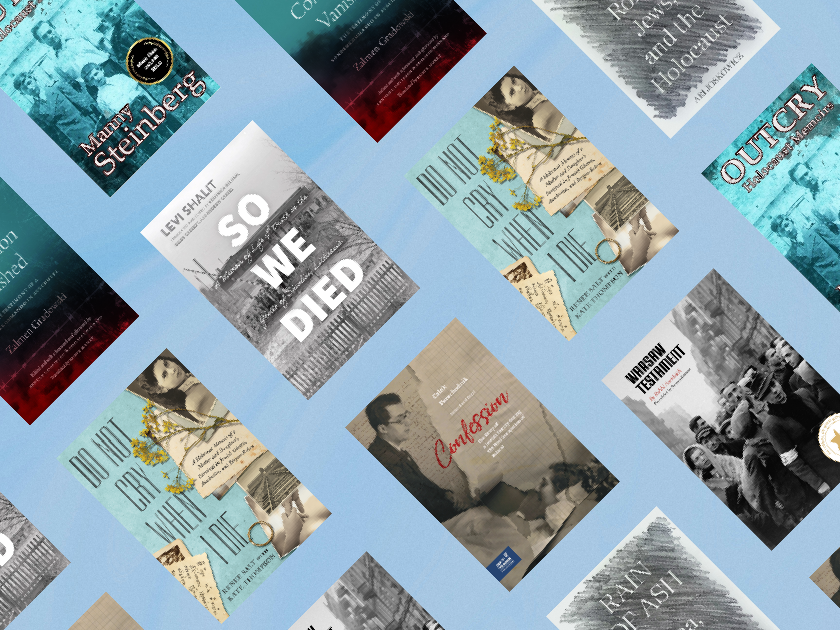
Over the past few years, my writing — both for the Jewish Book Council and research on my own book — has introduced me to numerous titles that are doing impressive, important work in recording Holocaust memory. These have taken a variety of forms, including memoirs and wartime diaries. Some, like Renee Salt and Kate Thompson’s Do Not Cry When I Die, were written by survivors who waited years to speak, while others, such as Zalmen Gradowski’s The Last Consolation Vanished: The Testimony of a Sonderkommando in Auschwitz, were published posthumously, written by those who did not survive. Many of these works share a focus on eyewitness accounts, which can feel raw and are often fragmentary in nature, resisting a conventional narrative arc. Many of these books that I am referring to don’t end with easy lessons about humanity, survival, or hope. The authors’ experiences are simply allowed to speak for themselves.
These are qualities, many would argue, that make them so important in terms of Holocaust memory. Unfortunately, these are also qualities that don’t always align with the business of publishing.
I found this out firsthand when pitching my own nonfiction book about the Holocaust, which traces the story of the Bursztajn family. Their fate reflects a broader reality — roughly 90% of Polish Jews were killed during the Holocaust. While the book includes the survival story of Dora Bursztajn, it also centers those who did not survive, attempting to hold multiple stories within the same narrative. Several industry insiders tried to warn me of the issues I might face in seeking publication, sometimes citing a saturated market, low sales for the genre, and lack of reader interest. I saw more than a few agents who represent historical nonfiction stipulate, among other things, that they don’t accept pitches about the Holocaust. One told me: “I don’t do Holocaust books,” explaining that “they’re too upsetting.”
That particular response has stayed with me because it clarifies a tension that I’ve noticed in Holocaust literature. For decades, widely-read Holocaust books have centered on survival: stories structured around endurance, resilience, and the possibility, however fragile, of life after liberation. To be sure, these accounts are essential. Preserving survivor testimony remains one of the most urgent literary and historical projects of our time.
But whose stories are told and how is an issue that must be grappled with. The discomfort expressed by that agent struck me as an expression of a broader dynamic.
This tension has been explored by scholars of Holocaust memory, though it is less often acknowledged in popular literary spaces. In The Holocaust: An Unfinished History, for instance, historian Dan Stone draws on the work of Holocaust scholar Lawrence Langer, describing a “generalized looking away,” in which “tears may flow, but the truly destructive nature of the Holocaust for its victims … are passed over in silence.” He points to a broader “beautifying” of the Holocaust: a tendency to elevate moving stories of survival and to frame the Holocaust through lessons and moral clarity, rather than through its full historical reality. In this framework, the narratives that circulate most widely are not necessarily those that most accurately reflect the historical record, but those that have been shaped into forms readers can bear. Suffering is not necessarily erased from these books, but it is mediated: structured into narrative arcs, tempered with hope, and made more digestible through tidy endings.
Alongside these narratives exists another body of work, one that might get less media fanfare, but that is crucial for Holocaust history. For instance, Rokhl Auerbach’s writing from the Warsaw Ghetto, recently published in English as Warsaw Testament and winner of a National Jewish Book Award, includes her observations of everyday ghetto life, meant as a eulogy for those whom she saw as the walking dead. She frantically recorded as many names and stories as possible, knowing that few of them would make it out alive.
If remembering is, as Rokhl Auerbach and her fellow Warsaw Ghetto archivists understood, a form of resistance, then the question is not only how we preserve these histories, but how much of them we are willing to face.
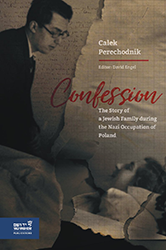
Similarly, Calek Perechodnik wrote his memoir during the war, after his wife Anka and their infant daughter were murdered in the Otwock Ghetto liquidation. Perechodnik, who was later killed during the Warsaw Ghetto Uprising, unfairly blamed himself for their deaths, and writes to them directly in his writing. Like Auerbach’s work, his Confessions is hard to read. He speaks directly to his late wife and daughter, imagining their deaths in vivid detail. “Aluśka, are you still alive or have you already suffocated,” he asks the ghost of his daughter. “Anka, do you still have a little water? Or maybe Aluśka is already drinking your tears?” These are the memoirs of people who had no hope.
Writing like Auerbach’s and Perechodnik’s — along with the work of the archivists, translators, editors, and (often) small, mission-driven presses who have saved their words from oblivion — does not not look away from suffering or emphasize survival. White Goat Press, Yad Vashem Publications, Amsterdam Publishers (where my own manuscript eventually found a home), and university presses at places like Cornell and the University of Alabama have been enabling this important work for decades. While, of course, Holocaust literature can be upsetting and hard to read, these presses specialize in the kinds of unfiltered, first-hand memoirs that can be especially challenging to read. They’ve published titles like Levi Shalit’s So We Died: A Memoir of Life and Death in the Ghetto of Šiauliai, Lithuania, Manny Steinberg’s Outcry: Holocaust Memoirs, and Ari Joskowicz’s study Rain of Ash: Roma, Jews, and the Holocaust. These books demand a lot from readers; more, perhaps, than the types of Holocaust narratives that have been shaped to fit a more conventional narrative arc that end with the subject’s liberation or moralizing lessons about humanity.
As the generation of survivors grows smaller, this tension is likely to become more pronounced. What remains uncertain is how these different forms will coexist, and which will be most visible to readers. While there is no single “right” way to record Holocaust memory, it seems increasingly important to pay attention not only to the stories themselves, but to how they are shaped — and what may be lost in that shaping.
If remembering is, as Rokhl Auerbach and her fellow Warsaw Ghetto archivists understood, a form of resistance, then the question is not only how we preserve these histories, but how much of them we are willing to face.