Join a community of readers who are committed to Jewish stories
Sign up for JBC’s Nu Reads, a curated selection of Jewish books delivered straight to your door!
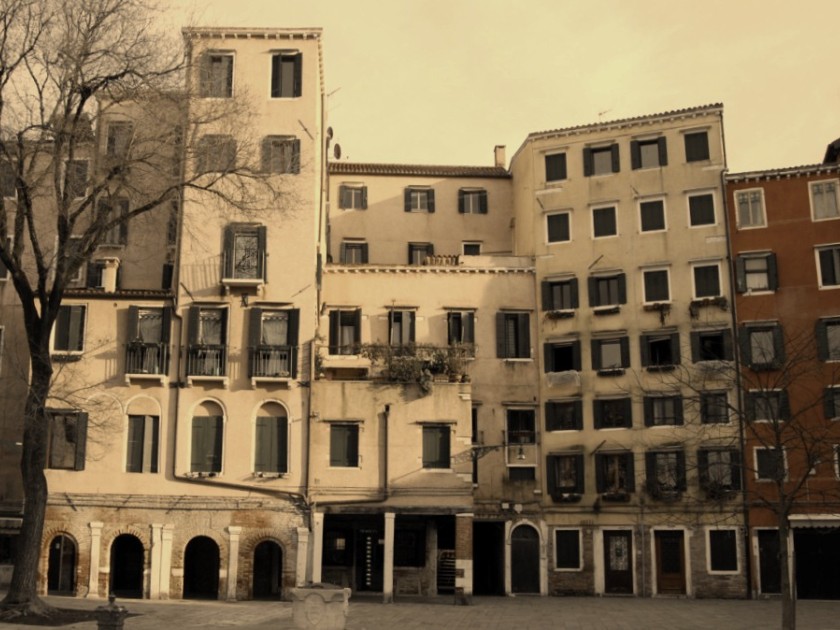
A bank in the Jewish ghetto of Venice, Italy.
Image by Kodaly via Wikimedia Commons, 2010
It was a cold January afternoon when I first came to the Ghetto. I got there much later than I had hoped. I had spent much of the day elsewhere and had lost track of time. It was already beginning to get dark. The campo seemed deserted. Shutters were closed and, apart from the tinkling of water in the wells, there was hardly a sound. There were no streetlights, barely even the glimmer of a lamp. But in the branches of the trees, thousands of tiny lights were shining.
Having nothing else to do, I wandered idly across the square. On a wall opposite, I spotted an imposing bronze plaque. It was hard to make out in the gloom. Squinting, I could just see the image of a train, pulling what looked like trucks. Hundreds of people — and around them, soldiers with guns. I caught my breath — a sharp intake of icy air. Behind the plaque, in a large, irregular recess set with a metal grille, there was an inscription with names. Not far off, there was another with a date. I picked out the numbers slowly. December 5, 1943. I stopped. December 5. My birthday.
Just then, I heard a sound coming from my right. A gentle song, joyful and defiant. Turning, I saw a light in a ground-floor window and a small group of men dressed in black, shawls pulled up, nodding their heads in prayer. Then it struck me. It was Friday. The Sabbath was beginning. Something stabbed at my heart. Without knowing why, I burst into tears.
It was in that moment that my fascination for the Venetian Ghetto began. Although I did not realize it at the time, I had glimpsed—felt—the essence of its past. To most of us, the word “ghetto” will be familiar. We know the tragic story of the Warsaw Ghetto, the Łódź Ghetto, and the horrors that followed. We have heard it used of the “imprisoned cities” of Black Americans, in parts of Harlem and Chicago, Brownsville and Detroit. We have seen it reimagined in poems and songs. But it was there, in an out‑of‑the-way corner of Cannaregio, that the ghetto — and its benighted history — was born.
______
What makes the Venetian Ghetto so historically important is not its originality per se. It was certainly not the first time Jews had been confined to a separate quarter. By the time it was established, on March 29, 1516, the practice of segregation was already a distressingly familiar part of European life. From at least the thirteenth century, Jews in cities throughout the continent had lived in specified neighborhoods, cut off from surrounding areas by barriers and iron gates. Some, like the vicus iudeorum in Cologne, were purely voluntary; in others, residency was only lightly enforced. But in Prague, Frankfurt am Main, Marseilles, and at least a dozen other cities, Jews were forced to live in areas that were “obligatory, separate, and enclosed” — just as in Venice.
Rather, the significance of the Venetian Ghetto lies in its name — or what that name has come to represent. After all, it was in Venice that the word “ghetto” was coined. At root, of course, the term had nothing to do with Jews, let alone segregation. Derived from the verb gettare, meaning “to cast,” it was originally the name of the municipal copper foundry (geto). It was just by chance that, when the Venetian government decided to confine the city’s Jews, it chose to house them on the island next door — which, having previously served as the foundry’s dumping ground, was known as the geto nuovo. The name stuck — and before long, it came to describe not just the island but the institution of Jewish segregation itself.
This marked a turning point. Until then, Jewish quarters throughout Europe had been known by a dizzying array of names. Yet none had succeeded in encapsulating a clear, generalizable conception of segregation. Either they described a geographical area too narrow to be applied elsewhere — a street (Judenstraße), an alley (Judengasse), a square (Judenplatz) — or they were so vague that it was impossible to know exactly what type of confinement they entailed (Judería, Juiverie). The word ghetto cut through the confusion. Since it was a metonym, rather than just a geographical marker, it could be used of Jewish quarters anywhere — not just those on sites of former foundries. Yet because the Ghetto Nuovo also happened to be separated from the city around it more completely than any other Jewish quarter in Europe (ringed as it was by high walls, and surrounded on all sides by water), there could be no doubt about the type of segregation it described.
Words, as Ludwig Wittgenstein famously observed, are deeds, and to endow them with clarity is to lend them a special power. Over the years that followed, the concept of a ghetto quickly spread. Following the promulgation of Pope Paul IV’s bull Cum nimis absurdum in 1555, Jews in cities throughout the Italian peninsula were confined to areas increasingly identified as ghettos. As early as 1562, the Jewish quarter in Rome was referred to as a ghetto. In 1571, the Medici family established a dedicated ghetto in Florence. And a rash of others followed. Ghettos were established in Mirandola in 1602, Padua in 1603, Mantua in 1612, Ferrara in 1624 — and dozens of other cities, continuing right until the dawn of the French Revolution.
“Ghetto” was far from a simple term, however; and the further it spread, the more complex, even contradictory, its associations became. Although for statesmen and prelates it continued to denote a site of Jewish segregation, it could also evoke a set of economic relations, a commercial arrangement, even a religious rapprochement. For Jews themselves, it was equally nuanced. It was understandably seen as a form of exclusion, marginalization, and oppression; but it could also entail tangible benefits, overlapping with the concept of a holy community (Kehilla Kedosha) and reinforcing a keenly felt sense of distinctiveness. At every level, and in every place, it intersected with concepts of power and place, faith and finance, exclusion and admission; was shaped by notions of gender and disease; and served as a mirror to the societies from which it sprang.
Following the Napoleonic invasions, Jewish segregation in Italy was progressively abolished. But far from curtailing the ghetto, this only broadened its scope — both geographically and conceptually. Now untethered from Venice, the word ghetto moved first to Germany, where it came to signify the clustering of Jews in a given space, or even a culture of Jewish particularism. Either one of these two meanings could be understood negatively, as a rejection of the totalizing mission of the emergent nation-state, or positively, as an affirmation of identity. A few decades later, in the United States, amid the great waves of immigration that marked the Gilded Age, the ghetto then shed its purely Jewish connotations. Used to describe the living conditions of any minority group, it became a shorthand for vulnerability, poverty, and powerlessness — a biting counterpoint to the wealth and privilege of the Gilded Age. And after the Nazis’ invasion of Poland in September 1939, it came to be applied to sites of appalling confinement and eventual genocide. Even today, it continues to evolve. Just as, in Denmark, the official classification of migrant communities as ghettos reflects a deliberate effort to stigmatize, so the reappropriation of the word by rap artists and fashion icons signals an attempt to reclaim lost agency and restore self-respect.
No one could claim that the Venetian Ghetto was the model, or even the prototype, for these incarnations, of course. There was no straight line leading from the quays of Cannaregio to the streets of Warsaw. The evolution of the concept has been too stuttering, and its associations too different to admit so simplistic a reading. No matter how hard you look, it is impossible to find the fate of Holocaust victims foreshadowed in the deliberations of the Venetian Senate on a spring day more than four hundred years before. Just as nature abhors a vacuum, so history scorns any hint of inevitability. Each ghetto is born for its own time and against its own context — a fact of which its protagonists have sometimes been keenly aware. There is certainly no lack of testimonies to how greatly the concept has changed over the centuries, or how remote certain ghettos are from their Venetian antecedent. Yet each ghetto is nevertheless a branch forking from the same trunk — and it is in Venice that we must seek their common root.
Excerpted from The First Ghetto: Venice and the Origins of Modern Antisemitism by Alexander Lee. Copyright © 2026 by Alexander Lee. Reprinted by permission of Basic Books.
Alexander Lee is a prize-winning historian at the University of Warwick. He is the author of five acclaimed books, including Machiavelli: His Life and Times (a Financial Times Book of the Year). He appears frequently on television, radio, and podcasts. He lives in France. The publisher will be flying him in for the Jewish book fairs.