Join a community of readers who are committed to Jewish stories
Sign up for JBC’s Nu Reads, a curated selection of Jewish books delivered straight to your door!
Jewish Book World reviewer Eric Ackland examines three new books from Jewish Lights that tackle different aspects of the High Holidays experience (this review will appear in the winter issue of Jewish Book World).
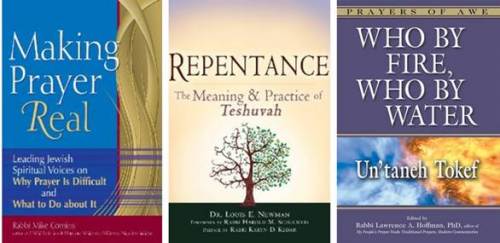
Making Prayer Real: Leading Jewish Voices on Why Prayer is Difficult and What to Do About It
Rabbi Mike Comins
Jewish Lights Publishing, 2010. 200 pp. $18.99
ISBN: 978−1−58023−417−7
Repentance: The Meaning & Practice of Teshuva
Dr. Louis E. Newman
Jewish Lights Publishing, 2010. 224 pp. $24.99
ISBN: 978−1−58023−426−9
For many Jews, religious services, and particularly the High Holidays can be very alien and intimidating. Lack of familiarity with prayer (both formal and informal), lack of familiarity with Hebrew and with the order of the services, and even discomfort with the notions of God and of sin only compound the boredom and discomfort that the long services may cause even those who have the knowledge and skills to appreciate them. These three books tackle different aspects of the High Holidays experience and the religious experience in general.
Making Prayer Real: Leading Jewish Spiritual Voices on Why Prayer is Difficult and What to Do About It by Reform Rabbi Mike Comins and with 53 other contributing Rabbis and leaders/thinkers, mostly from the liberal Jewish sects, is a wonderful introduction to the world of prayer, giving the skeptical and the unfamiliar a broad outline of understanding and a sensitive and generous permission from which to begin to experiment and explore.
Rabbi Comins and his contributors offer strategies for approaching both private and communal prayer that take into consideration many of the obstacles that moderns struggle with in terms of understanding prayer’s purpose, and in embracing its process. Even more compelling, the Rabbis share their personal experiences and thoughts about prayer with a refreshing sincerity that I confess, surprised me, as I recall the (as least to me) dry, very unspiritual Reform Hebrew school and synagogue of my youth. Rabbi Comins writes that his experience as a child was similar. I don’t know if the preponderance of congregants in the liberal Jewish world have become as earnestly spiritual as many of their leaders currently clearly are, but Jews of any background — from the unaffiliated to even the Orthodox — who are seeking to connect more deeply with God and with their heritage, and who wish to experience the transformative power of prayer will find a lot of wisdom and inspiration in this book.
*******
All of us have done (or omitted to do) things we regret, and fallen short of what would be morally ideal; for many of us, these may be ongoing patterns of behavior. Some may stifle their consciousness of wrong-doing and bury it deep within, while others may only be too aware and overwhelmed with guilt and despair. Judaism has long provided a process by which we can atone for our sins and start afresh in the eyes of God and ourselves. In Repentance: The Meaning and Practice of Teshuva, Dr. Louis E. Newman, a professor of religious studies at Carleton College, begins by identifying teshuvah (repentance) as one of the “central religious-moral” teachings of Judaism, and takes a rigorous analytical approach to understanding what teshuva is and how it is done.
In 49 short chapters (none more than a few pages in length and thus perfect for reading in daily doses), Newman eloquently examines the various ways that Judaism has historically looked at sin, freewill, responsibility, fate, and atonement, before explaining the components of the teshuva process, and exploring some of the subjective factors that people encounter and struggle with in the process. Following the classic Jewish philosophers he breaks down the process of true atonement into components, which he identifies as: accepting culpability, feeling remorse, confession, apologizing, making restitution, making an accounting of one’s soul, and transformation: committing to forgo the same behavior in the future.
Although he does speak of God, Dr. Newman’s thinking is grounded in psychological reality and functionality, and thus, even those not-so-comfortable with the God-concept could derive real value from the book. However, Dr. Newman only briefly alludes to (and then essentially dismisses) the traditional Jewish understanding that there is a world-to-come to which this world is just a passageway, and that reward and punishment for earthly deeds is meted out not just in life, but, more crucially, afterwards as well. This is something which virtually all, if not all, the classic sources he cites (as well as contemporary Orthodox leaders) took/take as axiomatic and as central to understanding the full consequence and moral weight of our deeds, and thus of the potent corrective power of teshuva as well. To put the omission in context, Dr. Newman devoted a chapter (a rewarding one) to philosophically tangling with the idea of animal sacrifice as teshuva’s historical antecedent, while brushing aside this still-vital belief in a world-to-come in just a few paragraphs (he only refers to it in the past-tense), and without clearly indicating that his dismissal is neither universal nor authoritative. This is a serious omission from a historical and theological perspective, and ultimately, a disservice to readers, especially those who won’t notice the sleight-of-hand. That said, I reiterate that I found the book an otherwise worthy introduction to the subject.
*******
One of the great discomforts of praying from a siddur (Jewish prayer book) or Machzor (prayer book for a specific holiday) is not understanding Hebrew, but an even greater one can be actually understanding it. For liberal-religious Jewry in particular, this has long posed a problem. As Reform Rabbi Lawrence A. Hoffman, PhD. candidly describes in the insightful introduction to Who by Fire, Who by Water: Un’taneh Tokef, when prayer books began appearing in translation, many Jews, both leaders and laity, were distressed by the content and meaning of the prayers. So editors,“ … changed the Hebrew, so that the English would come out ‘decently’; they purposefully mistranslated the originals to avoid ideas that ancient authors had no trouble with but that modern worshipers found horrifying; they composed alternative prayers in the vernacular — prayers on the same theme as the original, but saying what modern people were likely to appreciate; they called for the prayer to be sung, so no one would pay much attention to the words; or they omitted the troublesome prayers altogether.” Rabbi Hoffman neglects to mention one necessarily complementary strategy, which may or may not have been similarly deliberate: that of not adequately educating the liberal Jewish laity to be able to read and comprehend Hebrew, leaving it for the Rabbinate alone to undemocratically mediate and interpret the classic texts for the laity, much as the Catholic Church preferred for its clergy to do prior to the Reformation. (At the second Reform rabbinic conference in Frankfurt in 1845, according to Conservative movement Jewish historian Neil Gillman, fifteen conference members “voted that Hebrew should not be “objectively necessary,” thirteen voted that it should be, and three abstained.” One, Rabbi Zechariah Frankel, walked out over this issue even coming to a vote, and went on to become a forefather of the Conservative movement.)
Un’taneh Tokef, is one of the most powerful prayers in the Hebrew liturgy, and has long been central to both the Rosh Hashana and Yom Kippur services. This book, like Making Prayer Real, features essays by an array of Rabbis and other (mostly) liberal-Jewish thinkers, who here, rather than dealing with prayer in general, are earnestly tangling with the meaning of this particular prayer, the core substance of which is that of God’s power of judgment over human-beings. The prayer addresses the idea that everything we think and do is observed and recorded by God; that we are judged on Rosh Hashanah, and that on Yom Kippur, depending on the severity of our sins and whether we’ve fully repented in the intervening seven days, God decides who will live through the next year, who will die, when, and how, “Who at their end and who not at their end, Who by fire and who by water, Who by warfare and who by thirst, Who by earthquake, and who by plague …” and it asserts that “repentance, prayer, and charity” can avert the judgment of death. Heavy, troubling stuff, no doubt.
The essays within the book encompass history, theology, psychology, autobiography, literary analysis, and more. The range of very strong feeling about this prayer amongst the collected authors is wide. One contributor, Rabbi Tony Blayfield, DD says that for him the concept of God judging and determining when and how we’ll die is “loathsome” and even “blasphemous” (!) while for Rabbi Ruth Langer, PhD the prayer is meaningful on multiple levels. She writes that, “rational understandings of its theology should not be the only legitimate criterion. Elements of its performance, our memories and associations with past performances, its music, and the beauty of its poetry all play into our relationship with a prayer text.” Others are less troubled and engage more directly with the text.
As someone who has long struggled intellectually, emotionally, and even ethically with the content and meaning of many formal Jewish prayers (this one, not so much), I found reading the many raw, revealing, honest, and even profound essays in this book rewarding. Perhaps my greatest “take-away” from the book is the importance of not diluting the Jewish liturgy from on high so as to make it more comfortable and pleasing to modern ears. Even the contributors that felt the greatest discomfort with Un’taneh Tokef and who wish it would be censored, must engage with the concepts year after year, meaning that their moral radar must get re-engaged year after year. I remember my grandfather’s refusal to read parts of the Passover service that offended his sense of justice with fondness and admiration, but what I admired was his re-making the decision each year, as each year he was re-outraged. He would have been a lesser man for not having the opportunity. Everyone, not just an elite core of Rabbis and academics, should have the opportunity to be regularly discomfited in a way that makes them more cognizant of their conscience, the fragility of life, and of the enduring moral import of their deeds. A religion that is always comforting, that flatters and appeases and tells us we’re completely okay as we are, and that makes repentance an easy thing without great consequence if it isn’t sincere or complete isn’t one worth having. Better we should struggle and wrestle with God.
Eric Ackland is a freelance writer and editor.